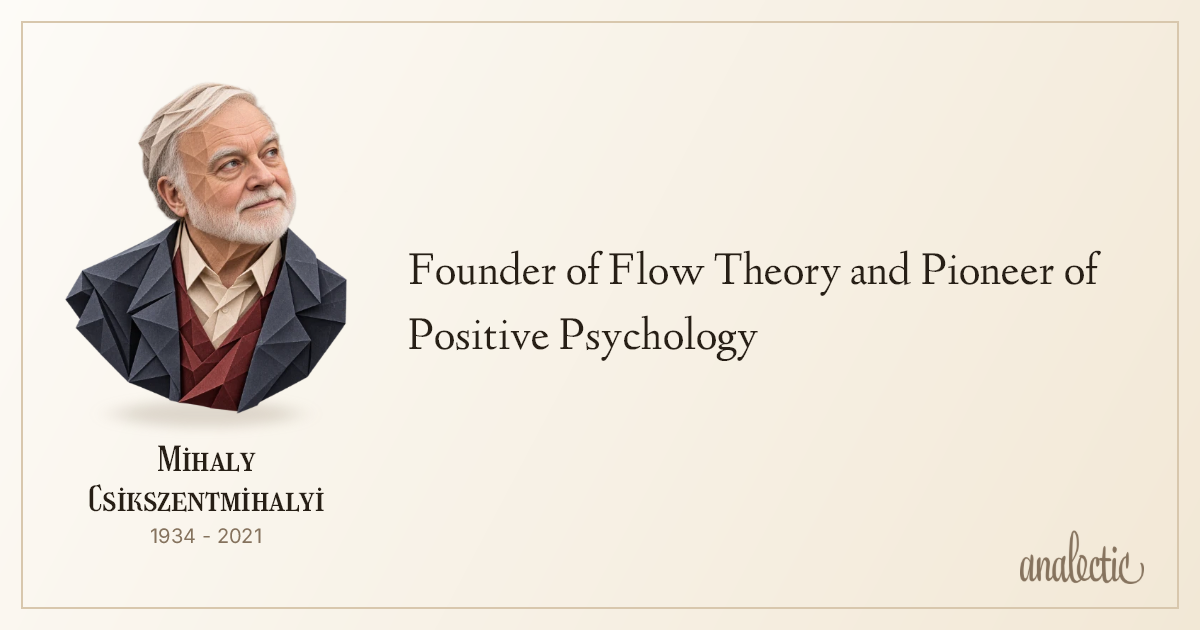
Mihaly Csikszentmihalyi
Founder of Flow Theory and Pioneer of Positive Psychology (1934 - 2021)
Mihaly Csikszentmihalyi was born in 1934 in Fiume, Italy (present-day Rijeka, Croatia). His childhood observations of the devastating effects of World War II led him to ponder how humans demonstrate resilience in the face of adversity and where they find happiness. After emigrating to the United States post-war, he studied psychology at the University of Chicago, where he began his profound investigations into human motivation and creativity. His intellectual journey was shaped by drawing from disciplines such as existential psychology, phenomenology, and systems theory.Csikszentmihalyi's paramount contribution was the development in the 1970s of the theoretical framework for a psychological state he termed 'flow'. This theory describes an optimal experience where an individual is fully immersed in an activity, with an altered perception of time and a loss of self-consciousness. In his magnum opus, 'Flow: The Psychology of Optimal Experience' (1990), he examined this concept across a broad spectrum from arts to sports, and from professional work to everyday pursuits. The flow state occurs within a 'channel' where skill level and challenge are in balance, and its frequent experience is directly correlated with psychological well-being and life satisfaction.Csikszentmihalyi's work transcended cognitive and behavioral models in psychology, becoming one of the foundational pillars of the 'Positive Psychology' movement focused on human positive potentials. Flow theory has inspired applications and research in a wide variety of fields including educational sciences, sports psychology, management and organizational studies, software design, and art therapy. His legacy established the idea that humanity's deepest moments of satisfaction and creativity are scientifically understandable and attainable. Today, the pursuit of optimal experience remains valid and significant across a broad context, from personal development to corporate productivity.
Mihaly Csikszentmihalyi — alıntılar
- “A person can make himself happy, or miserable, regardless of what is actually happening “outside,” just by changing the contents of consciousness.”
- “Entropy is the normal state of consciousness—a condition that is neither useful nor enjoyable.”
- “The best moments usually occur when a person’s body or mind is stretched to its limits in a voluntary effort to accomplish something difficult and worthwhile.”
- “Enjoyment appears at the boundary between boredom and anxiety, when the challenges are just balanced with the person’s capacity to act.”
- “Enjoyable events occur when a person has not only met some prior expectation or satisfied a need or a desire but also gone beyond what he or she has been programmed to do and achieved something unexpected, perhaps something even unimagined before.”
- “Loss of self-consciousness does not involve a loss of self, and certainly not a loss of consciousness, but rather, only a loss of consciousness of the self.”
- “What people enjoy is not the sense of being in control, but the sense of exercising control in difficult situations.”
- “Goals justify the effort they demand at the outset, but later it is the effort that justifies the goal.”
- “Of all the virtues we can learn no trait is more useful, more essential for survival, and more likely to improve the quality of life than the ability to transform adversity into an enjoyable challenge.”
- “To overcome the anxieties and depressions of contemporary life, individuals must become independent of the social environment to the degree that they no longer respond exclusively in terms of its rewards and punishments.”
- “Living exclusively by genetic and social instructions is fine as long as everything goes well. But the moment biological or social goals are frustrated—which in the long run is inevitable—a person must formulate new goals, and create a new flow activity for himself, or else he will waste his energies in inner turmoil.”
- “When a person has learned a symbolic system well enough to use it, she has established a portable, self-contained world within the mind.”
- “Cultures are defensive constructions against chaos, designed to reduce the impact of randomness on experience.”
- “Activity and reflection should ideally complement and support each other. Action by itself is blind, reflection impotent.”
- “The ultimate test for the ability to control the quality of experience is what a person does in solitude, with no external demands to give structure to attention.”
- “Attention shapes the self, and is in turn shaped by it.”
- “We can experience pleasure without any investment of psychic energy, whereas enjoyment happens only as a result of unusual investments of attention.”
- “When a society suffers from anomie, flow is made difficult because it is not clear what is worth investing psychic energy in; when it suffers from alienation the problem is that one cannot invest psychic energy in what is clearly desirable.”
- “The kind of material we write in diaries and letters does not exist before it is written down. It is the slow, organically growing process of thought involved in writing that lets the ideas emerge in the first place.”
- “One of the most basic delusions of our time is that home life takes care of itself naturally, and that the best strategy for dealing with it is to relax and let it take its course.”
- “To discard the hard-won information on how to live accumulated by our ancestors, or to expect to discover a viable set of goals all by oneself, is misguided hubris. The chances of success are about as good as in trying to build an electron microscope without the tools and knowledge of physics.”
- “Instead of accepting the unity of purpose provided by genetic instructions or by the rules of society, the challenge for us is to create harmony based on reason and choice.”
- “The psychic entropy peculiar to the human condition involves seeing more to do than one can actually accomplish and feeling able to accomplish more than what conditions allow.”
- “The inner harmony of technologically less advanced people is the positive side of their limited choices and of their stable repertory of skills, just as the confusion in our soul is the necessary consequence of unlimited opportunities and constant perfectibility.”
Analectic üzerinde tüm alıntılarını incele →