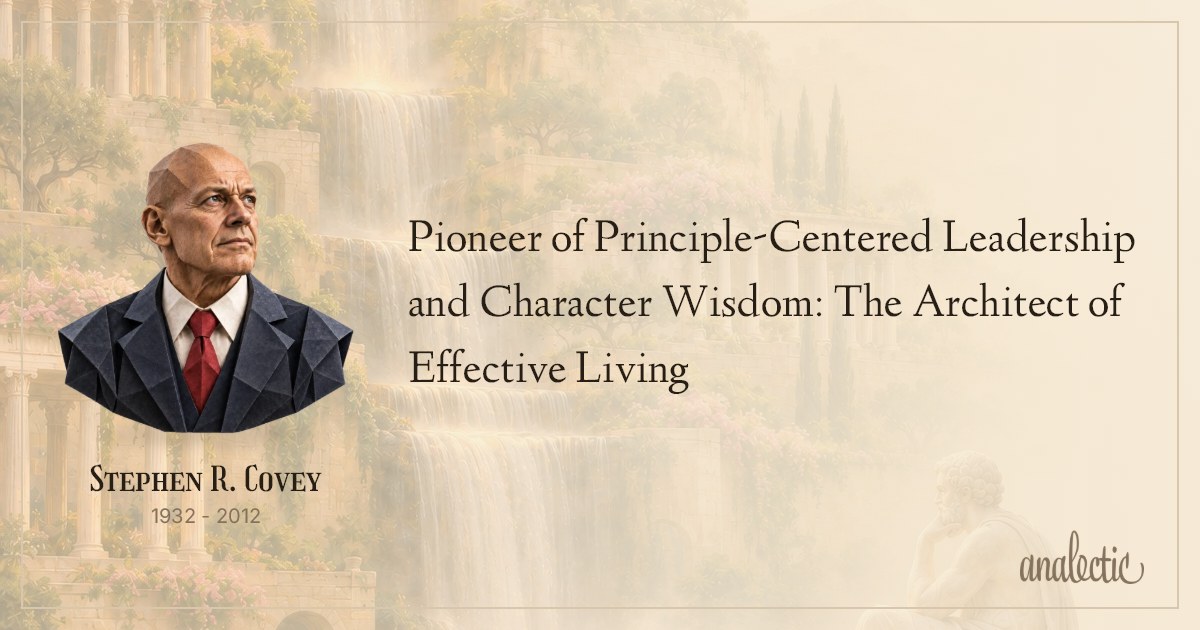
Stephen R. Covey
Pioneer of Principle-Centered Leadership and Character Wisdom: The Architect of Effective Living (1932 - 2012)
Stephen R. Covey was born in Salt Lake City in 1932, earned an MBA from Harvard, and completed his doctoral studies at Brigham Young University. Deeply examining the past two centuries of American success literature, Covey rejected the superficial image- and technique-based 'Personality Ethic' and revitalized the 'Character Ethic' grounded in universal natural laws such as honesty, justice, trustworthiness, and responsibility. According to him, true success is not built through external appearances but through inner character; humanity's deepest values endure not through the passage of time but by aligning with nature's enduring laws. This philosophical shift was a call that fundamentally challenged modern leadership: 'Start from within, not without.'Published in 1989, 'The 7 Habits of Highly Effective People' became the most influential business book of the 20th century, selling over 40 million copies worldwide. In this book, Covey taught readers to focus on what they can control through the concepts of 'Circle of Influence and Circle of Concern,' to live purposefully through 'Begin with the End in Mind,' to create mutual value through 'Think Win-Win,' and to practice empathetic communication through 'Seek First to Understand, Then to Be Understood.' Together, these principles mapped out a blueprint for individual and organizational effectiveness. These ideas deepened the understanding of leadership not only in business but also in families, schools, and communities—each one a foundational stone of a lifestyle aligned with human nature. Covey demonstrated that leadership is not a talent but a habit.Covey's legacy reached its pinnacle with the philosophy of 'Principle-Centered Leadership' and the '8th Habit: Finding Your Voice and Inspiring Others to Find Theirs.' He defined leadership not as a title but as the art of acting with integrity to reflect the value and potential of others. This approach, which unleashes the power of synergy by accelerating trust, emphasized that leaders must first listen to their own inner voice and then help others hear theirs. For Covey, leadership was a service that awakened the deepest human potential—the soul elevating another soul. He left an immortal legacy: A true leader does not manage others; he sees the leader within them and guides them to discover it.
Stephen R. Covey: quotes
- “Effective people focus on the principles they live by; they draw strength from internal values, not external circumstances.”
- “People waste their energy in the circle of concern instead of expanding their circle of influence, rendering themselves passive and powerless.”
- “Seek first to understand, then to be understood; this is the most powerful principle in human relationships.”
- “Win-Win or no deal; true success emerges only when both parties gain.”
- “The character ethic is rooted in the development of internal values; the personality ethic focuses only on external techniques.”
- “The speed of trust is directly proportional to the quality of leadership; as trust increases, organizations move faster.”
- “Reinventing yourself is not merely about improving skills—it is the transformation of your inner identity.”
- “Sharpening the saw means balancing and renewing your physical, mental, emotional, and spiritual dimensions.”
- “Humanity is reborn not by external solutions, but by inner awareness and a life grounded in personal values.”
- “Action tests willpower; willpower shapes character; character determines the enduring quality of life.”
- “A leader’s greatest power arises from the courage to remain faithful to inner values.”
- “Overcoming obstacles is less about eliminating external challenges and more about transforming your inner stance.”
- “Wisdom is not gained by accumulating knowledge alone, but by living it.”
- “Overcoming fear is not about being fearless—it is about moving forward in the presence of fear.”
- “Humanity is moved not by external validation, but by an inner purpose.”
- “Habits are formed by the accumulation of daily small decisions; great change arises from small actions.”
- “Stepping into the unknown is an expression of trust; trust begins with belief in your own inner values.”
- “Stillness is not merely silence—it is the quiet harmony of an inner stance aligned with core values.”
- “Most people live their lives according to the expectations of others; true freedom is choosing to live by your own principles.”
- “Effective people focus their energy on expanding their circle of influence; they have no energy to waste on things outside their control.”
- “Seek first to understand means to deeply listen to others—their perspectives, feelings, thoughts, and experiences—with genuine intent.”
- “Win-Win or No Deal: True collaboration emerges only when both parties gain; forced compromises are never lasting.”
- “Personality ethics focus on external success; character ethics are rooted in internal integrity—and that is the foundation of lasting effectiveness.”
- “Sharpening the saw is not merely physical—it is a continuous discipline across mental, emotional, and spiritual dimensions.”
- “A habit is the intersection of knowledge, skill, and desire; knowledge alone is never enough.”
- “An internal center allows you to respond not to events, but to principles.”
- “A leader sees the potential in others and guides them toward their highest self.”
- “The greatest freedom a human being has is the freedom to choose one’s response between stimulus and response.”
- “Without a goal, without a vision, discipline is merely a burden; with vision, discipline becomes freedom.”
- “Overcoming fear does not mean being fearless; it means acknowledging fear and moving forward with it.”
View on Analectic →