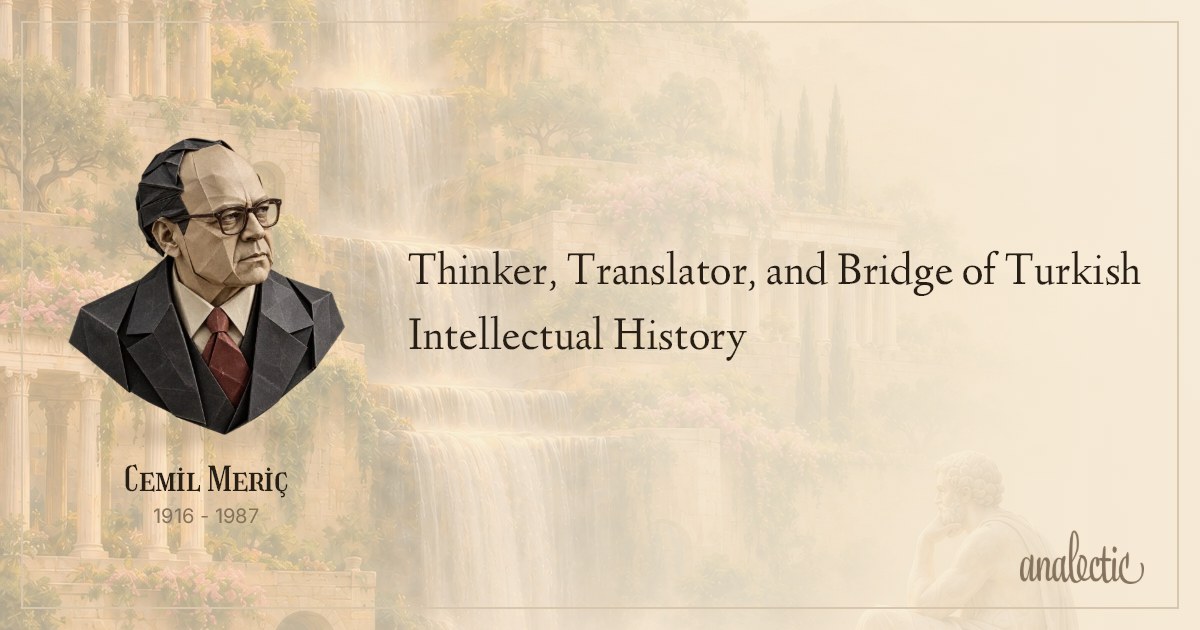
Cemil Meriç
Thinker, Translator, and Bridge of Turkish Intellectual History (1916 - 1987)
Cemil Meriç was born in 1916 in the Reyhanlı district of Hatay. The loss of his eyesight following an accident in his early youth led him to establish his relationship with the external world through books and thought, thereby laying the foundation for a uniquely introspective world of contemplation. He studied French Language and Literature at the Faculty of Letters of Istanbul University, yet was unable to complete his education due to the political atmosphere of the era. During this period, he embarked upon an intense regimen of reading and writing; his acquaintance with the foundational texts of Western thought constituted the initial mortar for the synthesizing and critical perspective he would later construct. His activities during the process of Hatay's annexation to the homeland and his subsequent career as a French teacher in various high schools in Istanbul shaped the distinct phases of his life.Meriç's oeuvre is defined by the profound bridges he built, as a translator and intellectual, between East and West. His essay collection 'Bu Ülke' (This Country) marks a turning point in its treatment of Turkey's crisis of identity and civilization; here, he critiques with severe language the superficialities of the Westernization process and the dangers of severance from one's own civilizational values. Works such as 'Umrandan Uygarlığa' (From Grandeur to Civilization), 'Kırk Ambar' (Forty Storehouses), and 'Mağaradakiler' (Those in the Cave) are notable for their style, which interweaves history, sociology, and literature, reflecting an encyclopedic reservoir of knowledge. Particularly 'Kırk Ambar', in the form of an encyclopedic glossary, unveils the history of thought behind words and concepts. His translations range from Victor Hugo to Balzac, from Indian literature to sociological classics, and this activity is viewed not merely as a linguistic task but rather as an effort of cultural transmission and intellectual reconstruction.Cemil Meriç's enduring influence in Turkish intellectual life stems from his original stance, which transformed his intellectual legacy into a veritable 'school'. Despite his visual impairment, his prolific literary career, sustained with the assistance of his daughter and aide Ümit Meriç, stands as a symbol of inspiring perseverance. The interdisciplinary and synthesizing approach he brought to the history of ideas has left profound marks on numerous intellectuals and academics of subsequent generations. Beyond the Turkish right and left opposition, his emphasis on the necessity of conducting a more deep-rooted civilizational reckoning continues to render his thought relevant. His library and archive remain an invaluable resource for researchers, and his legacy is kept alive through symposia discussing his ideas and works written about him.
Cemil Meriç: quotes
- “Ibn Khaldun is one of the polar stars of modern thought.”
- “To see is to dominate nature. However much the external world may overflow with hostile elements, it is condemned to be tamed and made submissive by the fluid that pours from the pupils of our intelligence.”
- “Religion, love, poetry: these are the ladders by which man, rolling in the void, leaps to a star.”
- “To see how even the fiercest saints, the most formidable heroes, at times become mired in mud, is a treacherous, bitter, and poisonous consolation for petty people.”
- “We have created religion, art, love so as not to see reality. Faust's thirst is no different from that of an infinite desert.”
- “Why is the dignified Juvenal not read? Why does the virile voice of Lucretius no longer resound on humanity's horizon?”
- “For them, Anatolia does not exist, Istanbul does not exist, Turkey does not exist, a world upon which people shed tears, suffer misery, and struggle does not exist.”
- “Finally, the madrasa and the palace. The ulama of the era of decline, who without trembling hands issued fatwas for every crime of their masters: They would not send their members to the military like any ordinary citizen, and in eternal baseness, they stubbornly strove to preserve a set of privileges they considered the blessing of this baseness.”
- “To sublime the organic is a fantasy like producing gold from copper. Our glands govern our lives. We cannot silence the screams rising from the dark regions of consciousness. The scream eventually becomes a growl. The growl transforms into a roar.”
- “The Turkish intellectual is distancing himself from the country as if fleeing a fire. No, as if fleeing a room he has soiled... Turkey of 1963 is a hundred times freer than the France of the Voltaires. Where are the Voltaires?”
- “A society that prefers to bestow upon the capitalist the rank of 'employer' is, of course, sanctifying liberalism... A benefactor like God.”
- “We must know India. There are two creative nations that have given direction to humanity's wisdom and understanding: India and Greece... We are at the centre of these two countries. The Mediterranean is the marriage bed of East and West...”
- “Humanity does not ascend like climbing the steps of a ladder. Its leaps are not always directed towards the same goal. Humanity casts the dice, sometimes it wins, sometimes it loses.”
- “The place of a Jesus who cannot create his apostles is the madhouse, not the cross.”
- “And to love. For the common people, religion is the freedom to destroy those who do not think like them. Nazif said, 'My religion is my hatred.' An Assyrian priest has risen from the dead, an Assyrian priest. A religion reconciled with hatred ceases to be a religion.”
- “Thought begins with doubt. Thought is whole with its contradictions. Is it not condemning ourselves to error to close our ears to opposing ideas?”
- “I have a wretched sensitivity that magnifies sorrows in a giant mirror.”
- “We are all wretched puppets. Our only power: the capacity for adaptation.”
- “The person whose soul is tormented by the devil takes out his pain, without a thought, on the nearest one.”
- “The intellectual is the man who believes he can rebuild the world anew each day; since Descartes, he has understood that reason and perception are universal.”
- “Like a skylark soaring from the swamp to the heavens, keep your distance from this unruly herd that thinks with its loins and lives from the navel down. Otherwise, you are manure, like carrion, manure...”
- “Every great man is the stepchild of the society in whose lap he lives.”
- “For those who set out to conquer the world of thought, the first country they must visit should be India. India grants a voice to all beliefs. Modern Europe, in its most enlightened aspects, is a continuation of India. India is perhaps not the whole truth, but it is truth.”
- “Contemplation begins with clarity, salvation with consciousness.”
- “Left and right… Two demons suckled by mad loves and unconscious hatreds.”
- “History is said to stage its works twice: first as tragedy, then as comedy. The geese of Rome were the heroes of a majestic tragedy; ours are the actors of a tasteless comedy.”
- “The lexicon is a nation's memory, that is, its very self; with its passion, its sensitivity, its consciousness.”
- “Freedom for thought, absolute freedom. We must fear not the book, but the lack of books.”
- “Isms are straitjackets forced upon our intellect.”
- “We have found a new name for the crumbs of knowledge that lodge in memory like pebbles: Culture.”
View on Analectic →