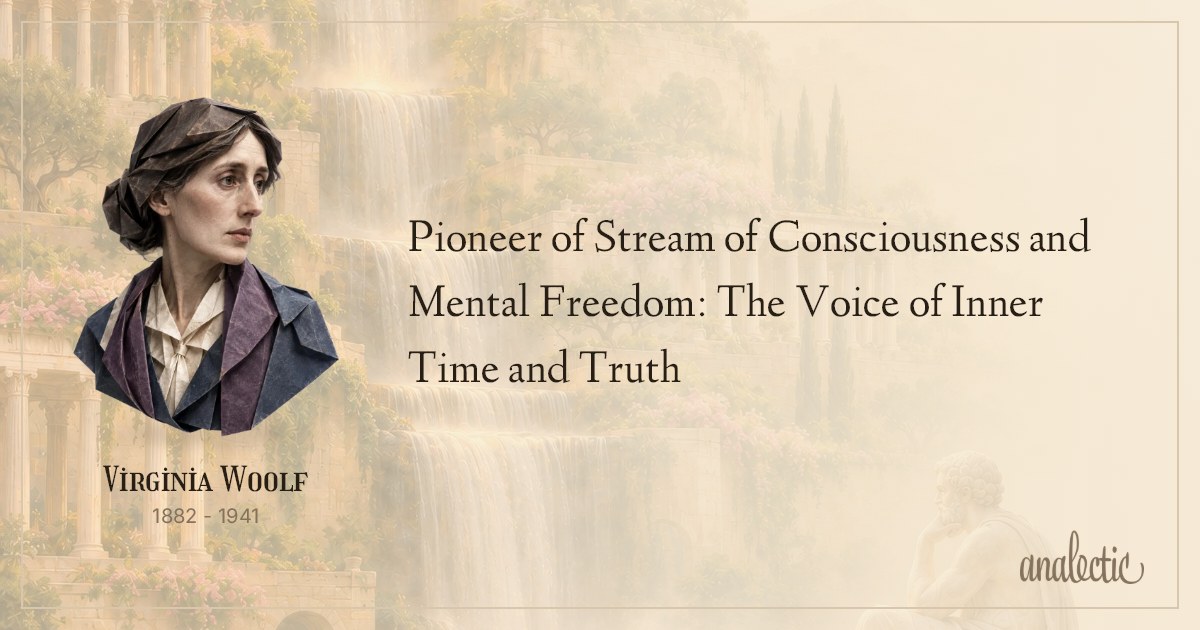
Virginia Woolf
Pioneer of Stream of Consciousness and Mental Freedom: The Voice of Inner Time and Truth (1882 - 1941)
Born in 1882 amidst London’s intellectual ferment, Virginia Woolf grew freely amid the libraries of Sir Leslie Stephen, the historian of literature. Her mind, nourished by her father’s shelves, carried the seeds of rebellion against the rigid social codes of the Victorian era. Alongside the Bloomsbury Group, she became a herald of a revolution that questioned art, morality, and gender roles. Wielding her words like a blade against the patriarchal shackles that stifled women’s creativity, she championed intellectual and economic autonomy as the very manifesto of her literature.Her novels were voyages through the labyrinths of human consciousness. In Mrs. Dalloway, she painted the fluidity of inner time against the mechanical ticking of clock towers; in To the Lighthouse, she sculpted the fragile architecture of memory; in The Waves, she wove the rhythm of existence with poetic language. Stream of consciousness, in her hands, became a philosophical discovery. In A Room of One’s Own, she exposed women’s silence as a historical injustice, crying out: "Lock up your libraries...". In those fragile, luminous moments when she captured the human soul as a "radiant state," she elevated literature to a metaphysical dimension.Her life was shaken by the storms within her psyche and the world’s descent into war. Yet every line she wrote became an aesthetic sanctuary resisting chaos. Even as she stepped into the cold waters of the Ouse River in 1941, her final letter to her loved ones wished them "all happiness." Her pen endured as an instrument that forever recorded the liberation of the female mind, the boundless sea of consciousness, and the mysterious harmony of existence. Woolf became not merely a literary luminary, but a compass shining in the collective conscience of humanity.
Virginia Woolf: quotes
- “Lock up your libraries if you like; but there is no gate, no lock, no bolt that you can set upon the freedom of my mind.”
- “A woman must have money and a room of her own if she is to write fiction and cultivate her own intellect.”
- “Life is not a series of gig lamps symmetrically arranged; life is a luminous halo, a semi-transparent envelope surrounding us from the beginning of consciousness to the end.”
- “To be silent; to be alone. All the looking and the doing, expanding and contracting, ceased; and the soul sank into peace.”
- “Examine for a moment an ordinary mind on an ordinary day. The mind receives a myriad impressions—trivial, fantastic, evanescent, or engraved with the sharpness of steel.”
- “You cannot find peace by avoiding life. Step into the current and face the depth of your own existence.”
- “Against you I will fling myself, unvanquished and unyielding, O Death!”
- “Arrange whatever pieces come your way. The art of living is making a mosaic out of the fragments of time.”
- “Writing is like a profound immersion; you must hold your breath and dive beneath the surface of the obvious.”
- “Solitude is not a withdrawal from reality, but the sacred space where our fragmented self gathers into unity.”
- “One cannot think well, love well, sleep well, if one has not dined well. The body and the soul are inseparably intertwined.”
- “Across the vast darkness of melancholy, the creative mind builds frail bridges of words that endure.”
- “Focus your gaze not upon what others applaud, but upon the subtle truth that vibrates in your own bones.”
- “The beauty of the world has two edges, one of laughter, one of anguish, cutting the heart into tranquility.”
- “The habit of reading is the only unfailing discipline that protects the soul from intellectual decay.”
- “Behind the cotton wool of daily routine, there is a pattern concealed; and we are connected to this hidden whole.”
- “Dare to be truthful to your own impressions. Let no external authority dictate the rhythm of your thought.”
- “Pain is real and inevitable, yet the human spirit possesses the extraordinary capacity to transfigure sorrow into illumination.”
- “Every moment is a drop of liquid time; to experience it fully, one must be entirely present.”
- “When the chatter of the world fades, the soul remembers its eternal kinship with the stars.”
- “To shape language into truth requires the strict precision of a craftsman and the boundless patience of an artist.”
- “Do not hide behind the opinions of others. Step forward and proclaim what you see with unblinking eyes.”
- “The waves break upon the shore again and again, yet the deeper ocean remains unmoved.”
- “We are all parts of a single work of art; we are the words, we are the music, we are the thing itself.”
View on Analectic →