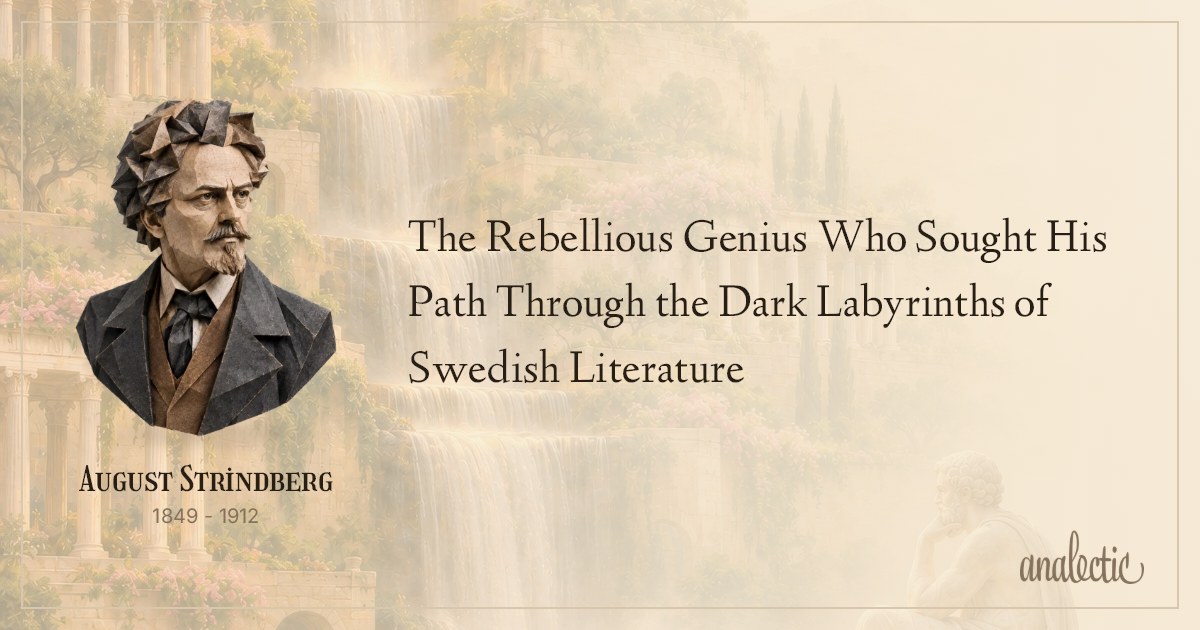
August Strindberg
The Rebellious Genius Who Sought His Path Through the Dark Labyrinths of Swedish Literature (1849 - 1912)
August Strindberg, born in Stockholm in 1849, endured a childhood woven with class tensions, raised in the turbulent marriage of a servant mother and a merchant father. The loneliness and alienation he later chronicled in his autobiographical novel 'The Son of a Servant' foretold the spiritual crises that would permeate his entire life. His mystical quests—from alchemy and occultism to Nietzsche and Swedenborg—infused the foundational texts of modern Swedish literature with a rebellious breath, branding him simultaneously as a genius and society’s madman.Strindberg shattered the boundaries of naturalist theater, opening the doors to expressionism and surrealism. In 'Miss Julie,' he carved the conflict of class and gender with the precision of a tragic blade; in 'The Father,' he exposed the fragility of masculinity. In 'A Dream Play' and 'The Ghost Sonata,' he rejected the linear flow of time, suspending the thread of human consciousness into the abysses of the psyche, transforming it into a dark poetry confronting the absurdity of existence. In 'Inferno,' he elevated his own psychoses into a universal mythology.Strindberg, who nourished Kafka’s anxieties, O’Neill’s character analyses, and Bergman’s existential inquiries, profoundly shaped 20th-century art through the archetypal images embedded in the DNA of avant-garde theater. This unyielding modernist transmuted suffering into a rite of purification and crisis into the raw matter of artistic truth—offering infinite inspiration to those who dare to lose themselves in the labyrinths of the human soul.
August Strindberg: quotes
- “It is pitiful to be human—yet this very pity is what makes us sacred.”
- “The mind that questions everything demolishes all the false orders established by the world.”
- “Doubt is the most corrosive poison that can seep into the soul, consuming faith from within like a slow-burning fire.”
- “Love is a battlefield where the weaker perishes.”
- “I must walk through my own hell to reach the light.”
- “Solitude is the soul's mirror; crowds are the noisy refuge where one flees from oneself.”
- “Silence often roars louder than the most terrifying scream, for it shrieks the truths it hides within.”
- “In dreams, all is possible: time and space dissolve, leaving only the soul’s pure longing.”
- “Society's virtue is often merely cowardice; its morality, mere habit.”
- “He who fears the fall never dares to climb high.”
- “Suffering is the soul's fire that purifies.”
- “Truth is naked; but people only wish to accept it when dressed in the ornate lies they themselves have tailored.”
- “To lose faith in one's own reason is the final shipwreck.”
- “Life is a tangle of contradictions; he who tries to unravel it may go mad, but he who accepts it attains wisdom.”
- “There are no accidents in the universe—only unseen hands guiding the threads of a fate we dare not name.”
- “When the masks fall from people's faces, nothing remains but a helpless loneliness.”
- “To create is to impose order upon the chaos within the soul.”
- “Pride is the armor the weak don to appear strong.”
- “The mind that is in harmony with nature has found an unshakeable refuge against all the confusion of the world.”
- “Words can wound deeper than swords, for they strike not the flesh, but the soul.”
- “Death is the soul’s release from earth’s heavy chains.”
- “Even in the darkest night, the stars shine for those who lift their eyes.”
- “A honest rage is nobler than a false kindness.”
- “If you do not wish to bear the burden of the past, you must begin each new day with an unblemished conscience.”
- “To love is both a curse and a blessing; but to live without love is the decay of the soul.”
View on Analectic →