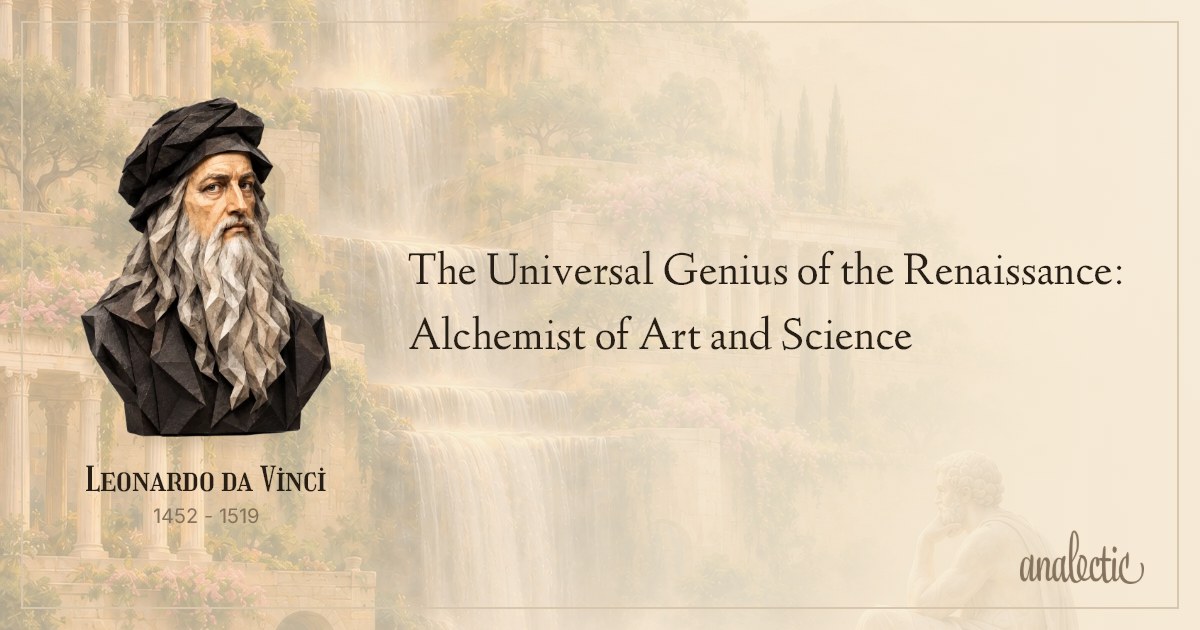
Leonardo da Vinci
The Universal Genius of the Renaissance: Alchemist of Art and Science (1452 - 1519)
Leonardo, born in 1452 in the quiet Tuscan village of Vinci, was the illegitimate son of a notary and a peasant woman. From the moment he entered Andrea del Verrocchio’s workshop as a youth, he was consumed by a fervent passion to decipher the language of nature. He elevated observation to a sacred rite; every detail—from the drift of clouds to the quiver of facial muscles—seemed to him a cipher of the cosmos. At the heart of his reputation as 'Homo Universalis' lay an insatiable curiosity that bridged disciplines and held experience as the sole source of truth.Leonardo was among the rare geniuses who united art and science. The mathematics of perspective hid within the enigmatic smile of the Mona Lisa; the anatomy of drama unfolded in The Last Supper. With the Vitruvian Man, he proclaimed the human body the microcosm of the universe, while his notebooks teemed with designs of flying machines, documenting an imagination unbound by limits. In his anatomical studies, he rendered the structure of bones with poetic precision; as he sketched the swirls of water, he uncovered the laws of hydrodynamics. His codices were not mere sketchbooks, but whispered letters of wisdom addressed to future generations.Standing at the zenith of the Italian Renaissance, Leonardo endures in history as the symbol of human creative potential. His genius was an alchemy that fused beauty and truth in a single vessel. In the fluttering wings of birds, he perceived the laws of physics; in ancient myths, he discerned the depths of the human soul. Though five centuries have passed since his death, the legacy of this universal genius—who taught us 'how to learn'—continues to inspire artists, scientists, and all inquisitive minds. For he was not merely a painter or inventor, but the infinite mirror of humanity itself.
Leonardo da Vinci: quotes
- “Simplicity is the ultimate sophistication.”
- “Learning never wearies the mind, for it is the one thing that exhausts no soul and leaves no regret.”
- “Painting is a silent poetry, and poetry is a blind painting.”
- “As a day well spent brings sweet sleep, so a life well lived brings a peaceful death.”
- “Time is long enough for those who know how to use it.”
- “Obstacles do not bend me; each one is shattered by the force of my resolve.”
- “The eye is the window of the soul, the gateway through which the spirit beholds the beauty of the universe.”
- “Nature never violates her own laws.”
- “Experience never deceives; it is only our judgments, reaching beyond its reach, that betray us.”
- “Perfection is woven from the finest details, yet perfection itself transcends mere detail.”
- “Art is never finished, only abandoned.”
- “Nothing can be loved or hated unless one first possesses full knowledge of it.”
- “The water you touch in the river is the last of what has flowed and the first of what is to come; so too is the present moment.”
- “He who thinks little errs much.”
- “All our knowledge finds its origin in the senses.”
- “Iron rusts from disuse; stagnant water loses its purity and freezes in cold; even so does inaction sap the vigour of the mind.”
- “He who fixes his gaze upon a star never alters his purpose nor loses his way.”
- “Water is the driving force of all nature.”
- “Shadow holds such power that light, without it, could never reveal its virtues.”
- “Nature is filled with infinite reasons, never yet explored by human experience.”
- “No loss is more irreparable than that of time.”
- “Great love arises from a profound understanding of what is loved.”
- “Wisdom is the child of experience.”
- “A mind that does not challenge its own thoughts can never attain truth.”
- “The painter's mind must become a mirror, clear and unstained, reflecting the very soul of nature.”
- “Those who achieve success do not sit back and wait for fortune to unfold—they rise and act.”
- “Those who fall in love with practice without science are like a pilot who sets sail without rudder or compass.”
- “The noblest pleasure is the joy of understanding.”
- “Silence is the sanctuary where the thinking soul finds its peace.”
- “The measure of a man lies in the magnitude of his thoughts and the weight of his deeds.”
View on Analectic →