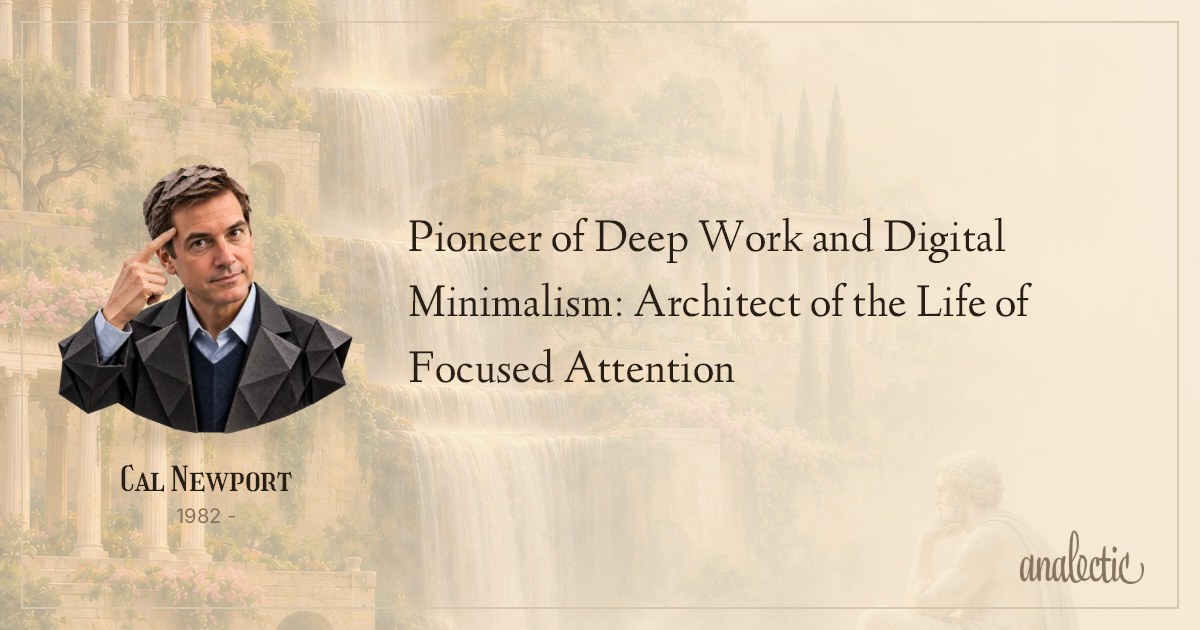
Cal Newport
Pioneer of Deep Work and Digital Minimalism: Architect of the Life of Focused Attention (1982 -)
Born in 1982, Cal Newport began his journey into the origins of mental discipline through rigorous academic training in theoretical computer science at Dartmouth and MIT. While serving as an associate professor at Georgetown University, he emerged as a leading intellectual voice challenging the attention economy of the digital age. Though he began in computer science, his focus gradually shifted to how modern technology manipulates the human mind—a transformation that was not merely a critique of technology, but a philosophical call for intellectual freedom. Newport demonstrated that understanding how we manage attention is as much a science as writing code.With his globally acclaimed book 'Deep Work,' Newport declared that attention is the most valuable resource in the knowledge economy, exposing the illusion of productivity when it is fragmented by shallow tasks—emails, instant notifications, unnecessary meetings. He drew a fundamental distinction between being busy and being productive: true value is not generated by surface-level motion, but by intense, deep concentration. This book was not merely a guide to efficiency; it was an epistemological shock that revealed the greatest lie of modern life—that attention had become a resource, a commodity, a battlefield.Through works such as 'Digital Minimalism,' 'So Good They Can't Ignore You,' and 'Slow Productivity,' Newport rejected the passion myth and championed the 'Craftsman Mindset': mastery is not built through fleeting interest, but through patience, repetition, and depth. He sought not to change technology, but to transform mindset, crafting a manifesto for the power of less, clarity, and excellence. Newport is not merely an author; he is a philosopher offering a way of life for intellectual freedom—his ideas serve as a compass for generations lost in digital noise: depth is not merely a strategy, but a mode of existence.
Cal Newport: quotes
- “Deep work is not just a skill, but a philosophy: it is a way of filling your mind with depth by silencing the noise in your attention.”
- “Digital minimalism means accepting technology only when it creates genuine value in your life.”
- “Happiness in your career comes not from your passion, but from the development of your skills; thus, those who say 'get good' are wiser than those who say 'follow your passion.'”
- “Email is the most harmful habit of the modern workplace; constant responsiveness destroys the capacity for deep thought.”
- “Slow productivity is not about doing more things, but about doing the right things with depth.”
- “Cognitive fitness is not just the strength of your concentration, but the courage to choose what you focus on.”
- “Eliminating all shallow work is the first step to deep work; because these tasks fill your mind with lies.”
- “A skill is acquired not merely with time, but with deliberate effort; thus, each day you must decide to do something better.”
- “Overcoming fear begins not with trying something new, but with letting go of something old: for example, deleting an app you feel you must constantly check.”
- “A mindful life is not about technology, but about listening to an inner voice that guides your purpose.”
- “If everything is important, nothing is important; deep work demands the courage to choose.”
- “The mind drifts from depth in a constantly fragmented environment; thus, preserving silence is a moral imperative.”
- “Having a skill is stronger than finding a passion; because skill creates its own value.”
- “Protecting your attention is the greatest form of resistance in the modern world; because everything is designed to steal it.”
- “Deep work is not merely a method, but a lifestyle; this lifestyle shapes your mind like a work of art.”
- “Email is the most common mask of ego in the modern world; with every reply you show a 'self,' but the true self disappears.”
- “Don't wait for the 'right time' to do something; deep work begins with determination, not motivation.”
- “Wisdom lies not in knowing what to choose, but in knowing what to reject.”
- “Deep work is not just time management; it's the art of deciding what your mind should focus on.”
- “Digital minimalism is the intentional integration of technology only into your life in ways that serve what is truly valuable.”
- “Career success is not found by following passion, but by acquiring valuable skills — and those skills are built through deep work.”
- “Email fragments your cognitive capacity and destroys your ability to think deeply — this is the most dangerous sham of the modern workplace.”
- “Slow productivity is not about doing more — it’s about doing less, but with greater depth.”
- “The deeper your skill, the less you are affected by external noise — this is the foundation of cognitive fitness.”
- “A small action creates a great habit — but only if that action is performed with deep intention.”
- “The greatest trick in modern work is convincing people that being busy is the same as being productive.”
- “A person’s true power lies in their ability to decide who controls their attention.”
- “A deep mind is built not only by thinking deeply, but by refusing to think about trivial things.”
- “When deciding to do something, asking 'why?' is more critical than asking 'how?'”
- “Attention is your most valuable asset — and you must defend it daily from being stolen.”
View on Analectic →