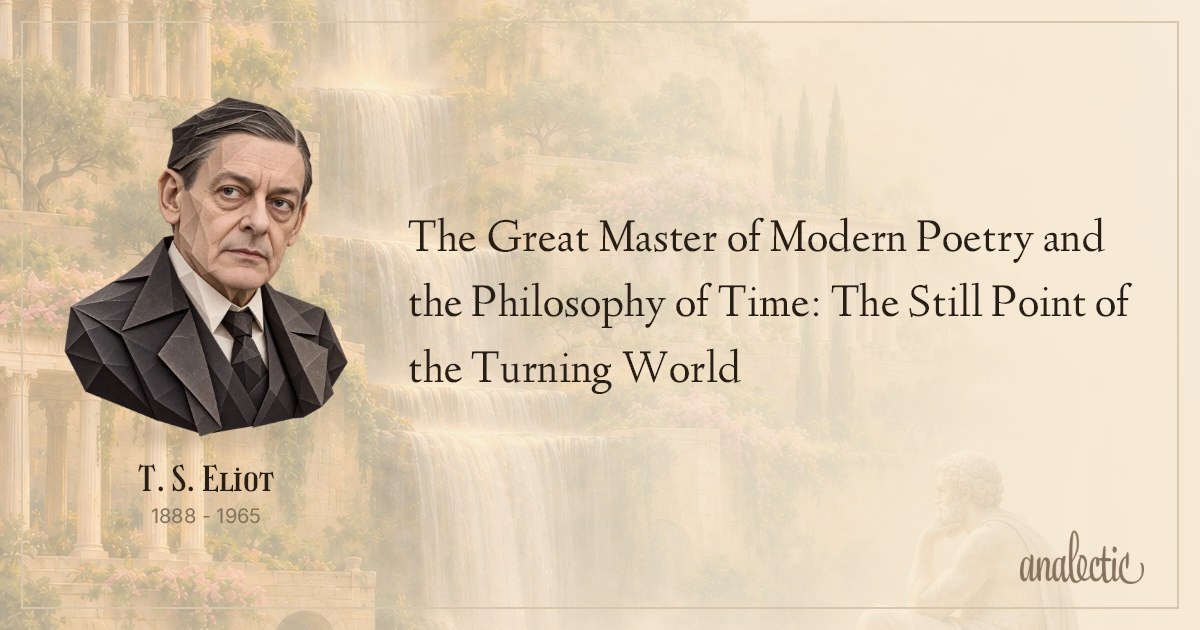
T. S. Eliot
The Great Master of Modern Poetry and the Philosophy of Time: The Still Point of the Turning World (1888 - 1965)
Thomas Stearns Eliot was born in St. Louis in 1888. His intellectual journey, deepening in philosophy and literature at Harvard, the Sorbonne, and Oxford, drew him into the labyrinthine intellects of Europe. Upon settling in England in 1914, he began pushing the boundaries of modern poetry within Ezra Pound’s avant-garde circle. His 1915 poem, 'The Love Song of J. Alfred Prufrock,' rendered with sharp irony and fragmented imagery the inner conflicts, indecisiveness, and urban alienation of the modern soul. Prufrock’s cry, 'Do I dare disturb the universe? / To have squeezed the universe into a ball / To roll it toward some overwhelming question,' became a harbinger of the existential crisis of the twentieth century.Published in 1922, 'The Waste Land' transformed modern poetry into a sacred text, weaving the spiritual desertion of postwar Western civilization into a mythological collage through the gaze of Tiresias. In 'The Hollow Men,' Eliot immortalized humanity’s spiritual void with the haunting lines: 'This is the way the world ends / Not with a bang but a whimper.' In 'Four Quartets,' he transmuted the cyclical nature of time, the labyrinths of memory, and the mystical quest for redemption into a philosophical symphony. His metaphor of 'the still point of the turning world' challenged generations to contemplate the possibility of stillness amid chaos.Awarded the Nobel Prize in Literature in 1948, Eliot, in his essay 'Tradition and the Individual Talent,' emphasized the vital creative role of dialogue with the past. This intellectual titan, questioning modernity’s epistemological arrogance with 'Where is the wisdom we have lost in knowledge?', transformed poetry into a metaphysical quest. With lyrical intensity, cultural memory, and conceptual depth, he did not merely reshape literature—he redrew the spiritual map of humanity.
T. S. Eliot: quotes
- “We shall not cease from exploration, and the end of all our exploring will be to arrive where we started and know the place for the first time.”
- “Where is the wisdom we have lost in knowledge? Where is the knowledge we have lost in information?”
- “Only those who will risk going too far can possibly find out how far one can go.”
- “At the still point of the turning world. Neither flesh nor fleshless; Neither from nor towards; at the still point, there the dance is.”
- “Time present and time past are both perhaps present in time future, and time future contained in time past.”
- “This is the way the world ends: not with a bang but a whimper.”
- “Words strain, crack and sometimes break, under the burden, under the tension, slip, slide, perish, decay with imprecision, will not stay in place, will not stay still.”
- “Do I dare disturb the universe? In a minute there is time for decisions and revisions which a minute will reverse.”
- “Immature poets imitate; mature poets steal; bad poets deface what they take, and good poets make it into something better.”
- “Teach us to care and not to care. Teach us to sit still.”
- “What we call the beginning is often the end. And to make an end is to make a beginning. The end is where we start from.”
- “Humankind cannot bear very much reality, yet only by enduring truth does the spirit mature.”
- “For last year's words belong to last year's language. And next year's words await another voice.”
- “April is the cruellest month, breeding lilacs out of the dead land, mixing memory and desire.”
- “Tradition cannot be inherited, and if you want it you must obtain it by great labour.”
- “I said to my soul, be still, and wait without hope; for hope would be hope for the wrong thing.”
- “Anxiety is the handmaiden of creativity, but fortitude transforms anxiety into enduring art.”
- “Distracted from distraction by distraction, filled with fancies and empty of meaning: this is the sickness of a scattered mind.”
- “We are the hollow men, we are the stuffed men, leaning together, headpiece filled with straw.”
- “Poetry is not a turning loose of emotion, but an escape from emotion; it is not the expression of personality, but an escape from personality.”
- “The darkness declares the glory of light, and the silence proclaims the sacred depth of the word.”
- “Half of the harm that is done in this world is due to people who want to feel important. Dare to seek truth instead.”
- “Suffering is permanent, obscure and dark, and shares the nature of infinity; yet within it lies the forge of human dignity.”
- “In my beginning is my end... In my end is my beginning.”
View on Analectic →