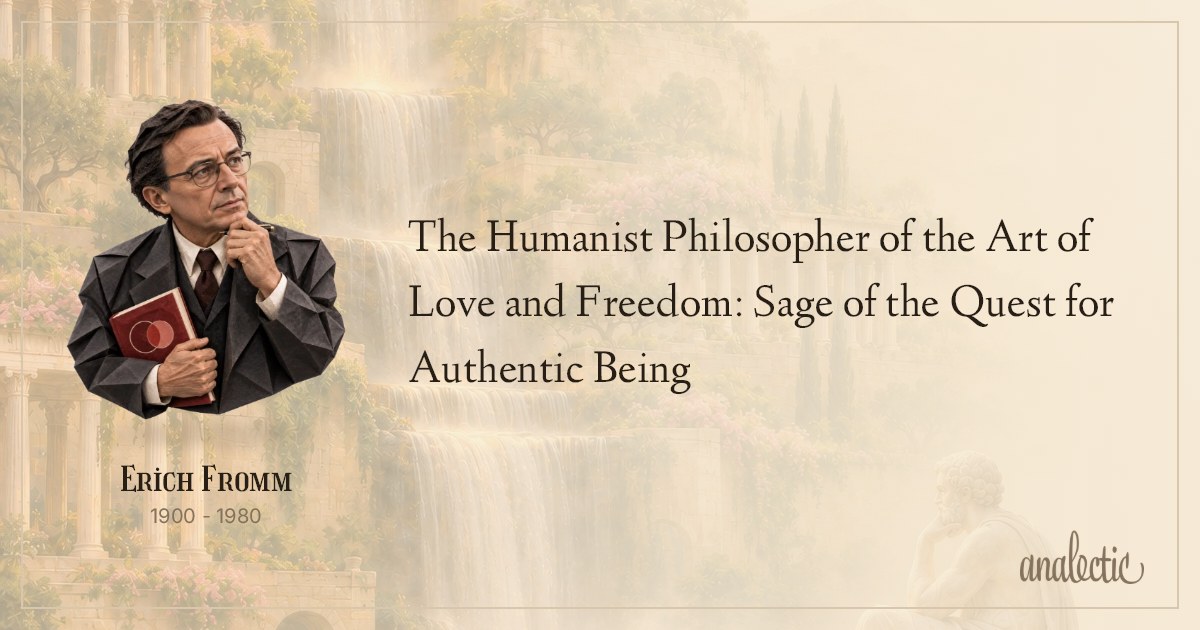
Erich Fromm
The Humanist Philosopher of the Art of Love and Freedom: Sage of the Quest for Authentic Being (1900 - 1980)
Erich Fromm, a profound philosophical mind born in Frankfurt in 1900, was a humanist psychoanalyst who fiercely critiqued the spiritual collapse of modern society, humanity's alienation from freedom, and the commodification of love as a consumable good. Synthesizing Freud’s psychoanalysis with Marx’s social critique, Fromm correlated the existential loneliness and fear of the individual with the passivity and lust for domination generated by social structures, diagnosing the modern individual’s inner void with the precision of a medical prognosis. For him, human fulfillment arises not merely from material prosperity, but from the capacity to love freely, to exist creatively, and to forge authentic bonds. Thus, Fromm defined love not as an emotion, but as an art—a disciplined, patient, and attentive practice, an act of surrendering one’s own being to another, yet thereby enriching it.In his 1941 masterpiece, The Fear of Freedom, Fromm analyzed how social pressures suppress individual autonomy and the psychological mechanisms by which people submit to authority to escape the terror of freedom. He argued that the fear of freedom stems from the unbearable solitude and meaninglessness of existence, compelling individuals to dissolve themselves into institutions, leaders, or ideologies—seeking refuge from liberty itself. Yet this escape, Fromm warned, produces not true freedom but a form of psychological slavery. His theory resonates with startling clarity in today’s world of social media identity traps, societal conformity, and emotional consumerism. For Fromm, freedom is not merely a political right, but an inner heroic struggle.His 1956 work, The Art of Loving, stands as the deepest and most humanely expressive articulation of his philosophy. Here, love is defined not as mere romantic sentiment, but as an act, a decision, a discipline: to love is to give one’s own being to another, yet this giving is not loss, but self-enrichment. Fromm identified four essential elements of love: care, responsibility, respect, and knowledge; without them, love degenerates into domination or dependency. He insisted that love is not a matter of taking, but of giving; not consumption, but creative being. This lifelong quest of Fromm’s reminds us of our age’s greatest lie: love cannot be purchased; it is born only from a free spirit. Fromm, who died in Mexico in 1980, continues to illuminate every soul struggling against loneliness, even beyond the grave.
Erich Fromm: quotes
- “Love is not a feeling, but an art; it requires knowledge, effort, and continuous practice.”
- “Greed is an endless well; it consumes not to satisfy need, but to fill the infinite void within.”
- “To be free requires courage; for freedom demands the courage to depart from the herd and to bear the responsibility of one's own solitude.”
- “If I am what I have, then who am I when I lose what I have?”
- “The capacity to be alone is the prerequisite for the capacity to love.”
- “Discipline is not an external compulsion imposed upon us, but the faithful commitment of the human being to their own inner purpose.”
- “To live in fear of suffering is, in truth, to flee from life itself.”
- “Mature love says: 'I need you because I love you.' Immature love says: 'I love you because I need you.'”
- “To think as the majority thinks is comfortable; but to think with one's own reason is the highest virtue.”
- “To focus is to give your entire being and soul to a single action in the present moment.”
- “The tragedy of the modern human is that they know perfectly well what they want to possess, but never consider what they want to be.”
- “Inner peace is attained not by accumulating what one possesses, but by deepening the state of being.”
- “The art of loving, like carpentry or music, demands patience, attention, and a disciplined commitment to work.”
- “Disappointments are inevitable; what matters is to see in them not a collapse, but an opportunity to free ourselves from our own false expectations.”
- “Those who fear standing on their own two feet seek refuge in the arms of dictators and dogmas.”
- “Love is the desire to see the other person grow and flourish according to their own nature, not to dominate them.”
- “One who does not know how to listen to oneself cannot truly hear the truth of the outer world.”
- “The person at peace with their own existence is not dependent on the praise or blame of others.”
- “Laziness is not merely physical sluggishness; it is a betrayal of one's mental and spiritual potential.”
- “Alienation is the condition in which human beings become slaves to the things they have created, forgetting their own power.”
- “Growth is painful; for every step of growth demands the surrender of an old habit and a familiar comfort.”
- “Do not fear doubt; the most powerful antidote to dogma is a critical mind.”
- “The primary task of human beings is to bring into actuality what they potentially are: to give birth to themselves.”
- “Peace is not the absence of action, but the presence of inner harmony in every deed.”
- “To truly pay attention to something is to strive to comprehend it fully before passing judgment.”
- “Love is not a passive emotion, but an active power; it encompasses giving, caring, respecting, and taking responsibility.”
- “To remain unbroken by hardship draws strength from the deep faith in one's own human dignity.”
- “To dare to be oneself is the hardest yet most liberating battle in the world.”
- “The culture of consumption transforms the human being into an insatiable glutton; true wealth, however, lies in needing less.”
- “Character is built through the sum of the small moral choices you make each day.”
View on Analectic →