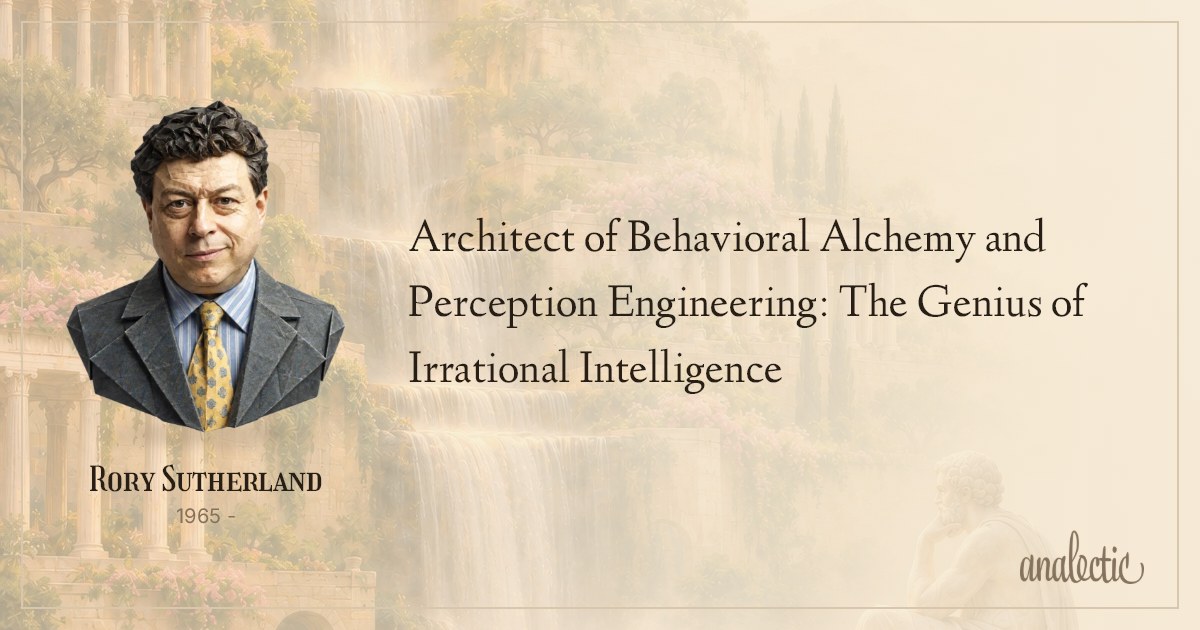
Rory Sutherland
Architect of Behavioral Alchemy and Perception Engineering: The Genius of Irrational Intelligence (1965 -)
Born in Wales in 1965, Rory Sutherland began his exploration of the limits of logic through classical philology at Cambridge University; yet the true miracle emerged when, in 1988, he began as a copywriting intern at Ogilvy UK. There, he did more than write advertisements—he ignited a cumulative intellectual revolution: he realized that advertising’s purpose was not merely to sell products, but to understand and guide the inner workings of the human mind. In the 2000s, by founding the world’s first behavioral economics application unit, he set out to dismantle the illusion of economic rationality. This unit became a laboratory that questioned not what people did, but why they did it—and thus, advertising met science.Sutherland’s magnum opus, "Alchemy: The Surprising Power of Ideas That Don’t Make Sense," argues against modern economics and engineering’s creed of "better materials, more funding," championing instead the thesis that "perception is reality’s most real reality." He insists there are two ways to improve something: one is to alter its physical reality; the other is to reframe how humans perceive it. Increasing the weight of a coffee cup makes its contents feel more premium; installing a mirror and music at a bus stop shortens the perceived wait. This is not engineering—it is the work of psychology, art, and alchemy—and Sutherland is the first to systematize this alchemy.The central tenet of Sutherland’s entire philosophy is that the human mind is not a calculator, but a play of context, narrative, and emotion. He defines marketing as "the art of understanding the complexity of human nature," studying not rational decision-making, but decisions shaped by intuition, emotion, and social context. When his TED talks were viewed millions of times, he was recognized not merely as an advertiser, but as one of the era’s deepest psychological philosophers. Sutherland reminds us: it is not reality, but perceived reality, that shapes the market—and this is the most potent form of alchemy.
Rory Sutherland: quotes
- “People don't just buy what a product does, they buy how it makes them feel; that's why we must seek psychological solutions over engineering ones.”
- “Value is not in reality but in perception; changing how something looks, not how good it is, can radically alter its value.”
- “Don't forget that a product being 'logical' is less important than it being purchasable; people act irrationally, but this irrationality makes sense within context.”
- “The purpose of advertising is not to change reality, but to change how reality is perceived.”
- “It’s often more effective to make something feel better rather than make it better; that is the true power of advertising.”
- “People make decisions not based on whether something is 'right', but whether it 'looks right'.”
- “Raising the perceived value of a product increases sales more sustainably than lowering its price.”
- “Engineers ask 'why?'; marketers ask 'how does it feel?'. Both are necessary, but the latter is far more often overlooked.”
- “The success of a campaign is measured not by how cleverly it was designed, but by how humanly it made people feel.”
- “People never find something 'right' unless they first believe it to be so; shaping perception is therefore more powerful than changing reality.”
- “Even if you think a product is 'bad', present it in a different context and people may find it 'brilliant'.”
- “People are willing to pay more not for less, but for more value — if that value is perceived.”
- “The fact that an idea seems irrational can be the key to its power — because humans are more emotionally attached to the irrational.”
- “Advertising is not a reflection of reality, but an interpretation of it — and interpretations are more powerful than reality.”
- “People buy not how good something is, but how special it makes them feel; personalization is deeper than technology.”
- “A campaign is measured not by how cleverly it was designed, but by how deeply it moved people — and people form bonds through irrationality.”
- “Engineering solutions fix a problem; psychological solutions make the problem disappear.”
- “People don't buy what a product does, but how it makes them feel; they choose psychological solutions, not engineering ones.”
- “Value is not reality; it is perception. Reality is built by engineering, but value is built by psychology.”
- “A product being 'logical' is not enough to make customers buy it; they must find it 'meaningful'.”
- “People make decisions not through rational analysis, but through the story of context. Narrative builds atop logic.”
- “The success of an ad is not measured by how much it explains, but by how little it says while evoking so much.”
- “Customers prefer a 'less bad' experience over a 'better' product. Suitability, not perfection, wins.”
- “An idea appearing 'irrational' increases its chance of leaving a deeper imprint on the human mind.”
- “People do not accept something as 'true' because they think it is right; they accept it as right because they feel it is true.”
- “A product’s price reflects perceived value, not cost. Perceived value is crafted not by engineering, but by poetry.”
- “When making a decision, people do not ask 'What should I do?' but 'Who do I want to be?'”
- “A campaign that creates a question in the customer’s mind drives them to buy; a campaign that gives an answer exhausts them.”
- “Customers remember not what a brand says, but what it silently implies.”
- “The more logical an idea appears, the less impact it has; the more absurd it seems, the more it is remembered.”
View on Analectic →