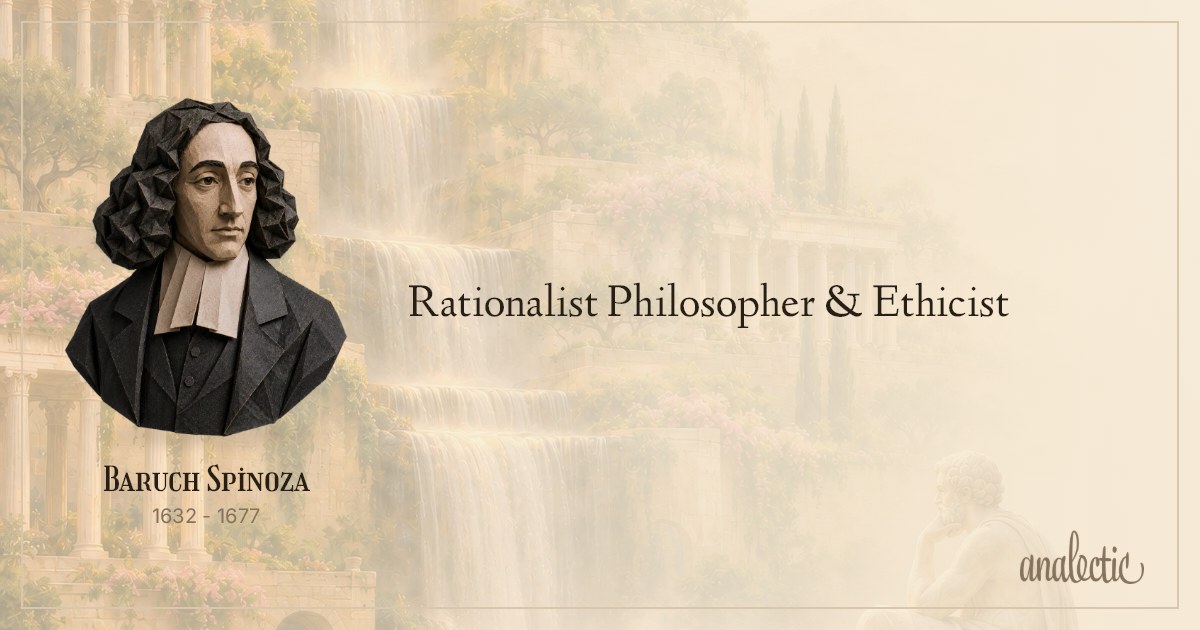
Baruch Spinoza
Rationalist Philosopher & Ethicist (1632 - 1677)
Baruch Spinoza (1632–1677), one of the most radical and influential rationalist thinkers of 17th-century philosophy, was a pioneer of modern secularism and the Enlightenment. Born into a Sephardic Jewish family that had fled the Portuguese Inquisition to seek refuge in Amsterdam, Spinoza deepened his learning in Hebrew theology, scholastic philosophy, and Cartesian thought. Because of his critical ideas questioning traditional religious dogmas, miracles, and the divine authorship of sacred texts—arguing instead that they were human-made—he was expelled from his community at the age of 24 by the Amsterdam Synagogue through the harshest form of excommunication (cherem). He turned down academic chairs offered by universities to preserve his intellectual freedom, earning a modest living by grinding optical lenses and writing philosophy.Spinoza's magnum opus, 'Ethics' (Ethica), demonstrated through the geometric method (using definitions, axioms, and propositions), represents the pinnacle of pantheistic philosophy by asserting the identity of God and nature ('Deus sive Natura' / God or Nature). According to him, there is only one substance (substantia) in the universe, and all individual entities are merely modes or manifestations of this infinite substance. Viewing human bondage as being enslaved by passive passions, and human freedom as understanding universal necessity and the order of nature guided by reason ('Amor Dei Intellectualis' / Intellectual Love of God), Spinoza also laid one of the strongest philosophical foundations for freedom of expression and democracy with his 'Theological-Political Treatise'.
Baruch Spinoza: quotes
- “Peace is not an absence of war, it is a virtue, a state of mind, a disposition for benevolence, confidence, justice.”
- “There is no hope unmingled with fear, and no fear unmingled with hope.”
- “Happiness is a virtue, not its reward.”
- “I have striven not to laugh at human actions, not to weep at them, nor to hate them, but to understand them.”
- “For peace is not mere absence of war, but is a virtue that springs from, a state of mind, a disposition for benevolence, confidence, justice.”
- “One and the same thing can at the same time be good, bad, and indifferent, e.g., music is good to the melancholy, bad to those who mourn, and neither good nor bad to the deaf.”
- “Peace is not the absence of war, but a virtue based on strength of character.”
- “Fear cannot be without hope nor hope without fear.”
- “Whatsoever is contrary to nature is contrary to reason, and whatsoever is contrary to reason is absurd.”
- “Freedom is absolutely necessary for the progress in science and the liberal arts.”
- “Desire is the essence of a man.”
- “Ambition is the immoderate desire for power.”
- “Men govern nothing with more difficulty than their tongues, and can moderate their desires more than their words.”
- “Pride is pleasure arising from a man's thinking too highly of himself.”
- “Only that thing is free which exists by the necessities of its own nature, and is determined in its actions by itself alone.”
- “Fame has also this great drawback, that if we pursue it, we must direct our lives so as to please the fancy of men.”
- “True virtue is life under the direction of reason.”
- “Sin cannot be conceived in a natural state, but only in a civil state, where it is decreed by common consent what is good or bad.”
- “All things excellent are as difficult as they are rare.”
- “It may easily come to pass that a vain man may become proud and imagine himself pleasing to all when he is in reality a universal nuisance.”
- “I have made a ceaseless effort not to ridicule, not to bewail, not to scorn human actions, but to understand them.”
- “All happiness or unhappiness solely depends upon the quality of the object to which we are attached by love.”
- “If you want the present to be different from the past, study the past.”
- “He alone is free who lives with free consent under the entire guidance of reason.”
- “Nothing in the universe is contingent, but all things are conditioned to exist and operate in a particular manner by the necessity of the divine nature.”
- “Desire is the very essence of man.”
- “The world would be happier if men had the same capacity to be silent that they have to speak.”
- “Blessedness is not the reward of virtue but virtue itself.”
- “So long as a man imagines that he cannot do this or that, so long as he is determined not to do it; and consequently so long as it is impossible to him that he should do it.”
- “I call him free who is led solely by reason.”
View on Analectic →