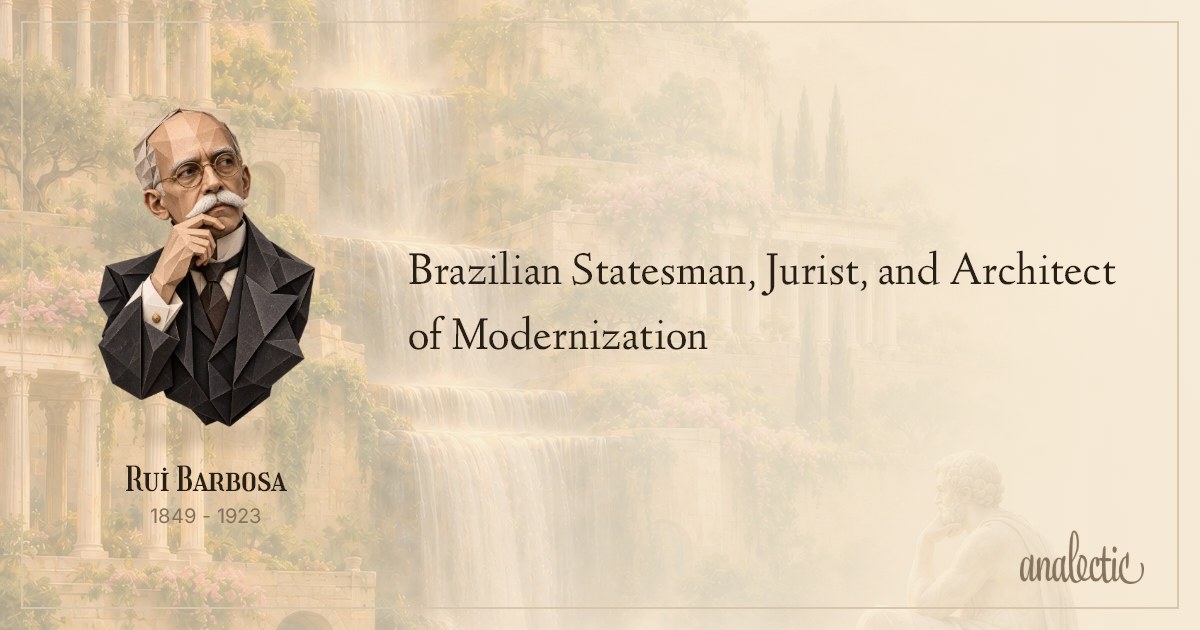
Rui Barbosa
Brazilian Statesman, Jurist, and Architect of Modernization (1849 - 1923)
Rui Barbosa was born on 5 November 1849 in Salvador, Bahia, and came of age during the twilight years of the Brazilian Empire. He pursued legal studies at the Recife Law School, where he encountered liberal ideas that would form the bedrock of his staunchly abolitionist and republican convictions. Launching a career in journalism, he swiftly distinguished himself on the nation's intellectual and political stage through his incisive writings for newspapers such as 'Diário de Notícias' and 'O Paiz'. His election as a deputy from Bahia in 1881 marked his formal entry into active politics, during which he played a pivotal parliamentary role in the processes leading to the abolition of slavery (Lei Áurea, 1888) and the proclamation of the Republic (1889). This formative period established him not merely as a politician but as a formidable public intellectual whose rhetoric was rooted in a profound commitment to legal principles and civil liberties.Appointed Minister of Finance in the provisional republican government established in 1890, Barbosa engineered a comprehensive series of legislative measures, famously known as the 'Rui Barbosa Reforms', which modernised the country's financial and civil codes. He contributed significantly to the drafting of the 1891 Constitution, ensuring the incorporation of foundational principles such as federalism, the separation of powers, and expanded individual rights. On the international stage, he served as the Brazilian delegate to the 1907 Hague Peace Conference, where his formidable expertise in maritime law and arbitration earned him the sobriquet 'The Eagle of The Hague'. His paramount legal work, the 'Commentaria à Constituição Federal Brasileira' (Commentary on the Federal Constitution), is regarded as a cornerstone of Brazilian constitutional jurisprudence, synthesising doctrinal analysis with a robust defence of civil guarantees.The legacy of Rui Barbosa resides in his indispensable role in constructing Brazil as a nation-state founded upon the rule of law, civil rights, and modern financial systems. His unwavering insistence on constitutional safeguards and individual freedoms profoundly shaped the country's legal culture and institutional framework. His intellectual rigour and oratorical prowess elevated him to legendary status both as a defence attorney and a public intellectual, whose court pleadings and essays were marked by erudition and rhetorical force. Following his death, his name was bestowed upon countless institutions, streets, and monuments, and in 1949, on the centenary of his birth, his remains were transferred to the Monument to Independence as a national hero. Today, he endures as a perpetual source of inspiration and a fundamental reference point for advocates of liberal democracy and the supremacy of law, his life's work embodying the synthesis of legal scholarship, political action, and civic virtue.
Rui Barbosa: quotes
- “For the spirit, I know no greater satisfaction than witnessing the triumph of scientific truth.”
- “When the school of the ocean unites with the school of war, they can be assured of being granted a proportionate share of knowledge among their peers.”
- “Liberty is not a luxury of tranquil times; it is, above all, the greatest element in the stability of institutions.”
- “Before the Republic, Brazil existed; and Brazil grew up Christian, and has remained Christian to this day. Therefore, if the Republic came to organize Brazil and not to crush it, the formula of constitutional liberty in the Republic must necessarily be a Christian formula.”
- “For the elect of the world of ideas, misery lies not in death, but in stagnation.”
- “It is impossible to be within civilization and remain outside of art.”
- “When justice becomes blind to one of two sides, it is no longer justice. It must look equally to the right and to the left.”
- “Injustice, no matter how small the victimized creature, drives me to rebellion, transforms me, inflames me, steals and carries away the tranquility of my heart and my respect for life.”
- “The autonomy of municipalities is the primary necessity in the democratic education of the country.”
- “The principle that ensures justice is protected from corruption is public opinion.”
- “Our Constitution, by granting broad freedom to religious beliefs, has entrusted the development of Christian sentiment in this country to the free action of the Brazilian conscience. Therefore, the right of the religious minority in our country must be safeguarded as absolutely as that of the majority.”
- “Brazilian constitutional law abolished the death penalty, but revolver democracy has taken it for its own use.”
- “The lawyer is of little value in tranquil times; his great role emerges when he must confront the power of despots by representing the noble character of free peoples before the courts.”
- “The Republic needs to be amiable, not terrible; it should reconcile, not persecute; it requires forgetting, not vengeance; instead of donning the skin of old reactions, it should expand and consolidate liberty.”
- “"Defense does not mean praise of the crime or the criminal. Its function is to stand by the accused, whether innocent or guilty, and be the voice of his legal rights." (The Lawyer's Duty)”
- “All civilization resides in liberty; all liberty resides in the security of individual rights. Liberty and legal guarantee are interchangeable equivalent terms.”
- “The supreme functions of power enjoy their sovereignty only within the limits of authority circumscribed by the laws. The moment authority is exceeded, the legally uncontrollable authority character and the sovereignty privilege of the government's political acts immediately cease.”
- “Situations born of terror soon become infected by the terror they spread and ultimately dissolve in their own terror.”
- “Light is the greatest enemy of crimes. In public opinion, light shines. The press is public opinion. Therefore, governments founded on blood and force, arbitrariness and corruption, secrecy and lies cannot reconcile themselves with the press.”
- “If Brazil is condemned by my representatives to continue being the laughingstock of the world, a pitiful, ridiculous, and humiliated nation, it will not be because I have failed to use my power to cry out for my country.”
- “The despot, by stealing the freedom of his peers, has also stolen his own peace from himself.”
- “Under the previous regime (Monarchy) a man bearing a certain stain on his life was a man lost forever – political careers were closed to him... In the Republic, the crippled are those who cannot be overthrown. In the Republic, all groups have been distanced from the movement of parties, the action of Governments, the practice of institutions.”
View on Analectic →