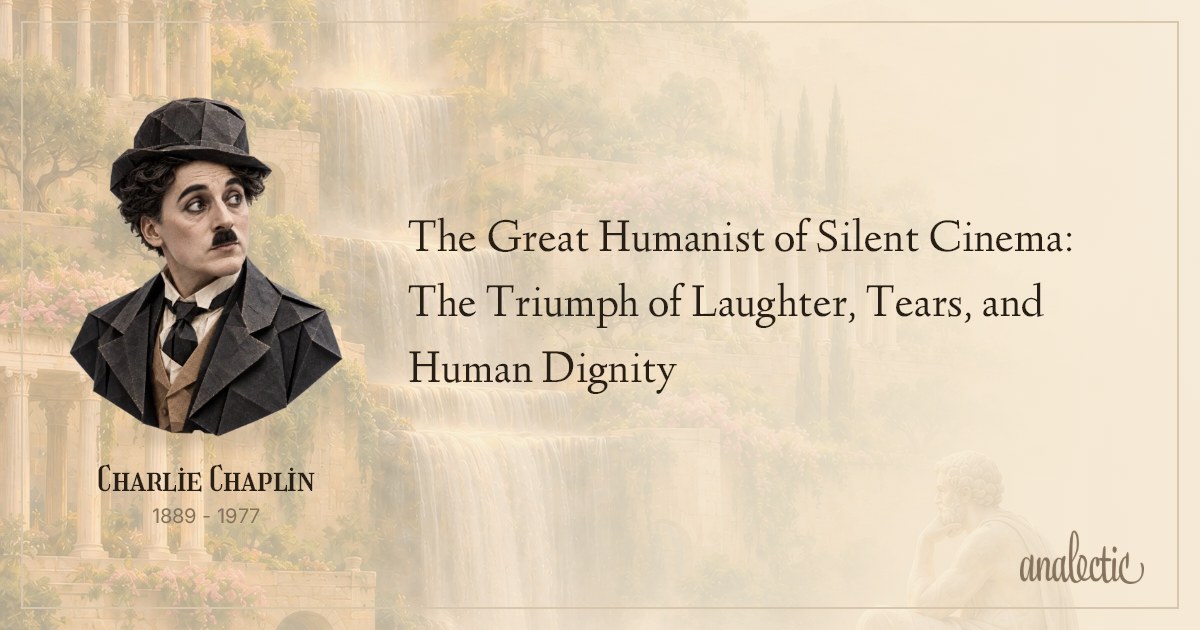
Charlie Chaplin
The Great Humanist of Silent Cinema: The Triumph of Laughter, Tears, and Human Dignity (1889 - 1977)
On a cold London night in 1889, amidst the impoverished streets of the East End, Charles Chaplin’s life taught him, at an early age, the dark and luminous faces of humanity. Abandoned as a child in a workhouse after his father’s alcoholism and his mother Hannah’s institutionalization, he clung to life at the age of five, stepping onto music hall stages. His genius, honed in Fred Karno’s pantomime company, reached Hollywood in 1914—the cradle of cinema—where, amid the trembling silence of the screen, he would weave the legend of an era, stitch by stitch.With his bowler hat, tight jacket, and cane transformed into an emblem of nobility, Chaplin’s ‘The Tramp’ became the most humane mask ever created. In ‘The Kid,’ he portrayed abandonment; in ‘The Gold Rush,’ hunger; in ‘City Lights,’ a tender love for a blind flower girl; and in ‘Modern Times,’ the tragedy of the human being crushed by industrial machinery. Each film was a humanist manifesto, uniting in a single frame the laughter and sobs of those crushed beneath the gears of the industrial age.As the shadow of fascism loomed, Chaplin etched one of history’s most courageous artistic resistances in 1940 with ‘The Great Dictator.’ The unforgettable speech at its climax was the manifesto of a century: ‘It is not hate that will save us, but the grace to love.’ When exiled from America by McCarthy’s witch hunts, he withdrew to the tranquil waters of Lake Geneva. Upon his return to the Oscars in 1972, the 12-minute standing ovation did not merely honor a genius—it saluted a spirit that had defied poverty, tyranny, and the alienation of humanity. He was the philosopher of laughter, the poet of tears, the immortal architect of human dignity.
Charlie Chaplin: quotes
- “You'll never find a rainbow if you're looking down.”
- “We think too much and feel too little. More than machinery we need humanity. More than cleverness we need kindness and gentleness.”
- “Nothing is permanent in this turbulent world, not even our greatest troubles.”
- “Failure is unimportant. It takes real courage to make a fool of yourself in search of beauty.”
- “Life is a tragedy when seen in close-up, but a comedy in long-shot.”
- “To truly laugh, you must be able to take your deepest pain, and play with it.”
- “Simplicity is not easy; it is the crowning achievement of relentless discipline and craft.”
- “A day without genuine laughter and kindness is a day utterly wasted.”
- “You have to believe in yourself; even in the darkest poverty, never doubt your inner worth.”
- “I always like walking in the rain, so no one can see my tears.”
- “Silence is universal; where words cause division and hatred, quiet gesture touches the raw soul.”
- “Let us fight for a decent world—a world where reason and brotherhood overcome greed.”
- “Perfection in performance comes only through exhausting repetition until movement feels as natural as breath.”
- “Do not despair in times of trial; human misery is but the temporary passing of darkness before dawn.”
- “Keep your focus sharp upon the fragile spark of dignity residing within every human soul.”
- “Inner serenity comes from forgiving the cruelty of the world while cherishing its gentle wonders.”
- “The soul of man has been given wings; dare to break free from the cage of tyranny.”
- “Discipline is the invisible architecture that grants true artistic freedom its effortless grace.”
- “When political storms rage, the quiet dignity of the solitary conscience remains unshaken.”
- “Concentrate on the essential truth of human vulnerability rather than grand, empty spectacles.”
- “Life is a wondrous, sacred gift; the greatest sin is to extinguish the light of curiosity within oneself.”
- “In the quiet stillness of introspection, one discovers that compassion is the highest form of intelligence.”
- “Stand tall when misunderstood; the integrity of your art will outlive the hostility of the present.”
- “Relentless creative focus turns the dust of everyday sorrow into timeless pearls of joy.”
- “We all desire to help one another; human beings are designed to live by each other's happiness, not misery.”
View on Analectic →