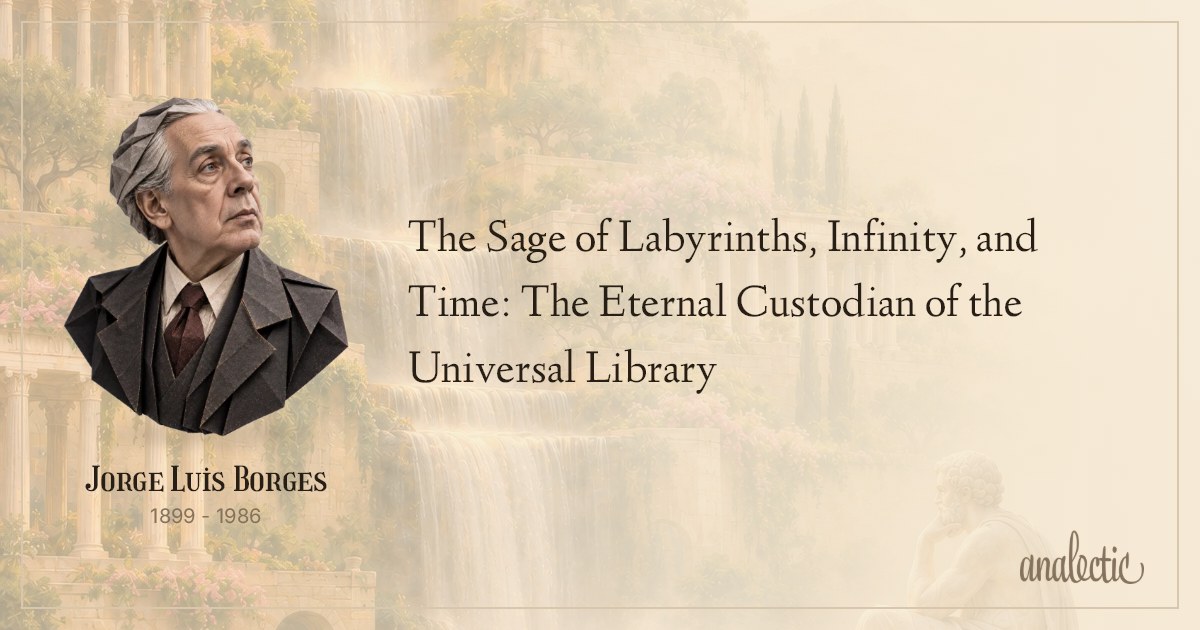
Jorge Luis Borges
The Sage of Labyrinths, Infinity, and Time: The Eternal Custodian of the Universal Library (1899 - 1986)
Born in 1899 amidst the rich cultural tapestry of Buenos Aires, Jorge Luis Borges set sail on an intellectual voyage that began in his father’s library, brimming with works in English, German, and French. His childhood unfolded between the chivalric dreams of Don Quixote and the philosophical upheavals of Nietzsche. In his youth, the pessimistic genius of Schopenhauer, discovered in Geneva, and the Ultraist movement, encountered in Spain, drew him into the enchanted labyrinths of poetry. Upon returning to Argentina in 1921, his lyrical verse transformed the streets of Buenos Aires into palimpsests, elevating the mundane to metaphysical epics: tango, knife-fights, and forgotten heroes became, in his pen, universal myths.With Ficciones and The Aleph, Borges drew world literature into the spiral of infinity, inviting readers to lose themselves among the boundless shelves of the Library of Babel, ensnared in the multiplying traps of mirrors and the cyclical paradoxes of time. Each tale was a philosophical experiment in which reality and fiction dissolved into one another: the writer who declared, I have always imagined Paradise as a kind of library, expanded the boundaries of existence through words. He interpreted his blindness as the cosmos shining in the mind’s darkness; with the aphorism Doubt is the noblest name of intellect, he sketched the portrait of a stoic philosopher courageously advancing through the labyrinths of knowledge.When appointed director of the National Library of Argentina in 1955, he smiled at the irony of continuing to write amidst eight hundred thousand books and darkness, embracing the poetry of fate. He exalted literature as the noblest expression of humanity’s quest to comprehend its own existence. Even after his death, this modern sage, who liberates our minds from the labyrinths of time, continues to guide readers along the infinite corridors of a paper universe, toward the open threshold of an Aleph.
Jorge Luis Borges: quotes
- “I have always imagined that Paradise will be a kind of library.”
- “To doubt is one of the noblest names of intelligence and independent thought.”
- “Nothing is built on stone; all is built on sand, but we must build as if the sand were stone.”
- “A man sets out to draw the world... and at the end of his life discovers that that patient labyrinth of lines traces the image of his own face.”
- “We are our memory, we are that chimerical museum of shifting shapes, that pile of broken mirrors.”
- “Reading is not a duty, but a form of happiness. If a book bores you, leave it; it was not written for you at this moment.”
- “Any life, however long and complicated, is actually made up of a single moment: the moment in which a man finds out who he is.”
- “Writing is nothing more than a guided dream, sculpted through patience and relentless revision.”
- “Time is a river that sweeps me along, but I am the river; it is a tiger that tears me apart, but I am the tiger.”
- “To be fearless does not mean lacking fear, but walking into the labyrinth with eyes open.”
- “I am all the writers that I have read, all the people that I have met, and all the cities I have visited.”
- “Blindness is not a total darkness; it is a gift that forces the mind to construct its own luminous universe.”
- “Mirrors and copulation are abominable, for they multiply the number of mankind and distort reality.”
- “The task of the poet is not to invent something out of nothing, but to discover the hidden melody in what already exists.”
- “Solitude is the quiet sanctuary where the soul converses with eternity.”
- “Do not fear the infinity of possibilities; embrace the single choice that defines your honor.”
- “Every encounter is a collision of two infinite universes disguised as ordinary men.”
- “I have committed the worst sin that a man can commit: I have not been happy. Yet today is a fresh canvas.”
- “To understand a single page profoundly is far greater than skimming a thousand libraries.”
- “We dream our lives, and in our waking hours we merely remember our dreams.”
- “A writer must cultivate the discipline of seeing the extraordinary in the mundane.”
- “Truth does not care about our comfort; it demands the courage to look into the abyss.”
- “Death is an echo of life, a gentle return to the timeless library of all being.”
View on Analectic →