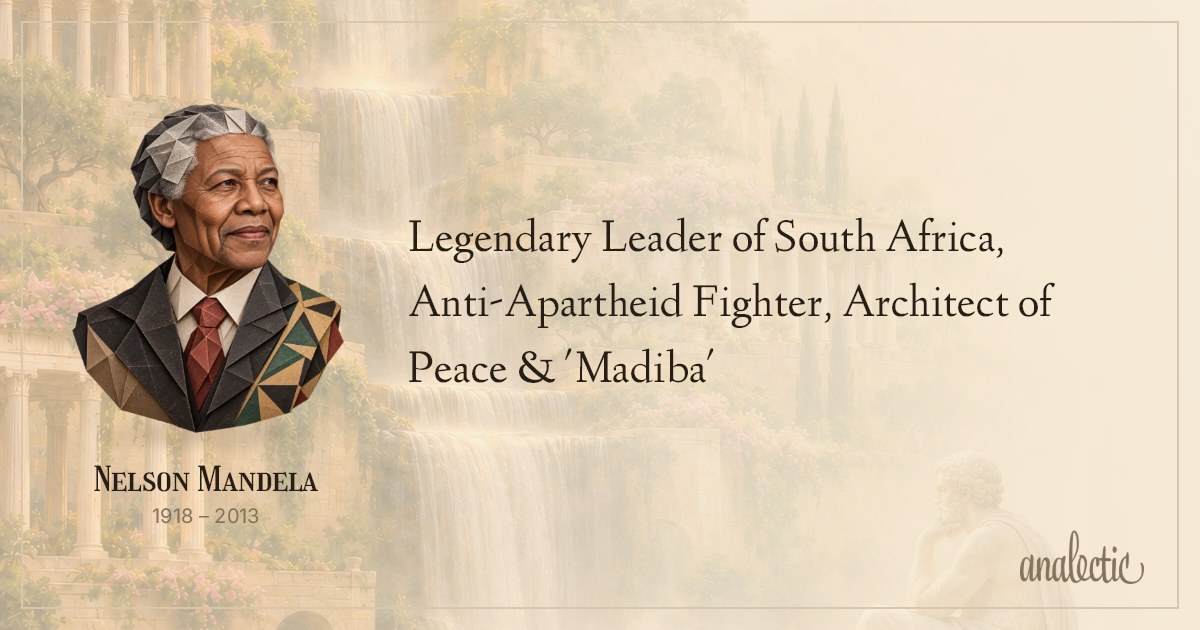
Nelson Mandela
Legendary Leader of South Africa, Anti-Apartheid Fighter, Architect of Peace & 'Madiba' (1918 – 2013)
Nelson Mandela (born Nelson Rolihlahla Mandela, clan name Madiba, 1918 – 2013) was the monumental leader of the anti-apartheid struggle in South Africa, a global beacon of reconciliation and moral courage, and the country's first democratically elected black president. Born in the village of Mvezo into the Thembu royal dynasty, Mandela studied law at Fort Hare and the University of the Witwatersrand, co-founding the African National Congress (ANC) Youth League in 1944. As the apartheid regime codified brutal racial subjugation, Mandela spearheaded nonviolent defiance campaigns before co-founding the ANC's armed wing, Umkhonto we Sizwe ("Spear of the Nation"), following the 1960 Sharpeville Massacre. Captured in 1962 and tried for treason at the historic Rivonia Trial (1963–1964), he delivered his immortal dock speech, concluding: "I have cherished the ideal of a democratic and free society in which all persons live together in harmony and with equal opportunities. It is an ideal which I hope to live for and to achieve. But if needs be, it is an ideal for which I am prepared to die."
Sentenced to life imprisonment, Mandela spent twenty-seven grueling years behind bars—eighteen of them in the unforgiving lime quarries of Robben Island, and later at Pollsmoor and Victor Verster prisons. Far from breaking his spirit, captivity forged his towering resolve, transforming the prison into a crucible of political philosophy and self-mastery. Resolutely rejecting conditional release offers that would compromise his people's freedom, he became the living conscience of the world. Amid mounting internal rebellion and international economic embargoes, President F.W. de Klerk unbanned the ANC and released Mandela on February 11, 1990. Steering the nation away from catastrophic civil war through razor-sharp diplomacy and profound empathy, Mandela shared the 1993 Nobel Peace Prize with de Klerk, and on April 27, 1994, triumphed in South Africa's first fully multiracial democratic elections.
As president, Mandela renounced retribution in favor of the humanistic African ethos of Ubuntu ("I am because we are"). He established the Truth and Reconciliation Commission under Archbishop Desmond Tutu to heal historic wounds, and famously donned the Springbok jersey at the 1995 Rugby World Cup, uniting black and white citizens under a shared national pride and christening the "Rainbow Nation." Honoring constitutionalism, he stepped down after a single presidential term in 1999, dedicating his remaining years through The Elders to human rights, HIV/AIDS eradication, and universal education before passing away in 2013 at age 95. Nelson Mandela endures across generations as an immortal testament to the triumph of dignity over oppression, the transformative power of forgiveness, and the unyielding sanctity of human freedom.
Nelson Mandela: quotes
- “Courage is not the absence of fear, but the triumph over it. The brave man is not he who does not feel afraid, but he who conquers that fear.”
- “Education is the most powerful weapon which you can use to change the world.”
- “It always seems impossible until it's done.”
- “I learned that courage was not the absence of fear, but the triumph over it. The brave man is not he who does not feel afraid, but he who conquers that fear.”
- “For to be free is not merely to cast off one's chains, but to live in a way that respects and enhances the freedom of others.”
- “Do not judge me by my successes, judge me by how many times I fell down and got back up again.”
- “As I walked out the door toward the gate that would lead to my freedom, I knew if I didn't leave my bitterness and hatred behind, I'd still be in prison.”
- “I have cherished the ideal of a democratic and free society in which all persons live together in harmony and with equal opportunities. It is an ideal which I hope to live for and to achieve. But if needs be, it is an ideal for which I am prepared to die.”
- “No one is born hating another person because of the color of his skin, or his background, or his religion. People must learn to hate, and if they can learn to hate, they can be taught to love, for love comes more naturally to the human heart than its opposite.”
- “After climbing a great hill, one only finds that there are many more hills to climb.”
- “A good head and a good heart are always a formidable combination.”
- “Compromise is not a surrender or a sign of weakness; it is the only path to building peace, provided one does not sacrifice fundamental principles.”
- “A leader is like a shepherd. He stays behind the flock, letting the most nimble go out ahead, whereupon the others follow, not realizing all along they are being directed from behind.”
- “Overcoming poverty is not a gesture of charity, it is an act of justice. Like slavery and apartheid, poverty is not natural; it is man-made and it can be overcome and eradicated by the actions of human beings.”
- “Part of being optimistic is keeping one's head pointed toward the sun, one's feet moving forward.”
- “If you talk to a man in a language he understands, that goes to his head. If you talk to him in his language, that goes to his heart.”
- “Difficulties break some men but make others. No axe is sharp enough to cut the soul of a sinner who keeps on trying, one armed with the hope that he will rise even in the end.”
- “There is no passion to be found playing small—in settling for a life that is less than the one you are capable of living.”
- “If you want to make peace with your enemy, you have to work with your enemy. Then he becomes your partner.”
- “I am not a saint, unless you think of a saint as a sinner who keeps on trying.”
- “There is no easy walk to freedom anywhere, and many of us will have to pass through the valley of the shadow of death again and again before we reach the mountaintop of our desires.”
- “A nation should not be judged by how it treats its highest citizens, but its lowest ones.”
- “We must use time wisely and forever realize that the time is always ripe to do right.”
- “Real leaders must be ready to sacrifice all for the freedom of their people.”
- “It is what we make out of what we have, not what we are given, that separates one person from another.”
View on Analectic →