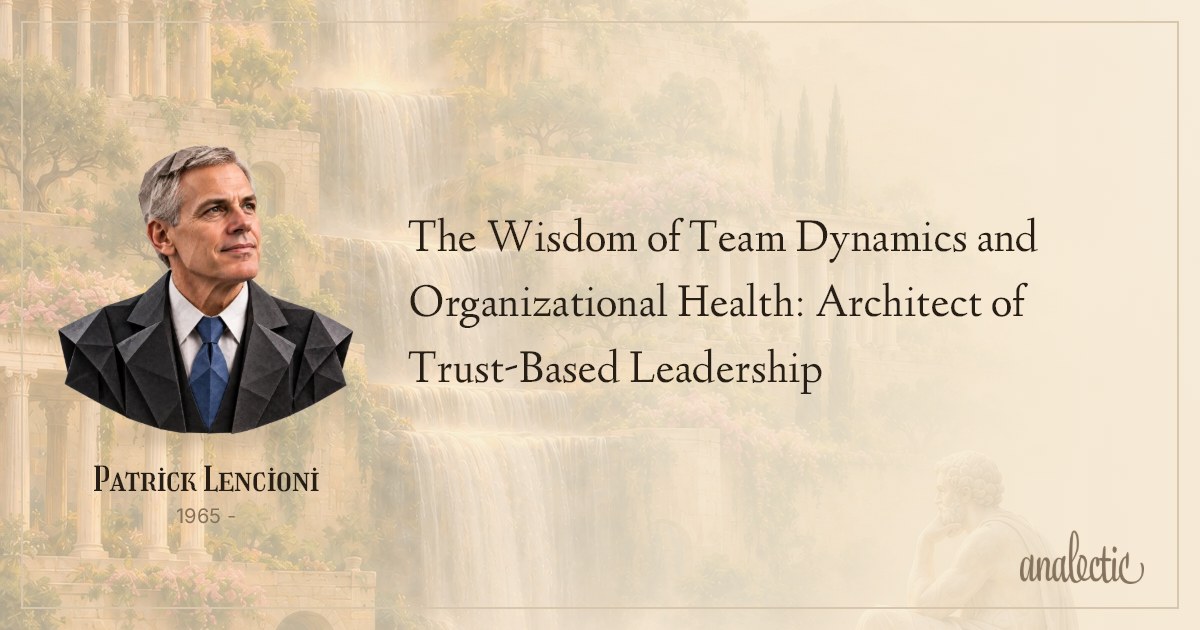
Patrick Lencioni
The Wisdom of Team Dynamics and Organizational Health: Architect of Trust-Based Leadership (1965 -)
Born in California in 1965, Patrick Lencioni is not merely a management consultant but a philosopher who reads the soul of organizations. Through founding The Table Group, he has reshaped the inner dynamics of thousands of institutions—from Fortune 500 corporations to nonprofit organizations and schools. Lencioni is one of the rare thinkers who transforms complex psychological and social realities into vivid, flowing fictional narratives. Rather than treating management as a set of technical principles, he works through human stories, leaving enduring impressions not in the mind but in the heart. For him, leadership is not a technical skill but an existential choice: to choose trust, to embrace vulnerability, and to be wounded together.His book, 'The Five Dysfunctions of a Team,' which has become a cult classic in the business world, reveals the roots of team failure on a hierarchical pyramid: Absence of Trust, Fear of Conflict, Lack of Commitment, Avoidance of Accountability, and Inattention to Results. Lencioni sees in all five dysfunctions the absence of 'Trust Based on Vulnerability.' A team becomes truly unified the moment its members can openly share their flaws, fears, and weaknesses. Conflict is not a threat but the direct consequence of transparency; accountability is not punishment but the natural fruit of trust. This pyramid reminds us that leadership’s power rests not on strength but on human frailty—and it is precisely this frailty that is the source of the strongest bonds.In 'The Advantage,' Lencioni argues that organizational health is a far greater competitive advantage than strategy, finance, or technology. The true advantage lies in an organization’s internal integrity: people trust one another, speak openly, and produce results together. To cultivate this integrity, he introduces the concept of the 'Ideal Team Player': Humble, Hungry, and Smart. These three virtues dissolve career-driven politics, ego wars, and individualism. Lencioni’s legacy is not the accumulation of leadership power but the enrichment of humanity: A team moves not by what a leader says, but by who they are. He reminds us—leadership is not about influencing, but about being together.
Patrick Lencioni: quotes
- “A team cannot do anything without trust; because trust is what allows for the courage to engage in conflict.”
- “Effective leadership begins with acknowledging your own weaknesses; because only then can you give others the gift of trust.”
- “A team’s commitment is not when everyone agrees, but when they commit even if they don’t fully understand the decision.”
- “Accountability arises where team members refuse to let each other off the hook; because respect is built on trust, not fear.”
- “Results matter only when the team is focused on a common goal; individual achievements are the enemy of collective success.”
- “A leader should strive to elevate the weakest member, not just the strongest; because a chain is only as strong as its weakest link.”
- “Organizational health is measured not by strategy or technology, but by the cleanliness of human relationships.”
- “The ideal team player puts the team’s interests ahead of their own; because ego is the poison of collaboration.”
- “A small, humble person is the heart of a great team; because they are not there to lead, but to move forward together.”
- “A leader’s greatest mistake is mistaking silence for agreement; silence often means disagreement.”
- “A good team doesn’t fear conflict; because conflict increases the quality of decisions, it doesn’t weaken them.”
- “A leader must tell the team not what to do, but why to do it; because purpose breeds discipline.”
- “An organization’s health depends on its ability to confront its own internal conflicts openly.”
- “Humility is the most powerful weapon of leadership; because those who possess it seek to elevate others.”
- “Hunger is more valuable than talent; because if someone wants to do something, they will find a way to do it.”
- “A team’s success comes not from how strong the leader is, but from how much the team trusts one another.”
- “Taking an emotional risk is the hardest yet most essential part of leadership; because trust is born only through vulnerability.”
- “A team cannot achieve true unity until it acknowledges its failures.”
- “Trust is the greatest fear of a weak leader; yet it is the greatest weapon of a strong one.”
- “Conflict is the healthiest behavior in a team, because it means they're confronting reality.”
- “A team cannot reach its goals if it doesn't commit to decisions, because indecision is the death of purpose.”
- “Accountability is a reflection of mutual respect among team members—not a leader’s power to punish.”
- “Results are the only true metric for a team, because all efforts are measured by outcomes.”
- “An ideal team player puts the team’s success ahead of their own ego.”
- “Being hungry isn’t just about working hard—it’s about seeing every moment as an opportunity.”
- “Humility is the most powerful force in leadership, because those who see it trust it.”
- “Smartness isn’t just about intellect—it’s about being able to connect with people.”
- “Organizational health is the only thing more important than strategy, finance, or technology.”
- “A leader’s job is to free team members from their inner fears—not to control them.”
- “Hidden conflict is the most poisonous habit in a team, because it’s an escape from reality.”
View on Analectic →