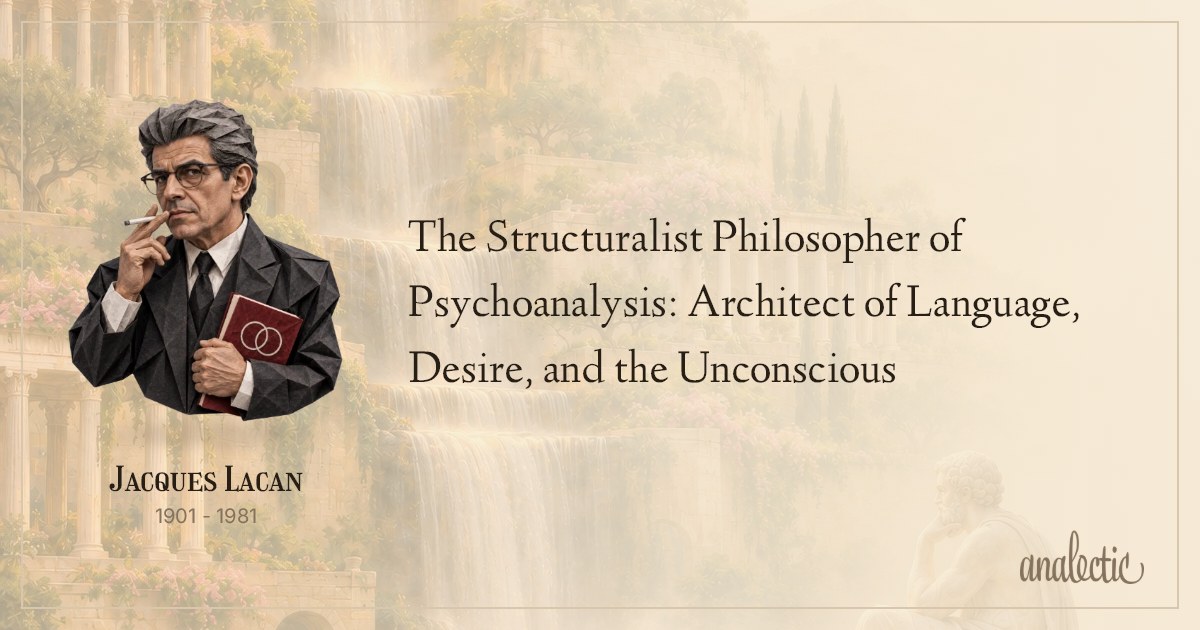
Jacques Lacan
The Structuralist Philosopher of Psychoanalysis: Architect of Language, Desire, and the Unconscious (1901 - 1981)
Born in Paris in 1901, Jacques Lacan completed his medical training in psychiatry, specializing in paranoid psychoses. In the 1930s, during the zenith of Surrealism, his intellectual dialogues with figures such as Salvador Dalí and André Breton nourished his radical theories of the unconscious. At the 1936 Marienbad Congress, his theory of the 'Mirror Stage' shattered conventional notions of human development: he described the infant’s perception of its reflection in the mirror as a 'foundational illusion'—the ego constructed upon a foreignated semblance of wholeness. This theory proclaimed that the human subject is condemned to an endless struggle with its own fragmented identity.Lacan, by synthesizing Freud’s psychoanalytic legacy with structuralist linguistics and philosophy, launched the movement 'Back to Freud,' redefining the discipline through aphorisms such as 'The unconscious is structured like a language' and 'Desire is the desire of the Other.' His triadic topology of the Real, the Symbolic, and the Imaginary imprisoned human existence within the boundaries of language; his defiance of the International Psychoanalytical Association and the founding of the École Freudienne de Paris unleashed an intellectual earthquake that would shake 20th-century thought from Derrida to Žižek. For Lacan, the human being was a nothingness caught between the laws imposed by the Symbolic Order and the desire of the Other.Through the theatricality of his seminars and the poetic complexity of his magnum opus, Écrits, Lacan transformed psychoanalysis from a clinical practice into an existential philosophy. This rebellious genius, who defined love as 'giving what you do not have to someone who does not want it,' interrogated the human condition until his death in 1981—trapping it within the labyrinths of language, the abyss of desire, and the dark theater of the unconscious. Today, Lacan endures as an indispensable guide to deciphering modern identity crises, capitalism’s mechanisms of desire production, and the ontological traps of language: an anti-philosopher who embraces the fractured subject.
Jacques Lacan: quotes
- “To love is to give to someone who does not want it, something that you do not have.”
- “Desire is always the desire of the Other. Man desires not merely an object, but its place and value in the gaze of the Other.”
- “The unconscious is structured like a language; our symptoms are the letters our unspeakable words find in our bodies.”
- “I am responsible for what I say; but you are responsible for what you understand. Communication is always a successful misunderstanding.”
- “Man desires only because he is lacking; desire vanishes the moment lack is filled.”
- “The ego you see in the mirror is not your true being; it is a foreignized illusion constructed by the mind to pacify itself.”
- “To renounce one's true desire is the only real crime one can commit against oneself.”
- “The real is a hole within the symbolic; a raw existence that language and reason can never fully enclose.”
- “Pain is the most violent knocking at the door by which the repressed truth seeks to emerge.”
- “I am where I do not think, I think where I am not.”
- “Words are not merely instruments of communication; they are the existential cages that constitute, shape, and imprison us.”
- “The way to be freed from an illusion is not to destroy it, but to accept the true void that lies behind it.”
- “What we desire is not the object itself, but the unattainable infinite pursuit it leaves behind.”
- “To confront the truth requires courage; for truth often levels all the castles erected by the ego.”
- “To know oneself is the discipline of escaping the slavery of desire and unraveling the structures within the labyrinth of the unconscious.”
- “The subject is what one signifier represents for another signifier; we are lost wanderers within our own discourse.”
- “Anxiety is fear without an object; it is the vertigo caused by the object of our desire approaching us more closely than we can bear.”
- “Inner peace is that silent moment when the ego relinquishes its entire obsession with control and attains peace with its own lack.”
- “Man speaks not merely because he does not know what he is, but because he fears to know what he is.”
- “To listen is the art of hearing not only the words spoken, but also the silences between them and the slips of the tongue.”
- “One who cannot confront their own shadow remains merely a figure in the light of others.”
- “Love is the courage to sanctify the lack of one another and to share together a void.”
- “The discipline of thought consists not in taking refuge in the comfort of established concepts, but in descending to the origin of every word.”
- “Moments of crisis are the labor pains during which the subject's false identities shatter and the authentic subject emerges.”
- “A 'self' cannot be constructed without the Other; yet as long as it remains dependent on the Other’s validation, it can never be freed.”
- “Silence is the most noisy and most honest form of speech of the unconscious.”
- “The mind is a vortex revolving around the thoughts it avoids; the storm does not cease until it dares to look directly at them.”
- “To reject the roles imposed upon you by society and to embrace your own existential lack is the most radical form of revolt.”
- “To understand a human being is to discover upon which illusions he has sustained his life.”
- “Freedom is the maturity to map one's unconscious and assume responsibility for one's destiny.”
View on Analectic →