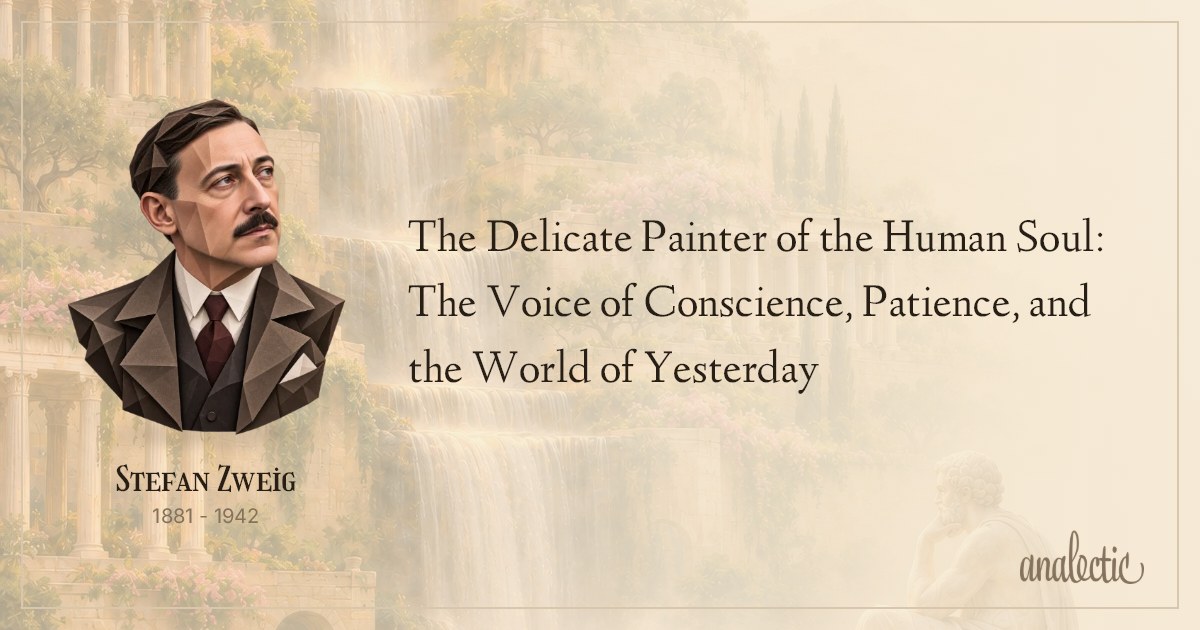
Stefan Zweig
The Delicate Painter of the Human Soul: The Voice of Conscience, Patience, and the World of Yesterday (1881 - 1942)
Stefan Zweig, born in 1881 during Vienna’s golden age—the cultural mosaic of Europe—was a humanist who flourished in the multilingual, multi-identity atmosphere of the Habsburg Empire. Raised in a Jewish bourgeois family, his youth was shaped by an insatiable intellectual curiosity, nourished by the writings of Goethe and Nietzsche. With an aesthetic sensitivity spanning from Freud’s psychoanalysis to Mahler’s symphonies, he reinterpreted pivotal moments in history as 'The Moments When Humanity’s Stars Shone.' In every line, he wove a thread-by-thread faith in humanity’s collective memory; even amid the shadows of war, he regarded the defense of peace as an intellectual duty.Zweig wrote with the meticulousness of a psychologist wandering the labyrinths of the human soul. In 'Chess,' he symbolized the mental occupation of fascism on a chessboard; in 'Letter from an Unknown Woman,' he confined the silent tragedy of passion within the narrow confines of a single letter. In 'The Impatient Heart,' he explored the struggle of conscience against hypocrisy, questioning the two faces of mercy. In 'Against the Tyranny of Conscience,' where he depicted the anguish of intellectual freedom in Calvin’s world, he defiantly proclaimed, 'Ideas can never be killed,' challenging totalitarian regimes. For him, mercy was not an act that elevated humanity, but one that transformed it: not a sign of weakness, but an expression of creative courage.When Nazism’s rise forced him into voluntary exile in 1934, he carried Europe’s soul with him. His journey—from London to New York, to the hills of Petrópolis in Brazil—became a personal cry over the collapse of a civilization. In 'The World of Yesterday,' as he bid farewell to the memory born from the ashes of the Habsburg Empire, he mourned the innocence humanity had lost. On February 22, 1942, when he took his own life hand in hand with his wife Lotte, the letter he left behind still emphasized his 'unshakable faith in humanity.' Even in death, this writer transformed into a humanist manifesto; he was etched into literary history as 'the voice of conscience,' the torch he lit in the dark corridors of the soul.
Stefan Zweig: quotes
- “There are two kinds of pity: the weak and sentimental kind, which is only an impatience of the heart to be rid of pain; and the creative kind, which knows what it wants and is determined to hold out patiently to the very end.”
- “No power on earth can destroy an idea whose time has come, nor can tyranny permanently extinguish the light of human conscience.”
- “A single decisive moment, a single second, can determine the fate of an individual, a nation, and centuries of human history.”
- “Passion is the only force that can elevate an ordinary mortal into a creator of enduring beauty.”
- “Only the person who has experienced both light and darkness, both triumph and disaster, has truly lived.”
- “Books are the ultimate sanctuary where the wounded soul finds quiet refuge and timeless companions.”
- “To think independently and speak the truth in an era of fanatical madness is the greatest courage of all.”
- “True mastery requires the patient discipline of chipping away all superfluous vanity until only the core remains.”
- “The world belongs not to those who conquer with force, but to those who enrich the human spirit through understanding.”
- “When everything around you is shattered, preserve the sacred flame of your inner values intact.”
- “To lose oneself completely in a task is the secret of all great accomplishments.”
- “Inner peace is found when we cease demanding from others what only our own soul can provide.”
- “Never bow down to the idols of your time; human dignity is superior to all dogmas.”
- “Inspiration is a fleeting spark; only relentless, daily labor can fan it into an eternal flame.”
- “Sorrow deepens the vessel of the heart so that it may hold a greater measure of wisdom.”
- “Observe the subtle nuances of human nature; in the smallest gesture lies the confession of a soul.”
- “Solitude cleanses the spirit of the noise of the world, restoring our true inner compass.”
- “Memories are the only paradise from which we cannot be driven out.”
- “It is easy to follow the crowd; the true test of spirit is to walk alone upon the path of integrity.”
- “Even in exile and defeat, the mind remains a free kingdom that no tyrant can subjugate.”
- “Simplicity of style is the hardest victory to achieve; it demands the sacrifice of all empty ornaments.”
- “Give your whole heart to the present hour; tomorrow is born out of the depth of today.”
- “A gentle heart and a clear mind can weather the fiercest storms of history without losing grace.”
- “We must preserve our faith in humanity, for the dark night of barbarism is always followed by a new dawn of reason.”
View on Analectic →