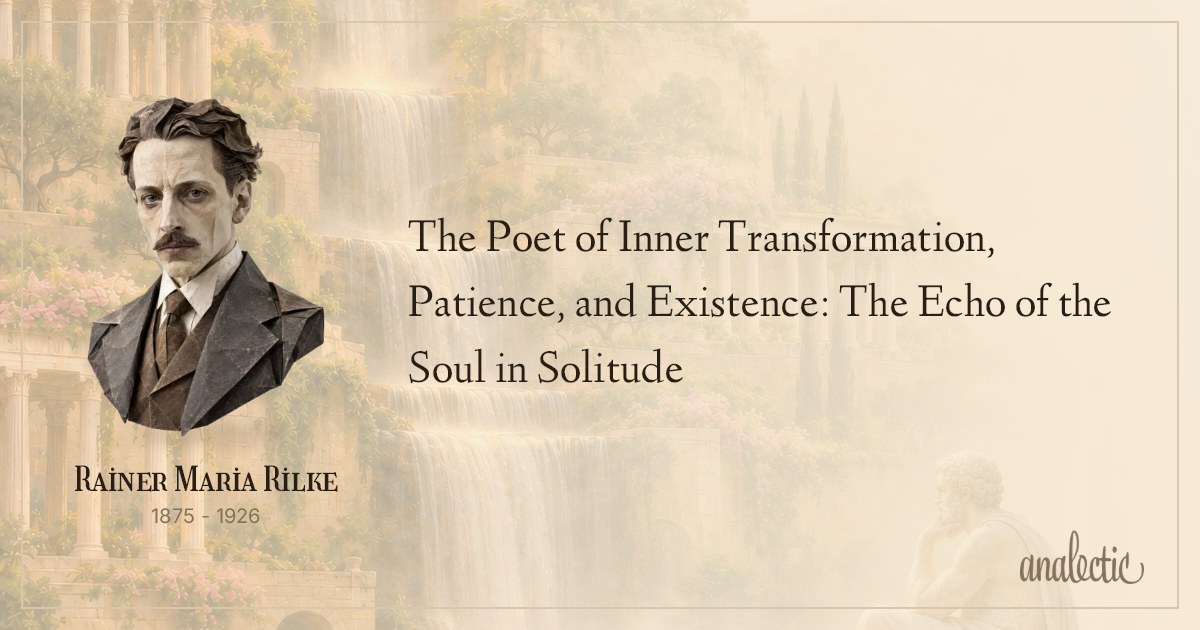
Rainer Maria Rilke
The Poet of Inner Transformation, Patience, and Existence: The Echo of the Soul in Solitude (1875 - 1926)
Born in Prague in 1875, Rainer Maria Rilke spent his childhood under the iron discipline of a military academy. He found escape from this rigid world in the fragile yet liberating sanctuary of poetry. During his years immersed in the artistic circles of Munich and Berlin, his encounter with Nietzsche’s muse, Lou Andreas-Salomé, ignited a revolution within his soul. Their journey to Russia allowed him to experience a mystical awakening beneath the golden domes of churches on Tolstoy’s soil. Settling in Paris, while apprenticing in Auguste Rodin’s studio, he learned to listen to the silent language of things: in his Dinggedichte (Object Poems), he captured the vibrations of the universe even in the petals of a rose, transmuting the art of patience into verse.In 'Letters to a Young Poet,' he became perhaps the most tender guide in literary history. Whispering, 'Be patient toward all that is unsolved in your heart,' he elevated existential anguish into a process of purification. In 'The Book of Hours,' he sought God within the inner quest of the human spirit; in 'Notes on the Malte Laurids Brigge,' he shaped the loneliness of the modern individual like the Gothic arches of a cathedral. For him, solitude was the deepest dialogue of the soul: 'We must love the questions themselves,' he declared, sanctifying uncertainty as a grace.The 'Duino Elegies,' born of a storm of inspiration at Duino Castle, reached their completion in a modest chateau in Switzerland, becoming an epic that transforms humanity into a hero before cosmic despair. The 'Sonnets to Orpheus' were a lyrical triumph, dancing with death. Rilke, who wrote, 'Beauty is the beginning of terror we cannot bear,' departed prematurely in 1926 from leukemia, yet his poems still carry a wisdom that trembles the soul at the threshold of the infinite. The poet of patience, the bard of solitude, remains, like a polar star, a guiding light for the lost spirits of the modern world.
Rainer Maria Rilke: quotes
- “Be patient toward all that is unsolved in your heart and try to love the questions themselves. Live the questions now; perhaps you will gradually live into the answer.”
- “Let everything happen to you: beauty and terror. Just keep going. No feeling is final.”
- “Your solitude will be a support and a home for you, even in the midst of very unfamiliar circumstances; and from it you will find all your paths.”
- “Perhaps all the dragons in our lives are princesses who are only waiting to see us act, just once, with beauty and courage.”
- “For beauty is nothing but the beginning of terror, which we are barely able to endure, and it amazes us so because it serenely disdains to destroy us.”
- “The only sadnesses that are dangerous and unhealthy are the ones that we carry about in public in order to drown them out.”
- “Go into yourself. Find out the reason that commands you to create; see whether it has spread its roots into the very depth of your heart.”
- “Works of art are of an infinite loneliness and with nothing to be so little reached as with criticism. Only love can grasp them and hold them.”
- “For one human being to love another human being: that is perhaps the most difficult of all our tasks; the ultimate, the last test and proof.”
- “Do not believe that he who seeks to comfort you lives untroubled among the simple and quiet words that sometimes do you good. His life may contain much sorrow.”
- “If your everyday life seems poor, don't blame it; blame yourself; admit to yourself that you are not enough of a poet to call forth its riches.”
- “You must change your life. Do not stay in the comfortable room of yesterday.”
- “Silence is the great teacher of the heart; in its stillness, the unspoken truths of being unfold.”
- “Patience is everything. In art as in life, one must not count, but ripen like the tree which does not force its sap.”
- “The future enters into us, in order to transform itself in us, long before it happens.”
- “Winning does not tempt that man. This is his growth: to be the deeply defeated by greater and greater things.”
- “Look at things as if you were seeing them for the very first time; in that gaze lies the pure essence of mastery.”
- “Do not be afraid of the unknown that surrounds you; trust the ground beneath your feet and step forward.”
- “Make your peace with the dark, for the stars only shine when the night embraces the earth.”
- “To write a single good line, one must have seen many cities, people, and things; one must know the quiet ritual of enduring labor.”
- “We are the bees of the invisible. We wildly collect the honey of the visible to store it in the great golden hive of the unseen.”
- “Do not run from your grief. It is the chisel that carves deeper capacity for joy in your soul.”
- “Everything is gestation and then bringing forth. Allow every impression and each germ of a feeling to mature completely in the dark.”
- “How should we be able to forget those ancient myths that are at the beginning of all peoples? Dare to live your own myth.”
- “Death is the side of life that is turned away from us, unilluminated by our mortal eyes, yet completing the eternal sphere.”
View on Analectic →