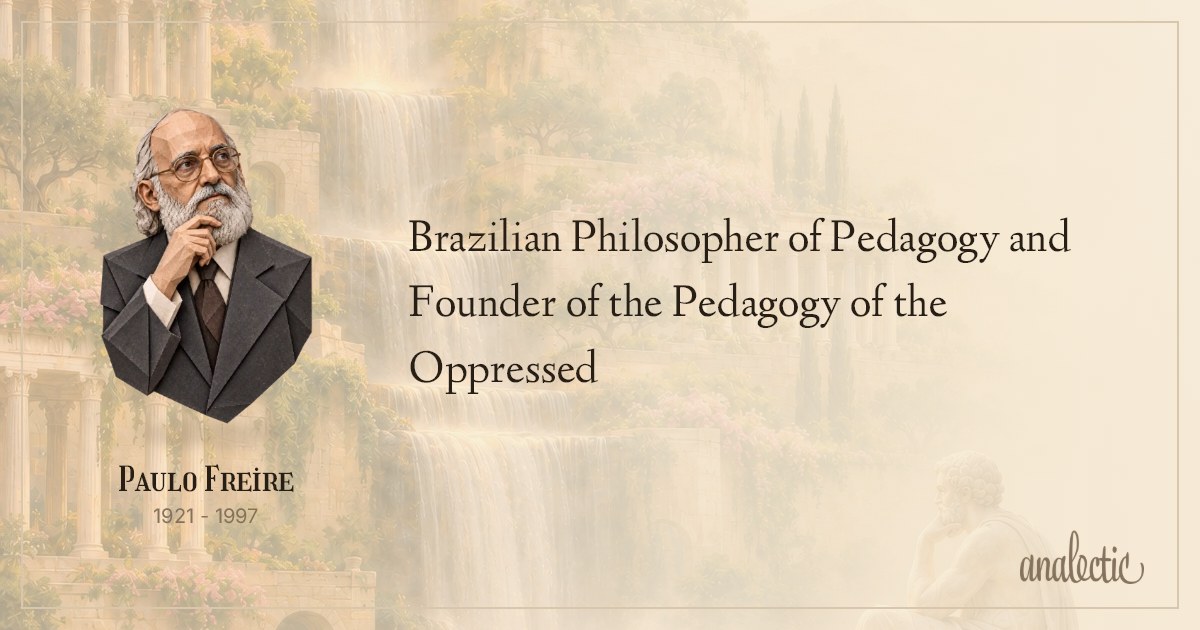
Paulo Freire
Brazilian Philosopher of Pedagogy and Founder of the Pedagogy of the Oppressed (1921 - 1997)
Paulo Reglus Neves Freire was born on September 19, 1921, in Recife, Brazil, into a middle-class family. The Great Depression of 1929 plunged his family into financial hardship, leading him to an early acquaintance with poverty and social injustice. Although he studied law, his true interests lay in linguistics and philosophy, with particular readings in existentialism and phenomenology. In the late 1940s, while working for the Pernambuco State Industrial Social Service (SESI) and later at the University of Recife, he began to gain attention for his innovative methods in adult literacy. During this period, he formulated his critique of the traditional 'banking model' of education, which he saw as viewing the student as a passive receptacle of knowledge and reinforcing existing social hierarchies.The cornerstone of Freire's thought is crystallized in his 1968 masterpiece, 'Pedagogy of the Oppressed' (Pedagogia do Oprimido). In this work, he defines education not as a neutral technical process but as a profoundly political praxis that must be either liberatory or oppressive. For him, true liberation is possible only when the oppressed can read the world with a critical consciousness (conscientização) and engage in transformative action (praxis). This process must be built upon ethical qualities such as dialogue, love, humility, and hope. Freire translated this theoretical framework into practice with his famous literacy methodology applied in Angicos, which made 300 workers literate in 45 days, but following the 1964 military coup, he was arrested and sent into exile for 'subversive' activities.Paulo Freire's legacy is that of becoming the founding father of the critical pedagogy movement worldwide by radically questioning traditional conceptions of education. His ideas have exerted a profound influence across a broad spectrum, from liberation theology in Latin America and post-colonial struggles in Africa to social justice education movements in North America and Europe. 'Pedagogy of the Oppressed' continues to be a fundamental reference text in fields such as educational sciences, development studies, communication, and even medical ethics. Freire, who died in São Paulo on May 2, 1997, remained committed to democratic citizenship education until the end of his life as the chief advisor to Brazil's 'Citizenship School' project, and he instilled in countless educators worldwide the belief that 'education is a practice of hope.'
Paulo Freire: quotes
- “At the point of encounter, there are neither utter ignoramuses nor perfect sages; there are only people who are attempting, together, to learn more than they now know.”
- “The person who begins to understand, explain, qualify, and quantify love is no longer loving.”
- “People are not built in silence, but in word, in work, in action-reflection.”
- “No one educates anyone else, no one educates themselves, people educate each other through the world.”
- “Our confirmation lies not in submission, but in rebellion against injustices.”
- “One of the school's greatest sins is to disregard everything the child brings to it. The school decrees that nothing existed before it.”
- “The alienated being does not seek an authentic world. This leads to a nostalgia: it desires another country and laments having been born in its own. It is ashamed of its own reality. It lives in another country, tries to imitate it, and believes that the less native it is, the more cultured it becomes.”
- “When human beings apprehend their reality, they can develop hypotheses about the challenge it poses and seek solutions. Thus they can transform it and, through their labor, create a world of their own, their own Self and their conditions.”
- “As a historical being, human beings are in a constant movement of search, incessantly making and remaking their knowledge.”
- “We all know something. We all are ignorant of something. That is why we are always learning.”
- “"No one knows everything, no one knows nothing."”
- “The school will become progressively better to the extent that each individual treats themselves as a comrade, a friend, a sibling.”
- “What is important in school is not only studying lessons, but also establishing bonds of friendship and coexistence.”
- “To create what does not yet exist must be the claim of every living subject.”
- “"What is my neutrality but, perhaps a comfortable, but hypocritical way, of hiding my choice or of fearing to denounce injustice? To 'wash one's hands' in the face of oppression is to reinforce the power of the oppressor, it is to choose their side."”
- “Reading the world precedes reading the word, and therefore the subsequent reading of the word cannot dispense with the continuity of reading the world.”
- “One of the most pitiful things for a human being is not to belong to their own time. And thus, to feel exiled within time.”
- “Revolution is life-affirming, it is life-creating; to create it, even if it must put an end to lives that forbid life.”
- “There is no more knowledge or less knowledge. There are different knowledges.”
- “In a country like Brazil, keeping hope alive is in itself a revolutionary act.”
- “I discovered that illiteracy is a prohibition imposed by the organized society upon the popular classes, a castration of men and women.”
- “Education was once considered magic, it could do everything; it was also once considered negative, it could do nothing. We have arrived at humility: it is not the key to the transformation of society.”
View on Analectic →