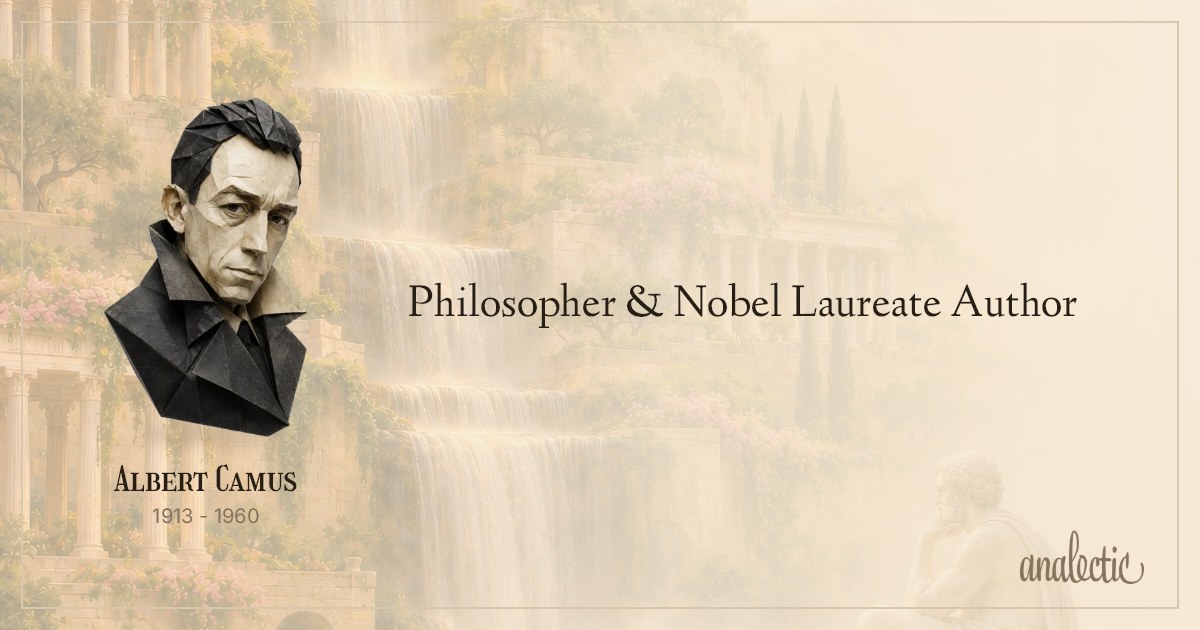
Albert Camus
Philosopher & Nobel Laureate Author (1913 - 1960)
Albert Camus (1913–1960) was a French author, philosopher, journalist, and Nobel laureate in Literature, widely regarded as one of the most profound figures of 20th-century thought and letters. Born in an impoverished district of Algeria and shaped by the luminous clarity of the Mediterranean, Camus established the philosophy of 'Absurdism,' which defines the inherent conflict between the human mind's longing for meaning and order and the absolute silence and indifference of the universe. Blending this philosophical inquiry with monumental literary prose in masterpieces such as 'The Stranger' (L'Étranger), 'The Myth of Sisyphus,' 'The Plague,' and 'The Fall,' he examined modern alienation, moral dilemmas, and existential crises with unmatched mastery.Awarded the Nobel Prize in Literature in 1957 at the age of just 44, Camus elevated human dignity, freedom, and the pursuit of justice above all totalitarian ideologies and violence. A prominent voice in the French Resistance against Nazi occupation during World War II, he argued that in a meaningless and absurd universe, humanity must neither surrender to despair nor seek refuge in suicide or false dogmas, but rather forge meaning through revolt, solidarity, and an unyielding passion for life. Although his life was tragically cut short by a car accident in 1960, his legacy dedicated to the human spirit's quest for liberty and integrity remains an enduring universal guide.
Albert Camus: quotes
- “In the depth of winter I finally learned that there was in me an invincible summer.”
- “Blessed are the hearts that can bend; they shall never be broken.”
- “The myth of unlimited production brings war in its train as inevitably as clouds announce a storm.”
- “Nobody realizes that some people expend tremendous energy merely to be normal.”
- “Autumn is a second spring when every leaf is a flower.”
- “Beauty is unbearable, drives us to despair, offering us for a minute the glimpse of an eternity that we should like to stretch out over the whole of time.”
- “There is but one truly serious philosophical problem, and that is suicide.”
- “There is no love of life without despair of life.”
- “The evil that is in the world almost always comes of ignorance, and good intentions may do as much harm as malevolence if they lack understanding.”
- “Man is the only creature that refuses to be what he is.”
- “The need to be right is the sign of a vulgar mind.”
- “Your successes and happiness are forgiven you only if you generously consent to share them.”
- “Lying is not only saying what isn't true. It is also, in fact especially, saying more than is true and, in the case of the human heart, saying more than one feels. We all do it, every day, to make life simpler.”
- “For if there is a sin against life, it consists perhaps not so much in despairing of life as in hoping for another life and in eluding the implacable grandeur of this life.”
- “Alas, after a certain age every man is responsible for his face.”
- “Retaliation is related to nature and instinct, not to law. Law, by definition, cannot obey the same rules as nature.”
- “To be happy we must not be too concerned with others.”
- “Integrity has no need of rules.”
- “All great deeds and all great thoughts have a ridiculous beginning. Great works are often born on a street corner or in a restaurant's revolving door.”
- “Real generosity toward the future lies in giving all to the present.”
- “We used to wonder where war lived, what it was that made it so vile. And now we realize that we know where it lives... inside ourselves.”
- “Martyrs, my friend, have to choose between being forgotten, mocked or used. As for being understood - never.”
- “The society based on production is only productive, not creative.”
- “The only way to deal with an unfree world is to become so absolutely free that your very existence is an act of rebellion.”
- “A man without ethics is a wild beast loosed upon this world.”
- “Nothing is more despicable than respect based on fear.”
- “By definition, a government has no conscience. Sometimes it has a policy, but nothing more.”
- “But what is happiness except the simple harmony between a man and the life he leads?”
- “Basically, at the very bottom of life, which seduces us all, there is only absurdity, and more absurdity. And maybe that's what gives us our joy for living, because the only thing that can defeat absurdity is lucidity.”
- “The struggle itself towards the heights is enough to fill a man's heart. One must imagine Sisyphus happy.”
View on Analectic →