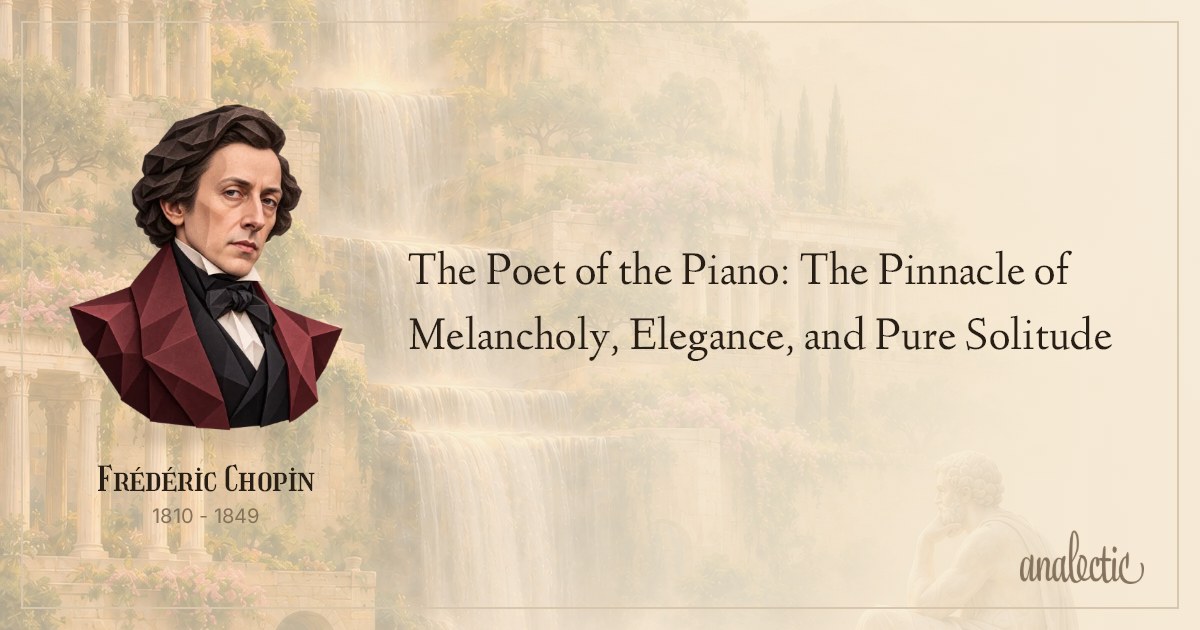
Frédéric Chopin
The Poet of the Piano: The Pinnacle of Melancholy, Elegance, and Pure Solitude (1810 - 1849)
Frédéric Chopin, born in 1810 in the Polish village of Żelazowa Wola, was hailed as 'Warsaw's Mozart' in childhood, his genius unfolding at the piano with uncanny grace. Yet the tragic fate of the 1830 Polish Uprising tore him from his homeland, hurling him into exile in Paris. Exile carved a wound in his soul that would never heal: for the rest of his life, he would never again set foot on Polish soil, burying his longing in the very notes of his music. This brilliant young virtuoso, radiant in Parisian salons, had left his heart forever in the melancholy blue of the Vistula River.Chopin transformed the piano from an instrument of spectacle into the very voice of the human soul: in his nocturnes, he whispered poems to the night; in his ballades, he unleashed epic passions; in his études, he turned technical complexity into lyrical miracles. His tempestuous love affair with George Sand infused his compositions with both inspiration and anguish. 'Purity is the highest state, attained only after all struggles are overcome,' he declared, subordinating virtuosity to the service of emotion. In his mazurkas, he united the rustic dances of Poland with aristocratic elegance; in his waltzes, he transfigured melancholy into a dance of fervent longing.Beneath the fragile shadow of tuberculosis, each breath a battle, Chopin breathed his last in Paris at the age of thirty-nine. As per his final wish, his heart was carried home to Warsaw and laid to rest in the Holy Cross Church. The 'eternal poet' of piano literature immortalized the most intimate tremors of the human spirit in his works: the silent revolution of sorrow, the fragility of passion, the resilience of grace... His notes are not mere music—they are poetry written in a mathematics that speaks not to the ear, but to the heart.
Frédéric Chopin: quotes
- “Simplicity is the final achievement. After one has played a vast quantity of notes and more notes, it is simplicity that emerges as the crowning reward of art.”
- “Time is the best censor, and patience a most excellent teacher.”
- “Bach is like an astronomer who defines the most wonderful stars. Beethoven embraces the whole universe. I only strive to express the soul and heart of man.”
- “Everything is nuance. Without nuance, music is just a series of mechanical sounds without life.”
- “I tell my piano the things I used to tell you; it understands my grief when words fail.”
- “Music has no fatherland; its homeland is the entire universe and every sensitive heart.”
- “Put all your soul into it, play the way you feel! Technique is only a vessel for emotion.”
- “It is useless to try to do anything without love and painstaking attention to detail.”
- “Sometimes I can only groan, and suffer, and pour out my despair at the piano.”
- “Listen carefully to the silence between the notes; that is where the true poetry breathes.”
- “To be truly original, an artist must dare to reveal their deepest vulnerabilities without fear.”
- “Art is the echo of the invisible realm reflecting in the fragile mirror of human emotion.”
- “A single pure note played with profound sincerity carries more truth than a thousand virtuosic displays.”
- “Do not practice blindly; let your mind guide every movement before the fingers touch the keys.”
- “Even in the deepest melancholy, the soul finds a bittersweet beauty that keeps it alive.”
- “Melody is the thought, harmony the body, but rhythm is the heartbeat of life itself.”
- “Never imitate anyone, even the greatest masters. Find your own voice, however quiet it may seem.”
- “Solitude is not emptiness; it is the sacred sanctuary where true inspiration is born.”
- “Touch the keys as if you were touching a living being, with tenderness and precision.”
- “The piano does not merely produce sound; it whispers the unspoken secrets of our mortality.”
- “When the world around you collapses, let your creative spirit remain unbroken.”
- “True freedom at the keyboard comes only after the strictest discipline of the fingers has been mastered.”
- “Express the passion of your people without compromise, even when exile keeps you far from home.”
- “Peace is found when the music within you aligns perfectly with the silence of the night.”
- “In the gentle fall of a teardrop or the cadence of a nocturne, infinity reveals itself.”
View on Analectic →