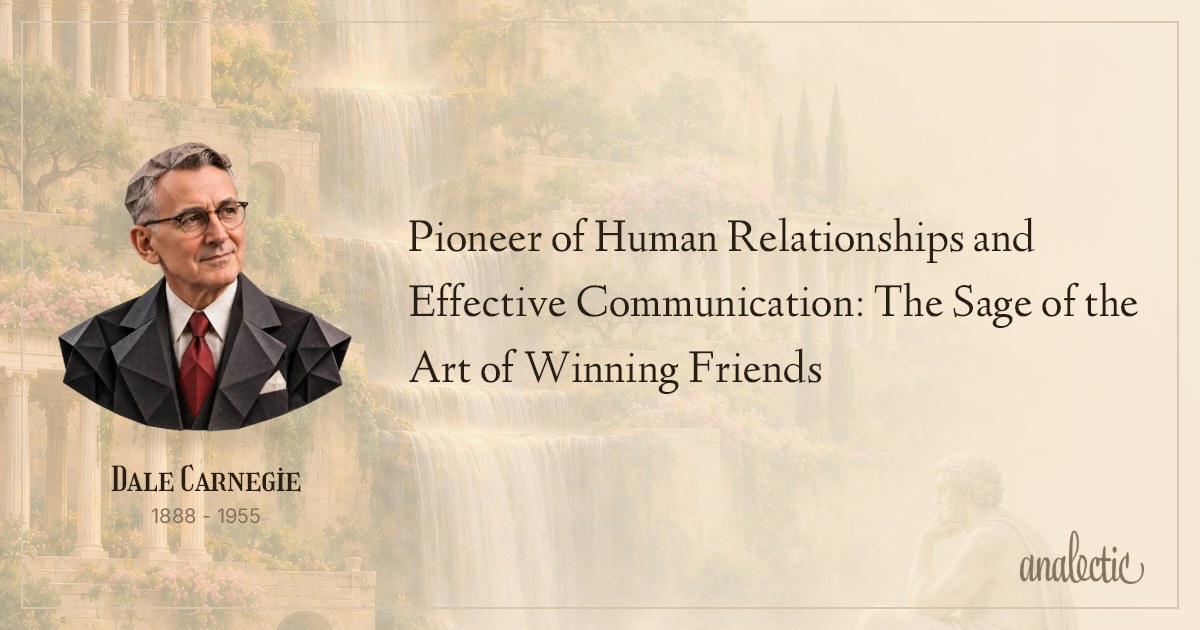
Dale Carnegie
Pioneer of Human Relationships and Effective Communication: The Sage of the Art of Winning Friends (1888 - 1955)
Born in 1888 on the rural farmlands of Missouri, Dale Carnegie was a farm boy who rose at dawn to milk cows—a boy shaped by hardship, yet forged by an unyielding resolve. In school, his gift for oratory drew attention; when he began teaching adult courses in public speaking and human relations at the YMCA, he was not merely instructing—he was crafting a philosophy. His lessons were not built on techniques, but on timeless human values: listening, showing understanding, and forging bonds with sincerity. These were the first veins of modern communication and leadership education—a journey from a quiet country boy to a master who understood the human heart.Published in 1936, How to Win Friends and Influence People was not merely a book, but a human revolution. Selling over thirty million copies, it replaced manipulation with empathy, persuasion with understanding. Carnegie declared, ‘A person’s own name is the sweetest and most important sound in any language,’ revealing that the most powerful weapon in communication is not strategy, but the heartbeat of genuine connection. He chose appreciation over criticism, understanding over concealment of faults. Every page was a bridge from one heart to another—and that bridge continues to transform the lives of millions today.As a sage not only of success but of peace, in his work How to Stop Worrying and Start Living, he traced the roots of anxiety to the human mind itself. Carnegie taught that the secret to sales and success lies not in tactics, but in entering another’s world with authentic interest. He reminded us: True influence arises not from what one says, but from what one makes another feel. His philosophy showed how a person who speaks from the heart can change the world. Dale Carnegie was not merely an author—he was a sage who spoke to humanity, and his words echo in the heart even in silence.
Dale Carnegie: quotes
- “People are interested in their own names; so to use a person's name in conversation is one of the most subtle and best ways to win their favor.”
- “If you want to win people over, see things from their point of view.”
- “Criticism is futile because it puts a person on the defensive and usually makes him strive to justify himself. Praise is the only way to change a person.”
- “People are more likely to accept an idea if they believe they discovered it themselves.”
- “It is not what you do, but how you feel while doing it that counts — for sincerity is the only true currency of influence.”
- “The most important thing you can do for another human being is to listen — truly listen — without interrupting, without judging, without planning your reply.”
- “When you stop thinking of yourself as a salesman and begin thinking of yourself as a friend, selling becomes not a task but a natural result of understanding.”
- “The way to overcome fear is to name it — to look it squarely in the face and say: 'I know what you are.'”
- “Twenty-four hours a day is all we have — and the measure of our life is not how busy we are, but how meaningful our use of time has been.”
- “To persuade another, you must speak his language — not yours.”
- “You don't have to like what another person likes — but you must understand why they do.”
- “People don't buy products. They buy the meaning behind them.”
- “When you make a mistake, admit it quickly — for honesty is the fastest path to trust.”
- “When someone speaks, don't listen to their words — listen to the emotion behind them. Emotion is the true message.”
- “The most powerful way to influence someone is to make them feel important — not you.”
- “The most valuable moment of your day is not when you close a sale — but when you change someone's life for the better.”
- “Willpower is not a single act — it is the daily choice to choose again.”
- “When you see yourself not as a tool but as a human being, every interaction becomes not a transaction but a connection.”
- “People are interested in themselves. If you understand another person's interests, you hold the key to communicating with them.”
- “The best way to convince a person is to let them express their own thoughts.”
- “Only when you truly understand a person's interests can you form a genuine bond with them.”
- “People enjoy hearing their own names. Using someone’s name sincerely and correctly is the quickest way to gain their trust.”
- “To understand someone’s feelings, to feel with them, to think with them — these are the true keys to influence.”
- “When you put yourself in another’s place, you begin to understand their thoughts and, consequently, their actions.”
- “People resist not to defend their ideas, but to protect their sense of self-worth.”
- “To persuade a person, it is not enough to say you agree — you must show that you share their feeling.”
- “You can influence a person not merely by doing something, but by explaining why you are doing it.”
- “To reach a goal, you must clearly state not only what you will do, but why you will do it.”
- “That is why allowing a person to express their own thoughts is the most powerful way to persuade them.”
- “Persuading a person by making them feel they discovered the idea themselves is the foundation of true partnership.”
View on Analectic →