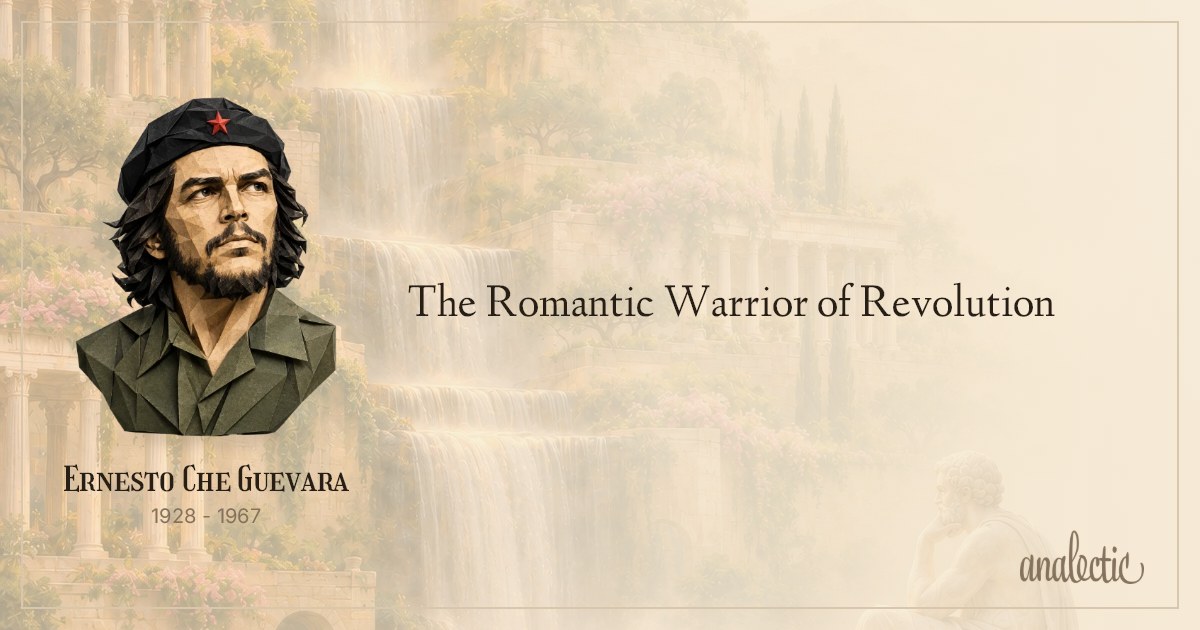
Ernesto Che Guevara
The Romantic Warrior of Revolution (1928 - 1967)
When Ernesto Che Guevara was born in 1928 into an aristocratic Argentine family, no one could foresee that this medical student would transform into a mythic figure of revolution across Latin America’s wounded lands. As a youth traversing the continent on his motorcycle, the poverty he witnessed, the despair in leper colonies, and the systematic subjugation of indigenous peoples transcended mere geography for him—it became a moral frontier. This journey became a clinical diagnosis not only of disease, but of capitalism’s gangrenous injustice. The physician who would take up arms to soothe a suffering beyond medicine’s reach had, by then, become ‘Che’.Rising to prominence alongside Fidel Castro as a guerrilla tactician in the Cuban Revolution, Che proposed to humanity, in the socialist order that followed victory, a new moral vision: the ‘hombre nuevo’—a subject purified of exploitation, endowed with collective consciousness, and unyielding to imperialism. His work, ‘Guerrilla Warfare,’ became the manifesto of revolutionary praxis, while in ‘Socialism and Man,’ he poetically reimagined Marx’s analysis of how capitalist domination alienates the human spirit. His struggle was a radical humanism, where bullets were fused with philosophy, and revolution with love.His assassination in 1967 by CIA-backed forces in the desolate valleys of Bolivia transformed Che into an immortal icon. Though his body was lost, his ideas became a marching hymn for the oppressed across the world. His fervent devotion to human dignity, his sanctification of silence-breaking resistance to injustice, and his insistence that sacrifice is a political virtue elevated him to the status of a transfigured saint of 21st-century resistance culture. Che was no longer merely a man—he had become the universal echo of a cry against injustice.
Ernesto Che Guevara: quotes
- “Let us be realistic and do the impossible.”
- “You are not defeated when you lose, but when you abandon.”
- “The one who fights may lose, but the one who does not fight is already lost.”
- “Allow me to say, at the risk of seeming absurd, that the true revolutionary is guided by profound feelings of love.”
- “Always be capable of feeling, most profoundly, any injustice committed against anyone in any part of the world. This is the noblest trait of a revolutionary.”
- “One must harden oneself but never lose tenderness.”
- “They may cut down every flower, yet never shall they halt the coming of spring.”
- “I am not a liberator. Liberators do not exist. The people liberate themselves.”
- “Silence is a debate continued through other means.”
- “If I ever have to bow my head, it will only be to lift a fallen comrade.”
- “The life of a single human being is worth millions of times more than all the possessions of the richest man on earth.”
- “Peace without justice is but a silent slavery.”
- “Knowledge and culture liberate man; ignorance is tyranny's most loyal ally.”
- “Wherever death may surprise us, let it be welcome, provided that our battle cry reaches a receptive ear and another hand extends to take up our arms.”
- “The future belongs to those courageous enough to sacrifice today for their convictions.”
- “The true strength of a leader lies not in the commands they issue, but in the hardships they share with their people.”
- “The brotherhood of dogs lasts only until a bone is thrown between them.”
- “If you have the courage to pursue them, every great dream can become reality.”
- “To remain neutral in the face of injustice is to side with the oppressor.”
- “At the end of the path, victory or death may await; but the greatest defeat is to shun the fight.”
- “We are neither deluded nor dreamers; we are those who perceive the truth behind the impossible.”
- “Ideas cannot be destroyed by bullets; they scatter into the wind and return as a storm.”
- “When the flame of dignity is extinguished within a man, all that remains is a walking shadow.”
- “Every dawn is a new beginning; if your conscience is clear, each step brings you closer to freedom.”
View on Analectic →