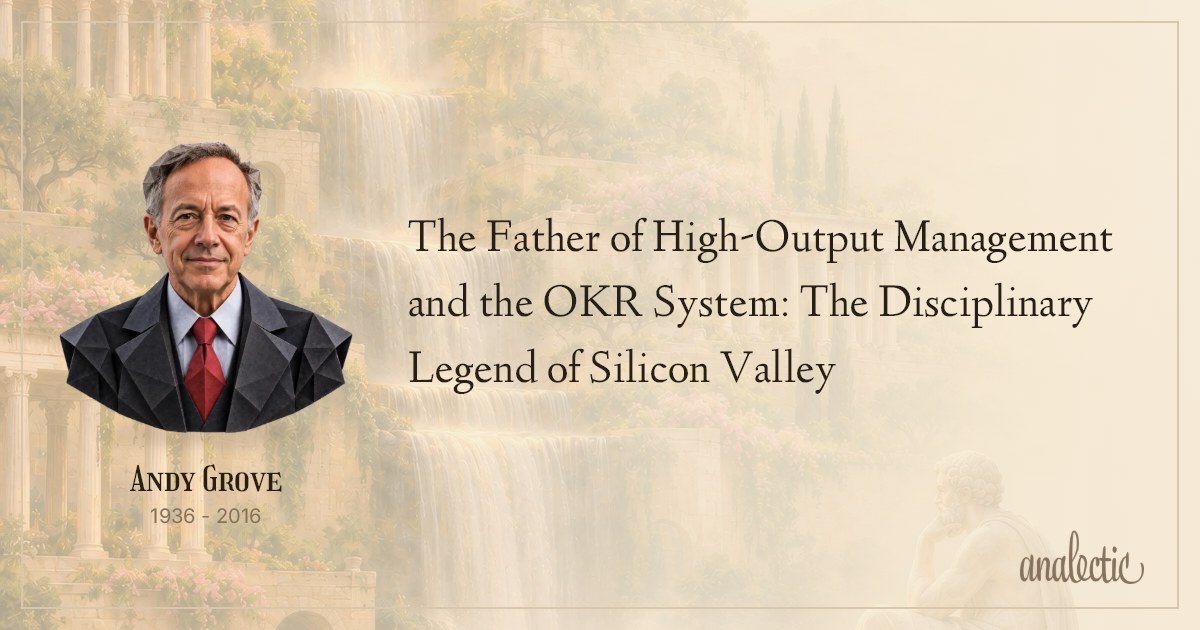
Andy Grove
The Father of High-Output Management and the OKR System: The Disciplinary Legend of Silicon Valley (1936 - 2016)
Andy Grove, born András István Gróf in Budapest in 1936, became a refugee who fled with not a single penny in his pocket amid the tragic tides of Nazi occupation and the 1956 Hungarian Revolution. This young man, who sought asylum in the United States, wielded his scientific acuity and disciplined work ethic like a weapon while studying chemical engineering at the City College of New York. His groundbreaking research at UC Berkeley in semiconductor technology earned him a place among Intel’s first ten employees—where, far more than an engineer, he emerged as a founding spirit, laying the very technological and organizational foundations of Silicon Valley. This man, who fused the hope of a refugee with the razor-sharp intellect of a scientist, did not merely found a company—he forged a new language of civilization.In his book, widely regarded as the Bible of management literature, High Output Management, Grove radically redefined the manager’s true output: not his own labor, but the collective output of his team and system. This philosophy gave birth to the OKR (Objectives and Key Results) framework—a structure that shapes every tech giant from Google to NVIDIA by demanding that every objective be tied to measurable, transparent, and team-oriented outcomes. With the concept of the ‘Management Leverage,’ he turned discipline into an art: a manager must elevate the productivity of his team’s actions, not his own. Thus, management was transformed from a duty into a craft.With his philosophy, ‘Only the Paranoid Survive,’ Grove elevated the detection and mastery of ‘strategic inflection points’—unexpected yet lethal transformations that threaten a company’s existence—to an art form. He transformed constructive conflict into an institutional virtue: a tool for confronting reality rather than succumbing to fear. In these very areas where weak leaders fled, he built a culture of harsh yet fair feedback. This man, who saved Intel’s transition from memory chips to microprocessors, also created a leadership philosophy. He left behind not merely a tech giant, but a discipline, a mindset, and an ethical legacy. He was not merely the father of Silicon Valley—he became its soul. And the soul is immortal.
Andy Grove: quotes
- “The output of the manager is the output of the organization; therefore, the manager's most important task is to increase the productivity of others.”
- “At a strategic inflection point, conventional decision-making fails; only the paranoid survive.”
- “The biggest mistake managers make is focusing on measuring the productivity of others instead of their own.”
- “Setting a goal is not merely a wish; it is the crystallization of a decision.”
- “Regular, repeated actions shape your capabilities; thus, discipline is the highest form of willpower.”
- “A leader gains real power when they acknowledge their fears—because then they see not just their fears, but reality itself.”
- “At a strategic inflection point, the most dangerous thing is insisting that everything is normal.”
- “Any action, however small, is better than inaction; for action is the construction of the future.”
- “An organization's productivity depends not on how many things leaders try to do, but on how many they choose not to do.”
- “Doing the right thing is the same as doing it at the right time; missing the timing is missing the goal.”
- “Managers' greatest weakness is not their own competence, but their obsession with measuring others’ competence.”
- “Delaying a confrontation turns it into a larger one; thus, constructive confrontation is a core leadership skill.”
- “A leader’s greatest responsibility is to cleanse their own mind of fear—because fear distorts reality.”
- “Goals are not merely a roadmap; they are a mental architecture; setting them reshapes your mind.”
- “For a leader to question others’ decisions without questioning their own is a form of terrible delusion.”
- “An organization’s true productivity emerges where fears are spoken openly and mistakes are confessed.”
- “A leader’s deepest power arises from the courage to admit their weaknesses—because only then do they begin to truly lead.”
- “The output of a manager is the output of the organization; therefore, the manager's most important job is to increase the productivity of others.”
- “At a strategic inflection point, it's not fear that saves you, but awareness; because only the aware detect change before it's too late.”
- “Good decisions are made not only with information, but with a calm mind and willpower strong enough to overcome fear.”
- “If you want to do something, make a plan to do it; planning is the only way to make willpower concrete.”
- “A leader’s greatest courage is admitting his own mistakes and confessing them to others in order to correct them.”
- “An organization’s true power lies not in how many people a manager influences, but in how much they increase the productivity of others.”
- “At a strategic inflection point, it’s not enough to know that something has changed—you must know how to change it.”
- “One of the greatest mistakes managers make is trying to measure the productivity of others instead of their own.”
- “To reach a goal, it’s not enough to be determined—you must take small steps toward it every single day.”
- “Taking a step into the unknown is more than overcoming fear—it is redefining your own boundaries.”
- “A leader’s most powerful weapon is suppressing their own ego to listen to the voice of the team.”
- “Only the paranoid survive; because they see not just threats, but the early signals of threats.”
- “An organization’s performance depends on how frequently and effectively managers engage in constructive confrontation.”
View on Analectic →