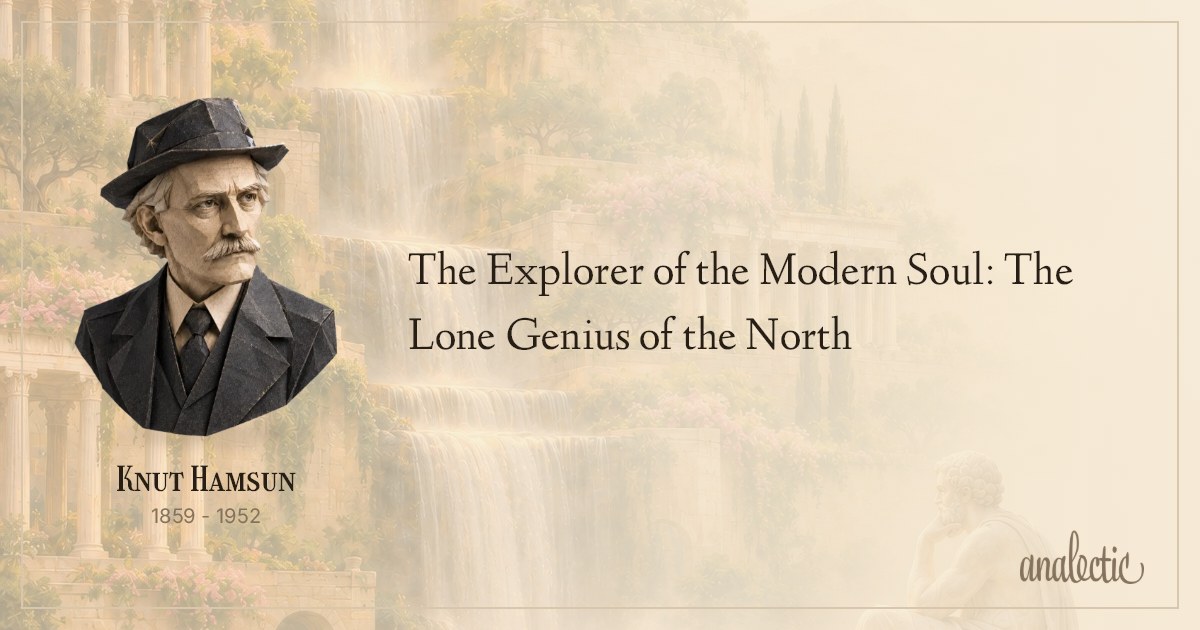
Knut Hamsun
The Explorer of the Modern Soul: The Lone Genius of the North (1859 - 1952)
Born in 1859 in the remote northern Norwegian village of Lom, Knut Hamsun grew under the shadow of harsh nature and profound solitude. His childhood was spent in struggle against poverty and the unforgiving earth—this battle sowed the seeds of his boundless curiosity for the depths of the human soul. In youth, he emigrated to America, working in fields, begging on streets, and sleeping on trains. These nomadic years became a laboratory for exploring the dark labyrinths of consciousness; he experienced firsthand the existential trials of hunger, isolation, and passion, laying the foundations of a psychological realism yet unnamed in modern literature.Recipient of the 1920 Nobel Prize in Literature, Hamsun became the pioneer of stream-of-consciousness technique through his novel 'Hunger,' a work that transforms physical deprivation into a spiritual odyssey—a milestone along the lineage stretching from Dostoevsky to Kafka. In 'Pan,' he chronicled the tragedy of a soldier dancing to the rhythm of nature; in 'Mysteries,' he unveiled the inner turmoil of an outcast alienated by society; in 'The Growth of the Soil,' he elevated the return to the earth into an epic poem, immortalizing humanity’s primal bond with nature in lyrical prose. Every line was a symphony where words attained musical resonance.Hamsun championed the pure poetry of nature against the artifice of modern civilization, boldly exposing the inner contradictions, repressed desires, and existential fears of the human condition. His works shaped 20th-century literature, influencing everything from Hemingway’s theory of the 'iceberg consciousness' to Kafka’s existential nightmares. Though his controversial political stances drew criticism throughout his life, his literary legacy endures as a window into the boundless depths of the human soul. He was not merely a writer—he was a seeker lost in the inner desert of the modern human.
Knut Hamsun: quotes
- “Hunger is a merciless mirror, revealing the soul in its purest, most naked form — no less than the body’s own torment.”
- “The human who works the soil is life's most ancient and truest master; there is no place for ostentation or falsehood in him.”
- “The forest sighs and whispers in the silent night, echoing the wildness slumbering within the soul.”
- “The human soul is deep with mysteries beyond reason's grasp.”
- “Love comes like a wind in the night—sudden, unannounced, shaking the soul, leaving behind either profound sorrow or infinite light.”
- “Pride is an invisible shield to which man clings tightly so as not to lose even his last crumb of bread.”
- “Nature moves in its own time; the seed lies hidden in the earth, patient and silent, until the hour of its awakening.”
- “Walking in solitude, I feel I am part of nature; there the trees are my confidants, and the wind my breath.”
- “A person who does not conform to society’s rules is immediately branded; yet sometimes the greatest truths are hidden in those deviant minds.”
- “The weight of thought often exceeds what the body can bear.”
- “To live simply is not poverty; on the contrary, it is the highest wealth, purified of life’s unnecessary noise.”
- “Those who never found each other own love forever.”
- “The silence of night speaks more truth than the day.”
- “We all play a part before one another, yet few dare to live in their own skin.”
- “There is no greater joy than reaping the fruit of seeds one has sown oneself.”
- “The urge to create flares up even in the darkest hour of despair.”
- “The eyes speak a language no alphabet has ever known.”
- “In the beating of birds' wings, in the waves' breaking upon the shore, there is an eternal harmony; man must surrender to this harmony.”
- “If you wish to understand a person's inner world, you must listen to their silences.”
- “Cities rise and crumble, but the earth endures forever.”
- “The greatest victory is when a man does not compromise his own dignity, even at the moment when nothing remains.”
- “A single glance can burn itself into the soul forever, more deeply than any lifetime of words.”
- “Death is but a passage in nature's great cycle.”
- “The blessing of labor lies in the inner peace it bestows.”
- “The unfathomable depths of the heart are humanity's true source.”
View on Analectic →