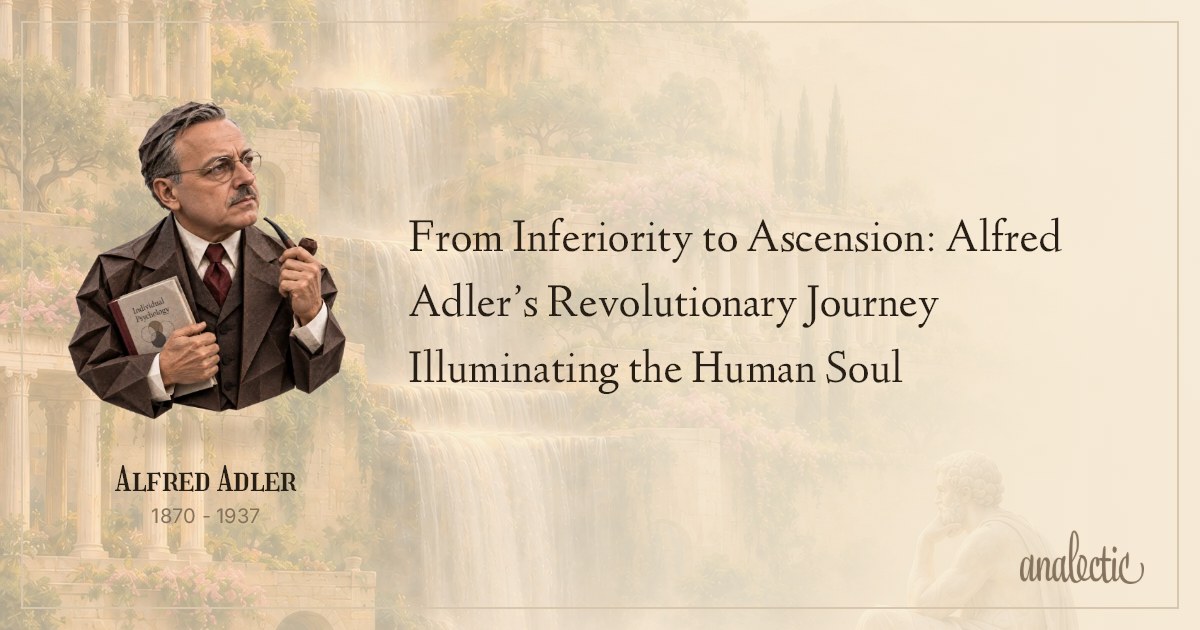
Alfred Adler
From Inferiority to Ascension: Alfred Adler’s Revolutionary Journey Illuminating the Human Soul (1870 - 1937)
Alfred Adler, architect of a mind that began in the humble quarters of Vienna in 1870 and radiated across the globe, was shaped by childhood struggles with rickets and life-threatening illnesses—experiences that propelled him to uncover the pivotal role of the 'feeling of inferiority' in human psychology. After completing his medical training, his path intersected with Freud’s, only to transform into a bold rebellion that transcended the boundaries of psychoanalysis. In 1911, breaking away from the psychoanalytic circle, he founded 'Individual Psychology,' defining the human being not as a passive victim of trauma, but as an active subject shaping the purpose of life. For Adler, every individual possessed the potential to overcome deficiencies through the 'striving for superiority.'Adler’s theory revolutionized psychology by insisting that the human being cannot be understood apart from their social context. With the concept of 'social interest' (Gemeinschaftsgefühl), he argued that psychological health arises only through belonging and solidarity. In opposition to Freud’s libido theory, he asserted that one's 'lifestyle' is consciously constructed through choice. Centering his philosophy on 'the courage to be,' he redefined therapy’s aim not as escaping blame, but as awakening the individual’s inner strength. In his seminal work, 'The Meaning of Life,' he inscribed the triumph of will over fate.Though his life ended abruptly in Aberdeen in 1937, the impact of his ideas could not be silenced. As a forerunner of humanistic psychology and cognitive-behavioral therapies, he inspired fields as vast as modern education systems and the literature of personal development. Today, Adler—enshrined in everyday language through concepts like 'inferiority complex' and 'compensation mechanisms'—stands as a guide in the relentless struggle to reveal each person’s unique potential. His legacy endures as a timeless wisdom whispering that human fragility can be transmuted into strength.
Alfred Adler: quotes
- “The greatest courage of a human being is to overcome the fear of being unloved and judged by others.”
- “It is not our past experiences that define us, but the meaning we assign to them.”
- “The feeling of inferiority is not a disease; it is a natural driving force that compels human beings to grow, learn, and transcend themselves.”
- “Character is not a fate bestowed at birth; it is the attitude and habitual mode of action the individual develops in response to life.”
- “A person's worth is measured not by what they receive from others, but by what they contribute to society and humanity.”
- “Inner peace begins when you stop competing with others and focus solely on your own growth.”
- “Making excuses is the most insidious way to evade responsibility and the effort that change demands.”
- “The person fixed on their goal sees obstacles not as excuses, but as steps to be overcome.”
- “All human problems are fundamentally problems of interpersonal relationship.”
- “Difficulties are the most honest mirrors, revealing the hidden strength and resilience within the human spirit.”
- “A person who cannot muster the courage to be imperfect will never achieve genuine success.”
- “Discipline is walking under the guidance of a long-term life purpose, not the fleeting impulses of the moment.”
- “Living to meet others' expectations is renting out your own life.”
- “True greatness is not being superior to others, but being superior to your former self.”
- “It is not what you have, but what you do with what you have that determines the direction of your life.”
- “Defeat becomes defeat only when you cease to strive.”
- “If you wish to change your future, you must stand firmly behind the decisions you make today.”
- “A mind that lacks social feeling and thinks only of its own interest is doomed, sooner or later, to loneliness.”
- “Accepting yourself as you are is the first step toward change and inner peace.”
- “Habits are the invisible masters of the human spirit; if you do not consciously govern them, they will govern you.”
- “Instead of fearing the unknown, embrace the infinite possibilities it offers.”
- “Human beings are miraculous beings who have built civilizations through their courageous efforts to overcome their shortcomings.”
- “Focus your mind not on what others think, but on the duty that lies before you.”
- “The pinnacle of maturity is not complaining in the face of pain, but asking, 'What can I learn from this situation?'”
- “Anger is a masked cry of powerlessness and helplessness; calmness is the sign of true strength.”
- “The meaning of life lies in being useful to others and contributing a brick to the common heritage of humanity.”
- “Each morning when you wake, ask yourself: 'How can I make the lives of others a little better today?'”
- “Those who fear drawing their own path are condemned to lose themselves in paths drawn by others.”
- “The person who transforms destructive emotions into constructive actions is the master of their own life.”
- “Trust is a moral decision, not based on evidence, but built by taking risks and choosing to believe.”
View on Analectic →