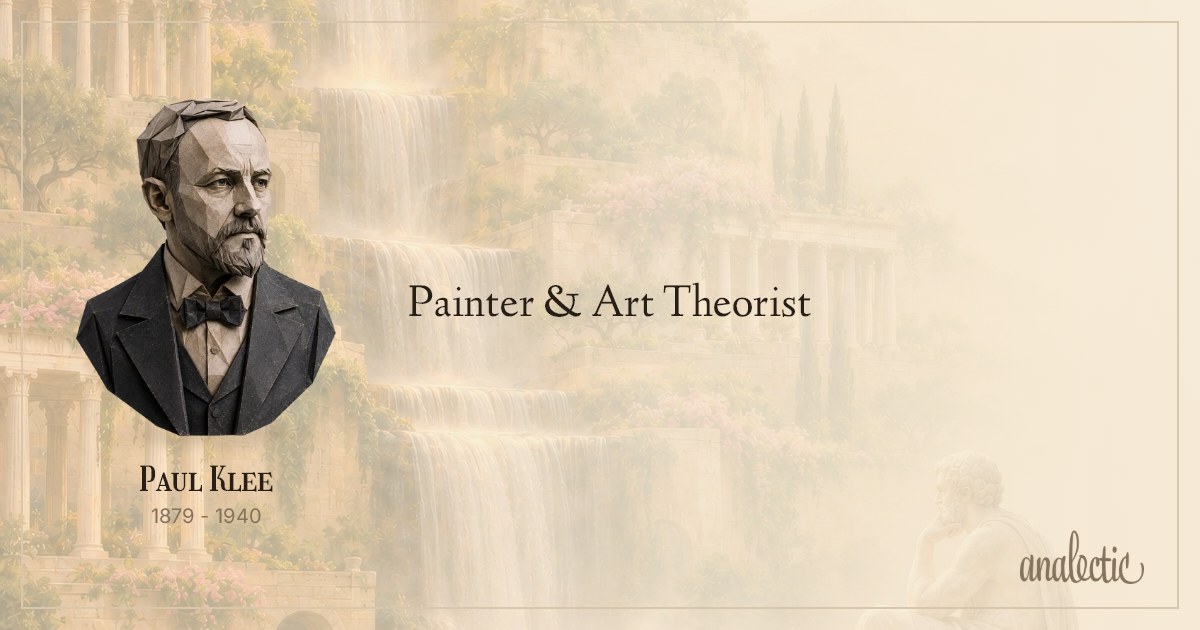
Paul Klee
Painter & Art Theorist (1879 - 1940)
Born near Bern, Switzerland, into a family of musicians, Paul Klee cultivated from an early age an intuitive affinity for rhythm, melody, and graphic precision. Following classical training in Munich, his artistic trajectory altered dramatically through his alliance with the avant-garde circle Der Blaue Reiter alongside Wassily Kandinsky. The ultimate epiphany arrived during his transformative 1914 journey to Tunisia, where the radiant Mediterranean light unlocked his chromatic consciousness, prompting him to famously declare: "Color has taken possession of me; I am a painter." Weathering the turbulence of the First World War, Klee emerged as an indispensable master and poetic pedagogue at the revolutionary Bauhaus.Enshrined in his dictum, "Art does not reproduce the visible; rather, it makes visible," Klee's philosophy conceived painting as a cosmic polyphony where lines, planes, and tones resonate like counterpoint. Melding childlike wonder with meticulous analytical rigor, his notebooks and canvases charted the dynamic genesis of forms rather than mere static reality. His enigmatic masterwork Angelus Novus, famously interpreted by Walter Benjamin as the Angel of History, endures as a haunting contemplation of human fragility and progress. Though forced into exile by totalitarian oppression in his final years, Klee gifted civilization a transcendent visual language that bridges spirit, nature, and lyrical abstraction.
Paul Klee: quotes
- “Art does not reproduce the visible; rather, it makes visible.”
- “Beauty is as relative as light and dark. Thus, there exists no beautiful woman, none at all, because you are never certain that a still far more beautiful woman will not appear and completely shame the supposed beauty of the first.”
- “The painter should not paint what he sees, but what will be seen.”
- “Children also have artistic ability, and there is wisdom in there having it! The more helpless they are, the more instructive are the examples they furnish us; and they must be preserved free of corruption from an early age.”
- “To emphasize only the beautiful seems to me to be like a mathematical system that only concerns itself with positive numbers.”
- “The worst state of affairs is when science begins to concern itself with art.”
- “A drawing is simply a line going for a walk.”
- “One eye sees, the other feels.”
- “A line is a dot that went for a walk.”
- “He has found his style, when he cannot do otherwise.”
- “The art of mastering life is the prerequisite for all further forms of expression, whether they are paintings, sculptures, tragedies, or musical compositions.”
- “One does not lash hat lies at a distance. The foibles that we ridicule must at least be a little bit our own. Only then will the work be a part of our own flesh. The garden must be weeded.”
- “Nature is garrulous to the point of confusion, let the artist be truly taciturn.”
- “Everything vanishes around me, and works are born as if out of the void. Ripe, graphic fruits fall off. My hand has become the obedient instrument of a remote will.”
- “A single day is enough to make us a little larger or, another time, a little smaller.”
- “In the final analysis, a drawing simply is no longer a drawing, no matter how self-sufficient its execution may be. It is a symbol, and the more profoundly the imaginary lines of projection meet higher dimensions, the better.”
- “Color possesses me. I don't have to pursue it. It will possess me always, I know it. That is the meaning of this happy hour: Color and I are one. I am a painter.”
- “When looking at any significant work of art, remember that a more significant one probably has had to be sacrificed.”
View on Analectic →