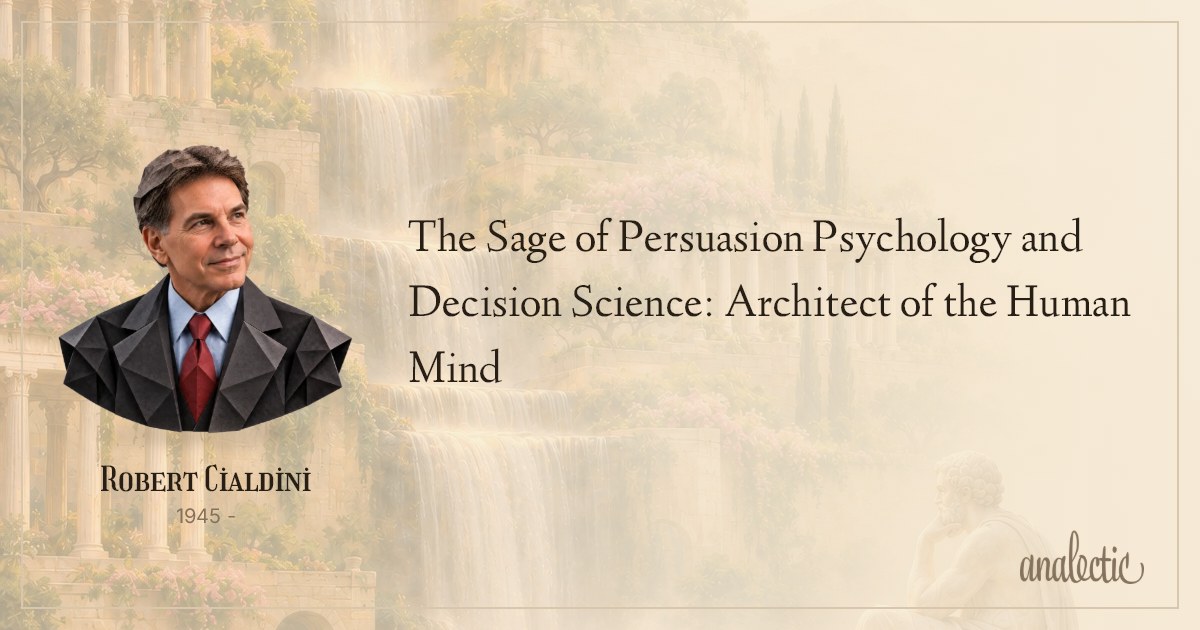
Robert Cialdini
The Sage of Persuasion Psychology and Decision Science: Architect of the Human Mind (1945 -)
Born in Wisconsin in 1945, Robert Cialdini pursued his education at Columbia and the University of North Carolina to grasp the profound depth of psychology in understanding human behavior. Yet Cialdini, unwilling to rest on academic theory alone, spent three years secretly observing and working alongside car salesmen, charity fundraisers, and direct sales teams—immersing himself in the field to uncover the true power of persuasion. This ethnographic odyssey transcended the confines of the laboratory, transforming into a scientific expedition to understand how and why human decisions are shaped. These meticulous, ethically daring observations did not merely yield an academic study; they forged an anthropological legacy that revealed the most fundamental mechanisms of human nature.His 1984 masterpiece, 'Influence: The Psychology of Persuasion,' became the foundational text of persuasion literature, selling over five million copies worldwide. In it, Cialdini grounded six universal psychological principles—reciprocity, commitment and consistency, social proof, liking, authority, and scarcity—in rigorous empirical data, historical anecdotes, and vivid narratives from everyday life. His subsequent landmark work, 'Pre-Suasion,' unveiled the critical importance of the moment before a message is delivered: how the mental framework must be prepared. Persuasion, he demonstrated, begins not merely with what is said, but with when and how it is said. Together, these two works stand as timeless classics, mapping the architecture of human decision-making.Cialdini argues that persuasion techniques are not manipulation, but rather ethical instruments aligned with the intrinsic architecture of human nature. He contends that when wielded with honesty and moral responsibility, these principles empower individual choice and strengthen societal trust. In modern marketing, leadership, and public policy, his work is not merely an effective tool—it is the very art of understanding and respectfully engaging the mind’s decision-making architecture. Cialdini believes in persuasion’s greatest power: the deepest way to influence others is to help them use their own minds.
Robert Cialdini: quotes
- “Once people make a decision, they strive to behave in ways that are consistent with that decision—it becomes part of how they define themselves.”
- “Perceiving something as scarce is one of the most powerful psychological drivers of its perceived value.”
- “When people commit to something, they convince themselves that they will follow through—it’s an internal drive for consistency.”
- “People see something as more correct, more trustworthy, and more valuable when they see others doing it.”
- “An authority is effective not merely because they know something, but because they are perceived as trustworthy and fair.”
- “People are more easily persuaded by those who treat them kindly, whom they perceive as similar to themselves, and whom they like.”
- “The power of a message begins not with what is said, but when it is said; the moments when attention is pre-arranged are the most potent moments of influence.”
- “Persuasion is not a force but a process—it guides people by allowing them to hear their own inner voice.”
- “A person’s feeling of belonging to a group is one of the deepest bonds that drives them to act in accordance with that group’s values.”
- “People feel an obligation to return a favor when something is given to them—it is a social debt.”
- “The success of a strategy stems not from how cleverly it is designed, but from how consistently it is executed.”
- “Fear can be a powerful motivator for action, but only when it is followed by a clear solution.”
- “Once people commit to a decision, they begin searching for evidence that supports it—it is a mechanism for protecting their own beliefs.”
- “Persuasion is not manipulation—it is understanding; when applied correctly, it benefits both the persuader and the persuaded.”
- “A salesperson creates the strongest influence when they allow the customer to arrive at their own decision.”
- “People exert more effort to complete something once they’ve started it—it is the psychological pressure of unfinished tasks.”
- “The impact of a message depends less on its content than on the context in which it is presented; context is the key to persuasion.”
- “Once people commit to an action, they begin to find reasons why not doing it would be inconsistent—it is the natural consequence of the drive for consistency.”
- “Once people make a decision, they are motivated to behave consistently with it because they see themselves as consistent individuals.”
- “One of the most powerful tools of influence is getting someone to see themselves as part of something—because people act on belonging.”
- “The value of a thing is directly proportional to its scarcity—because people desire more when they perceive loss as imminent.”
- “Persuasion begins not with what is said, but when it is said—in the privileged moments of attention when people are most open.”
- “When people encounter an authority figure, they suspend their own judgment and automatically comply—it’s a mental shortcut.”
- “Rather than forcing people to act, guiding them to make their own decisions creates lasting influence.”
- “People are more easily persuaded by those who are similar to them—because similarity builds trust at a primal level.”
- “Persuasion is not about forcing action—it’s about creating a pathway for people to want to act.”
- “A person’s past commitment shapes their future behavior—because consistency is foundational to identity.”
- “People are inclined to do what others are doing—especially those like them—because social proof is the most powerful source of trust.”
- “The first giver controls the dynamics of interaction—because reciprocity is one of the deepest laws of human relationships.”
- “Effective persuasion allows a person to hear their own inner voice—because true influence comes from within, not without.”
View on Analectic →