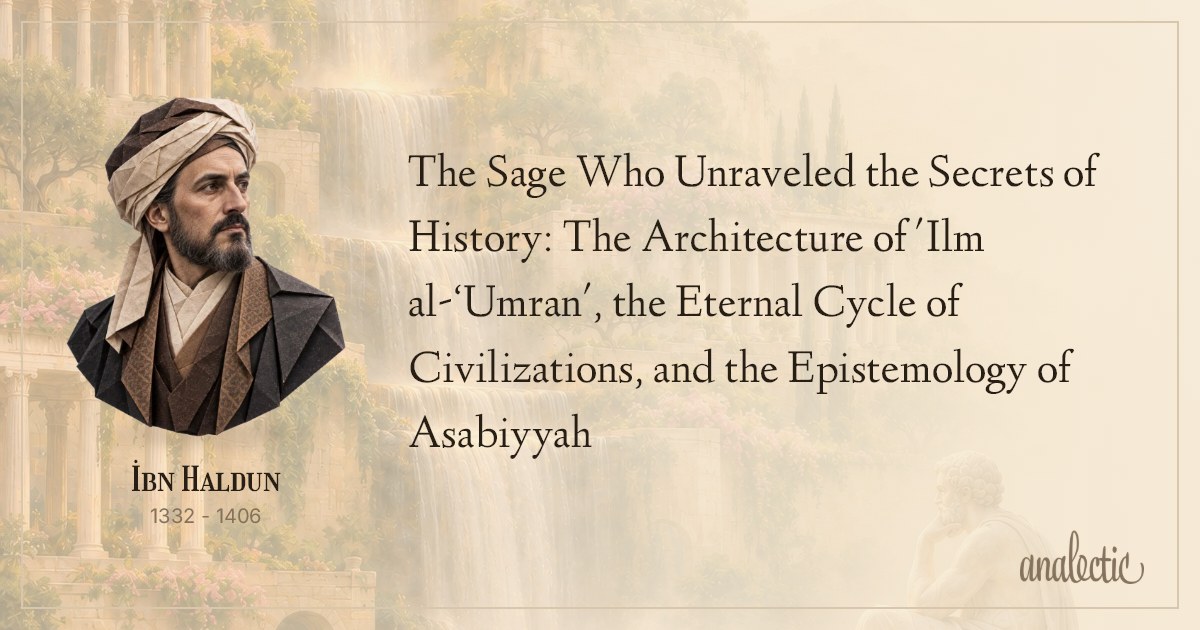
İbn Haldun
The Sage Who Unraveled the Secrets of History: The Architecture of 'Ilm al-‘Umran', the Eternal Cycle of Civilizations, and the Epistemology of Asabiyyah (1332 - 1406)
Born in 1332 in Tunis into a distinguished scholarly family descended from Andalusia, Ibn Khaldun received an interdisciplinary education spanning from Hadith to philosophy. At the age of sixteen, amid the darkness of the Great Plague, he lost both parents, who imparted to him early the inevitability of death and the fragility of social bonds. Serving as vizier, scribe, and diplomat in the courts of Fas, Granada, and Bejaia, he personally laid bare the intrigues beneath the glitter of power and the inner mechanisms of the state. He was a genius lost in the labyrinth of politics; every fall was a trial drawing him closer to truth.Withdrawing in 1375 to the Ibn Salama Fortress near Algiers to escape political chaos, he signed a manifesto that would revolutionize historiography: the Muqaddimah. In four years of solitude, he developed a new discipline he called 'Ilm al-‘Umran,' examining civilizations as living organisms. In his theory of 'asabiyyah,' he elucidated, with scientific rigor, how tribal solidarity builds states and how luxury corrodes them. By declaring 'geography is destiny,' he emphasized climate’s influence on culture, offering the West a secular pioneering vision in sociology and the philosophy of history.His struggle to establish justice as Chief Maliki Judge in Cairo subjected him to political pressure and exile. In 1401, at age seventy, as Timur besieged Damascus, he entered the conqueror’s tent and delivered an oration that moved the victor with its insights into the laws of civilizations. Though he lost his family in a shipwreck, Ibn Khaldun maintained his upright bearing; when he breathed his last in Cairo in 1406, he left behind not merely a single work, but a thought-revolution etched into humanity’s collective memory: History is not mere repetition; it is the rhythm of recurrence, and he alone deciphered it—and thus foretold the future.
İbn Haldun: quotes
- “The past resembles the future more than one drop of water resembles another.”
- “Civilizations, like individuals, are born, grow, reach maturity, decline, and perish.”
- “Injustice and oppression are the surest harbingers of the collapse and ruin of civilization.”
- “Social cohesion and collective solidarity (Asabiyyah) are the bedrock upon which great realms are built.”
- “Excessive luxury and soft comfort extinguish social vigor and lead inevitably to moral decay.”
- “The duty of the historian is not merely to transmit narrations, but to investigate the deep causal laws of events.”
- “Adversity and severe hardship forge resilient character, whereas idle comfort weakens the spirit.”
- “The seeker of truth must weigh every report in the impartial scales of reason and natural possibility.”
- “Inner serenity is found when one understands the immutable cycles of history and submits to divine wisdom.”
- “Courage is the resolve to speak the truth fearlessly before kings and to uphold justice against tyrants.”
- “Strict self-discipline and moderation are the ultimate bulwark protecting society against moral collapse.”
- “In times of political chaos, the scholar finds sanctuary in the tranquil pursuit of enduring wisdom.”
- “He who preserves quiet dignity in the face of political exile and catastrophe remains unvanquished.”
- “Unbiased observation, stripped of flattery and dogma, is the sole foundation of true science.”
- “No empire is immortal; within the pinnacle of power already lie hidden the quiet roots of decay.”
- “Dare to question accepted historical myths; wisdom begins only when uncritical conformity ends.”
- “Focus the intellect upon the fundamental essence of human association rather than superficial phenomena.”
- “Silent meditation upon the ruins of past dynasties silences the petty ambitions of the ego.”
- “Methodical discipline and constant intellectual labor are essential to uncover the hidden laws of nature.”
- “The fortitude to bear sudden loss with patience is the clearest sign of a noble and cultivated mind.”
- “To pioneer a new science requires the boldness to venture where no scholar has dared to tread.”
- “True peace belongs to the soul that has disentangled itself from the transient illusions of worldly glory.”
- “Man is shaped by his daily habits and cultural environment far more than by his biological ancestry.”
- “To stand steadfast for truth against the tide of popular ignorance is the supreme intellectual heroism.”
View on Analectic →