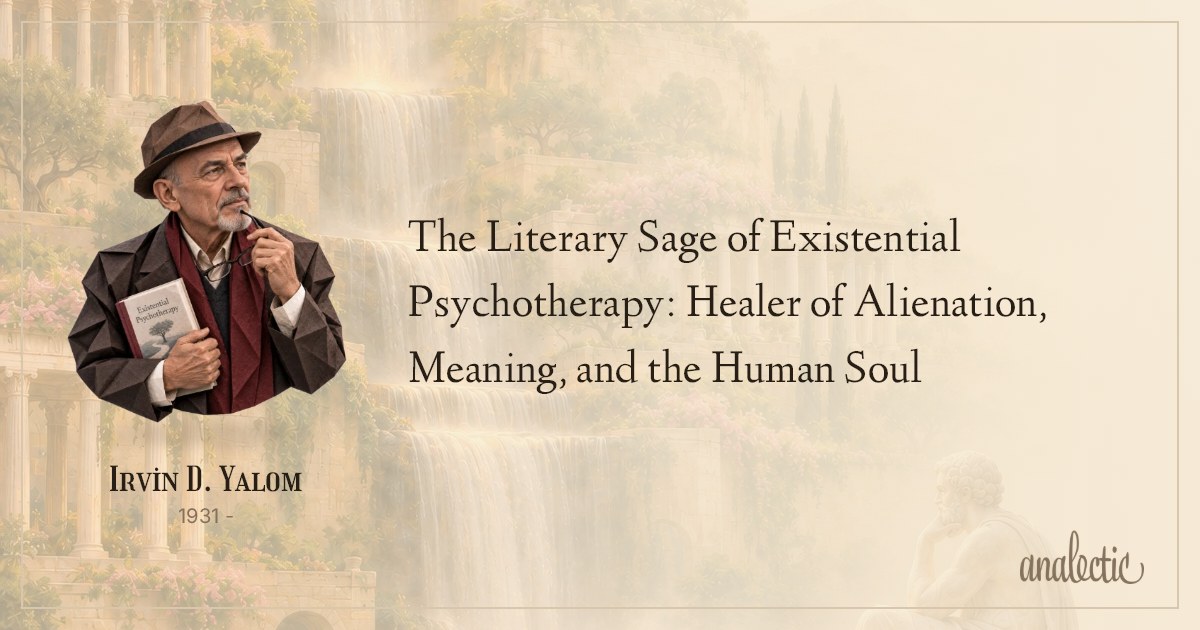
Irvin D. Yalom
The Literary Sage of Existential Psychotherapy: Healer of Alienation, Meaning, and the Human Soul (1931 -)
Irvin D. Yalom, born in 1931 in Washington, D.C., was an existential psychotherapist, writer, and philosopher; yet his true legacy lies in his extraordinary ability to articulate the profound terrors of loneliness, death, and meaninglessness with the eloquence of literature. While training in medicine, Yalom carried the voices of Rilke, Dostoyevsky, Kafka, and Sartre into the therapy room, crafting a language that enabled his patients to confront their isolation, accept the inevitability of death, and choose their existence with radical responsibility. Every book he wrote was not merely a session of therapy, but an existential journey: he did not simply listen to his patients—he gave them the courage to rewrite their own stories. Yalom taught that psychotherapy is not a technique, but an art of humanity; an art that, in a world where fear reigns supreme, reminds us what it means to be present with compassion.Yalom’s works resemble the deepest classics of literature far more than clinical case reports. Books like 'Existential Psychotherapy' and 'The Existential Psychotherapy of Death' transport philosophy’s abstract concepts into hospital rooms, while novels such as 'When Nietzsche Wept' and 'The Schopenhauer Cure' weave together the inner worlds of patients, the therapist’s own struggles, and the silent shadow of mortality. In these pages, Yalom, both healer and author, shares his patients’ solitude and empowers them to become the authors of their own being. Each sentence he wrote is like a prayer inscribed with a pen—a naming of fear, a resurrection of hope, a quiet affirmation of the search for meaning. By transforming literature into the language of psychotherapy, he does not merely inform his readers; he draws them into the abyss of existence itself.Yalom’s life was a living embodiment of existential therapy: an aging man, fully aware of death’s approach, continued to write, to speak, to love. His passing in 2020 was not merely the loss of a psychiatrist, but of a literary visionary and philosopher. Yet his books endure as beacons in the dark hours of every new generation. Yalom reminds us: humanity is not defined by its fears, but by its courage to face them; not by meaninglessness, but by the relentless pursuit of meaning; not by isolation, but by the compassionate presence we offer one another. His words remain, for all who wish to live existentially, a therapy room that lasts a lifetime: silent, yet profound; simple, yet infinite.
Irvin D. Yalom: quotes
- “The physical presence of death destroys the human being; but the idea of death saves us and awakens us to an authentic life.”
- “The fear of death diminishes in one who lives life fully and without regret. An un-lived life is the greatest poison that feeds the fear of death.”
- “The only way to come to terms with the feeling of loneliness is to make peace with your own solitude and become a whole unto yourself.”
- “Taking full responsibility for one's own life is the most terrifying yet most liberating experience a human being can have.”
- “Hope is not the denial of reality, but the continued capacity to generate meaning despite the stark nakedness of truth.”
- “Grief and pain are not enemies to be avoided, but sacred visitors that deepen the human soul.”
- “Focus on here and now. This moment is the only time in which we can heal the past and build the future.”
- “Love is the mutual honoring, preserving, and greeting of each other's solitude.”
- “A therapist who cannot muster the courage to face their own darkness cannot light a candle in the darkness of another.”
- “Spiritual maturity is the discipline of honestly confronting one's own frailties and rebuilding oneself anew each day.”
- “Inner peace begins the moment you accept life's uncontrollable uncertainty and dance with it.”
- “People believe they love because they wish to be loved; yet true love is the affirmation of another being without expectation of return.”
- “Even the heaviest losses are painful gifts that remind us how fragile and precious existence truly is.”
- “To escape the comfortable prison others have drawn around you requires the courage to face your own uncertainty.”
- “When listening to a person, silence all the prejudices in your mind; for pure attention is the noblest gift one can offer another.”
- “Life has no ultimate meaning; you give it meaning through your own choices, passions, and commitments.”
- “When you set aside the regrets of the past and the anxieties of the future, only the quiet peace of pure existence remains.”
- “To deceive oneself is the hardest and most noble battle a human being must wage against their own mind.”
- “A soul that has never been wounded can never fully grasp the depth of life or the power of compassion.”
- “To accept one's own fragility and share it with others is the highest form of human courage.”
- “In marriage, the essence is not two people leaning on each other, but two trees standing side by side, reaching toward the same sky.”
- “Do not resist the storms that scatter your mind; instead, focus solely on being the silent witness at the eye of the storm.”
- “When you stop trying to change others, you open the doors to your own inner peace.”
- “The more one clings to things, the greater the fear of loss and the existential anxiety that follows.”
- “An honest relationship is possible only when both individuals refuse to pay tribute to each other's false masks.”
- “Despair is not an end, but the threshold through which one encounters one’s own limits and steps into a new plane of existence.”
- “To accept oneself as the architect of one's own fate requires the courage to relinquish the false comfort of the victim role.”
- “Within every human lies a buried tragedy; it is in our power to transform that tragedy into wisdom.”
- “Forgiveness is making peace with the unchangeable past and walking lightly into the future.”
- “To give meaning to your life is to remain faithful to your conscience and the dignity of humanity in every decision you make.”
View on Analectic →