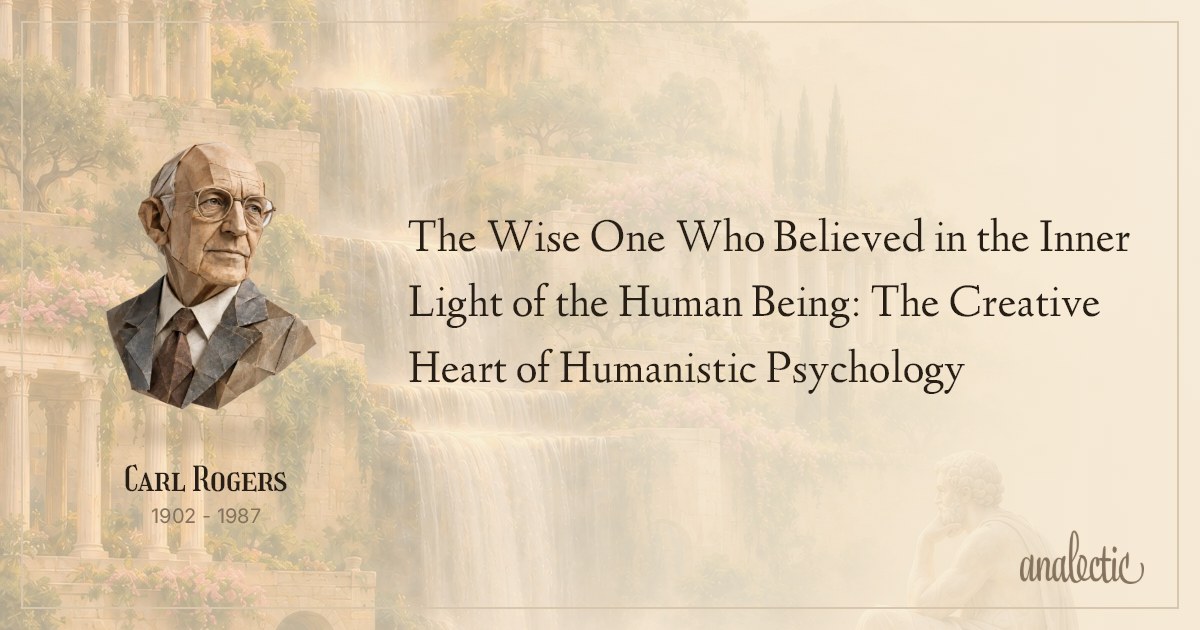
Carl Rogers
The Wise One Who Believed in the Inner Light of the Human Being: The Creative Heart of Humanistic Psychology (1902 - 1987)
Carl Ransom Rogers was born in 1902 in the quiet rural landscape of Illinois. His studies in agriculture and theology became a bridge drawing him into the profound depths of human nature. After completing his doctorate in psychology at Columbia University, he grew alienated from the cold diagnostic language of traditional psychiatry while working in centers for juvenile delinquency. His unwavering conviction—that every person, despite their fragility, is capable of journeying toward their own inner light—sowed the seeds of a quiet revolution against authoritarian models. His profound trust in each individual’s potential for self-actualization propelled him to seek a new language within psychology.Amid the rigid scientific dogmas of the 1940s, he became a revolutionary voice in therapy: Client-Centered Therapy. With this approach, which saw the client not as a ‘patient’ but as a ‘human being’ harboring wisdom within, Rogers liberated psychotherapy from the grip of authority. The triad of unconditional positive regard, deep empathy, and the therapist’s authenticity became the sacred foundation upon which a person’s courage to hear themselves was nurtured. His 1961 book, On Becoming a Person, transformed into the manifesto of humanistic psychology. For him, change began only when an individual recognized themselves as the hero of their own story.Rogers, who declared, ‘When I accept myself just as I am, then I can change,’ championed a wisdom woven with paradox. He led groups in conflict zones such as Northern Ireland and South Africa, building bridges of peace; in 1987, he was nominated for the Nobel Peace Prize. Though decades have passed since his death, he left a legacy that reminds us how profoundly healing it is to sit in a therapist’s chair, unjudged, simply heard. With his boundless faith in the inner light of the human being, Rogers continues to whisper the hope behind every ‘hello.’
Carl Rogers: quotes
- “The curious paradox is that when I accept myself just as I am, then I can change.”
- “To listen to another person without judgment and to understand them fully is the most healing act in the world.”
- “When I dare to trust my own experiences, I always find that I am on the most authentic path.”
- “A good life is not a destination; it is a process, a direction, and a continuous flow.”
- “To be authentic is the discipline of living in harmony with your inner truth, setting aside all masks.”
- “When we gently embrace painful emotions instead of suppressing them, they transform into a powerful force for growth.”
- “A person who feels unconditionally accepted reconnects with their own inner wisdom.”
- “To see the world through the eyes of the other person is the highest form of attention.”
- “What is most personal and private to the individual is, in fact, the most universal of all human experiences.”
- “Living according to your own inner compass, without depending on the approval of others, requires great courage.”
- “Realizing oneself is the effort to uncover one's potential within each day.”
- “When the mind calms, you can clearly hear what your body and emotions are trying to tell you.”
- “The human being is not inherently destructive; given the right conditions, it always tends toward growth and development.”
- “Vulnerability is not a weakness; it is the only bridge to touching one's own truth.”
- “Instead of fearing the uncertainty that change brings, focus on the freedom that growth offers.”
- “To stay with oneself, free from the burdens of the past and the projections of the future, is to experience pure presence.”
- “To love a person as they are is to gift them the space and freedom to be themselves.”
- “When you lower your defenses, the world ceases to be a hostile place.”
- “Honesty is not merely avoiding lies to others; it is also remaining transparent with oneself.”
- “Our wounds become our strongest sites of growth when met with compassionate understanding.”
- “Being able to express one's feelings without censorship is proof of self-respect.”
- “No one can teach another person anything; they can only guide them to discover it within themselves.”
- “Inner peace blossoms the day you lay down the endless war within yourself.”
- “Grasping the emotion behind the words is the key to deep empathy.”
- “Growth is not following pre-made recipes; it is embracing the responsibility that arises from your own experience.”
- “Being kind to oneself in difficult times is the noblest form of resilience.”
- “Do not fear confronting your own inadequacies; for growth begins only with the acceptance of those very gaps.”
- “A genuine relationship is the space where neither person feels the need to play a role with the other.”
- “A person who cannot understand themselves can never truly be forgiving toward others.”
- “Maturity is the courage to stand fully behind one's choices in every moment, transforming life into a work of art.”
View on Analectic →