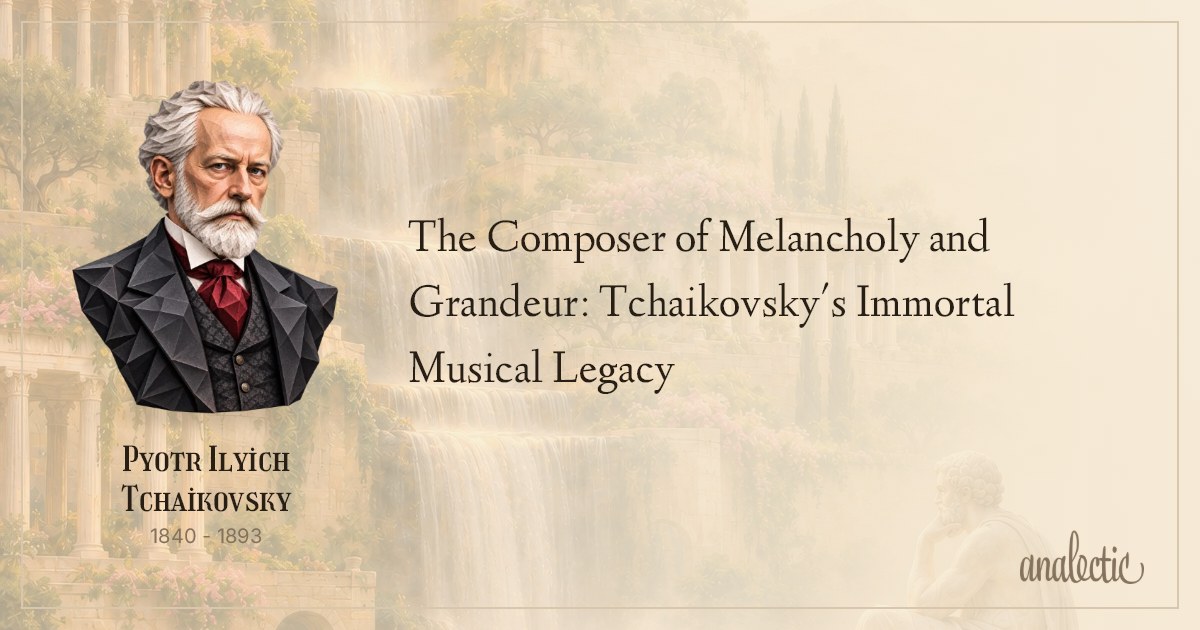
Pyotr Ilyich Tchaikovsky
The Composer of Melancholy and Grandeur: Tchaikovsky's Immortal Musical Legacy (1840 - 1893)
Pyotr Ilyich Tchaikovsky, born in 1840 in Votkinsk, beneath the shadow of the Ural Mountains, abandoned his career in law—pursued in St. Petersburg—to consecrate his destiny to music. Under the rigorous discipline of Anton Rubinstein’s St. Petersburg Conservatory, his talent forged an aesthetic revolution, uniting the collective melancholy of the Russian soul with the symphonic forms of the West. Though he forever felt himself an outsider in Europe, his river-like melodies and impassioned orchestration elevated his national identity while unlocking the gates to a universal language.This meticulous master, anchored to his desk at the break of dawn, regarded inspiration not as a romantic gift, but as a labor steeped in sweat and discipline. His thirteen-year correspondence with Nadezhda von Meck was more than financial patronage; it was a metaphysical dialogue woven in notes between two souls. From the enchanted veil of Swan Lake to the fairy-tale airs of The Nutcracker, and the tragic love of Eugene Onegin, his works were an act of liberation: transmuting personal anguish—the social taboo of his homosexuality, the dread of death—into the abstract cosmos of music. Each chord was a triumph of inner reckoning.When he departed this life nine days after the premiere of his Sixth Symphony, known as the ‘Pathétique,’ he left behind a testament of existential solitude laid bare: a farewell letter in sound. Tchaikovsky constructed, through his music, a temple where joy and sorrow are equally sanctified. By entrusting to the trembling vibrations of notes the grief that silence cannot articulate, he engraved the oldest tongue of the soul into eternity.
Pyotr Ilyich Tchaikovsky: quotes
- “Inspiration is a guest that does not willingly visit the lazy; she demands that we work.”
- “Truly there would be reason to go mad were it not for music.”
- “We must always work; a self-respecting artist must not fold his hands on the pretext that he is not in the mood.”
- “To regret the past, to hope in the future, and never to be satisfied with the present: that is what I spend my whole life doing.”
- “Music is not an illusion, but a revelation rather. Its triumphant power lies in the fact that it reveals to us beauties we find nowhere else.”
- “Without work, life has no meaning, no value, no flavor.”
- “What words cannot express, must be left to music.”
- “An artist cannot sit and wait for inspiration; he must go in search of it with pen in hand.”
- “I sit at the piano every morning at nine o'clock and mesdemoiselles les Inspirations have learned to be on time.”
- “There is no doubt that even the greatest musical geniuses have sometimes worked without inspiration.”
- “The creative process is an agonizing struggle, yet it is the only thing that gives life genuine meaning.”
- “To compose music is to pour out the innermost secrets of one's soul.”
- “In every human heart there is a spark of divine flame; our duty is to keep it burning.”
- “Solitude is the essential condition for deep artistic creation.”
- “Only that which comes straight from the heart has the power to touch other hearts.”
- “Doubt is the faithful companion of true talent.”
- “How often does a simple melody awaken the deepest memories we thought were lost forever.”
- “I write music because I cannot help writing it; it is my nature and my calling.”
- “Melancholy is a sweet sadness that cleanses the soul and prepares it for creation.”
- “The struggle against darkness and fate is what gives grandeur to human existence.”
- “A true masterpiece is born not from fleeting enthusiasm, but from patient and unyielding labor.”
- “Do not fear sorrow; often it is the forge in which the strongest spirits are shaped.”
- “Nature is the greatest symphonist; listening to her silence is the highest lesson in music.”
- “Life is fleeting, but an honest creation lives on in the hearts of generations.”
View on Analectic →