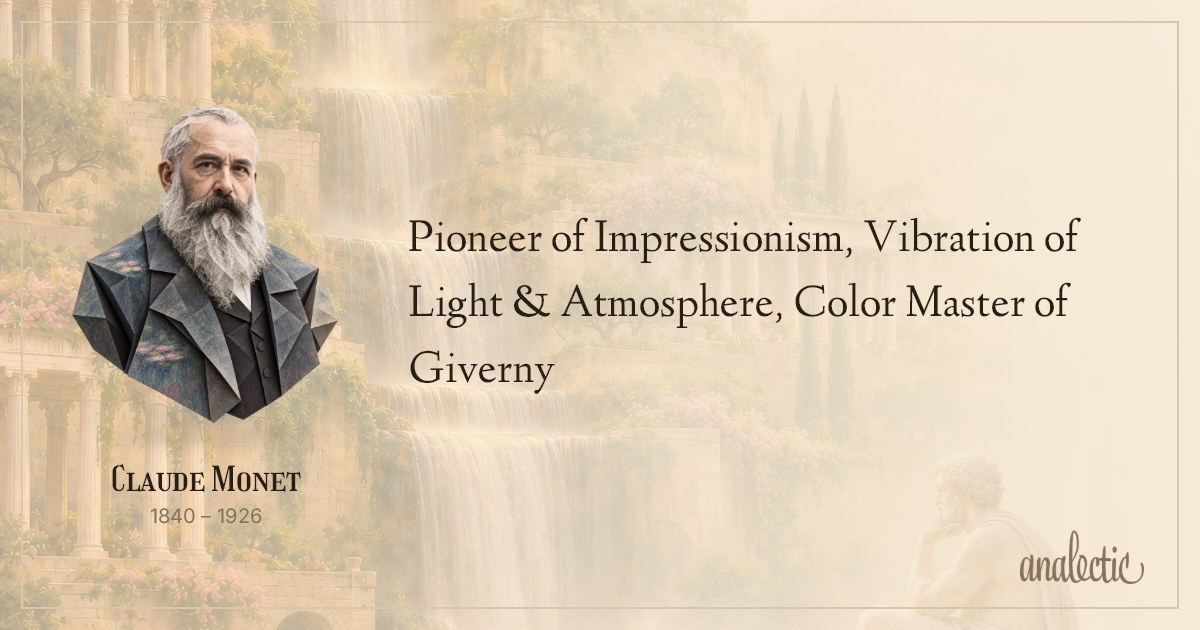
Claude Monet
Pioneer of Impressionism, Vibration of Light & Atmosphere, Color Master of Giverny (1840 – 1926)
Claude Monet (November 14, 1840, Paris – December 5, 1926, Giverny) was the driving force and primary namesake of Impressionism, fundamentally dismantling academic historicism to become the supreme poet of light and optical sensation in modern painting. Raised in the port town of Le Havre, Monet’s precocious gift as a caricaturist was reoriented toward natural landscape by Eugène Boudin, who introduced him to the transformative discipline of outdoor painting (*en plein air*). Moving to Paris to study at the Académie Suisse, he formed an indomitable brotherhood with Pierre-Auguste Renoir, Camille Pissarro, and Frédéric Bazille, uniting in defiance against the suffocating bitumen-toned dogmas of the official Paris Salon.
At the epoch-making 1874 independent exhibition in Paris, his canvas Impression, Sunrise (*Impression, soleil levant*) prompted a hostile critic to coin the term 'Impressionists'—a label the group proudly claimed. Monet held that a motif possessed no intrinsic local color, but existed solely through the momentary vibration of atmosphere and light: 'For me, a landscape does not exist in its own right, since its appearance changes at every moment; but the surrounding atmosphere brings it to life.' His legendary serial investigations—the Haystacks (*Les Meules*), the Rouen Cathedral facade, and the Poplars—systematically recorded the temporal flow of reality, effectively turning paint into an instrument of pure temporal philosophy.
From 1883 onward, Monet constructed his living artistic sanctuary at Giverny, designing a magnificent water garden and Japanese footbridge that became his final, obsessive motif. Even as severe cataracts threatened to blind him in his final decades, he painted with an incandescent, gestural freedom that presaged mid-century Abstract Expressionism, producing the monumental Water Lilies (*Nymphéas*) decor. Gifted to the French nation upon the 1918 armistice as an enduring monument to peace and infinite contemplation at the Musée de l'Orangerie, Monet’s life work stands as an immortal testament to the sacred, fleeting dialogue between human consciousness and the living cosmos.
Claude Monet: quotes
- “Color is my day-long obsession, joy, and torment.”
- “For me, a landscape does not exist in its own right; I paint the atmosphere and the vibrant light between objects and my eyes.”
- “When you go out to paint, try to forget what objects you have before you; merely think, here is a little square of blue, an oblong of pink, and paint it just as it looks to you.”
- “Light changes constantly, and every second it bestows an entirely new soul upon the world.”
- “I perhaps owe having become a painter to flowers.”
- “Everyone discusses my art and pretends to understand, as if it were necessary to understand, when it is simply necessary to love.”
- “My only desire is an intimate fusion with nature; to catch that which is most fleeting upon the canvas.”
- “The truth behind the visible world is hidden in that vibrant instant when light caresses matter.”
- “The water lilies are not merely flowers upon the pond; they are the mirror of time and eternity echoing upon the water.”
- “Time flows relentlessly, but color freezes it upon the canvas, rendering it immortal.”
- “I wish I had been born blind and then suddenly regained my sight, so that I could have begun to paint without knowing what the objects were before me.”
- “I am driven to the point of torment to capture what I am seeking: 'instantaneity', above all the envelope of light diffused everywhere. I am pursuing an impossibility.”
- “The sun sets so fast that I cannot follow it with my brush... Nature eludes me, and each time I arrive a few seconds too late.”
- “To truly see begins with forgetting the name of the thing you are looking at. The moment you call a tree a 'tree', you cease to see its unique light in that passing second.”
- “It took me time to understand my water lilies. I had planted them for pleasure, never imagining I would paint them... Then suddenly, I had the revelation of the magic of my pond. Since then, I have had no other model.”
- “My real studio was never four walls; my studio is the forest, the riverbank, and the infinite sky where the wind blows.”
- “My eyes may be failing me, but my brush now moves not by physical sight, but guided by forty years of memory, instinct, and the light of the soul.”
- “The further I advance, the more inadequate I feel before nature. Sometimes, unable to render the miracle before me, I am consumed with the urge to slash my canvases to pieces.”
- “I found myself at the bedside of my dying wife, mechanically analyzing the tragic succession of colors that death was imposing on her face. Painting is not a profession for me, but a relentless instinct that has taken hostage of my soul.”
- “I do not wish to be wealthy, nor do I chase applause; all I desire is to wake each morning, stand before nature, and listen to the secrets the light whispers to me.”
- “In nature, there is no such thing as absolute black or white; shadows are not black, they are vibrant participants in the dance of reflected color.”
- “At the end of the day, when I set down my palette, a deep serenity fills my heart; for I know that tomorrow morning the sun will rise anew and offer me a completely transformed world.”
View on Analectic →