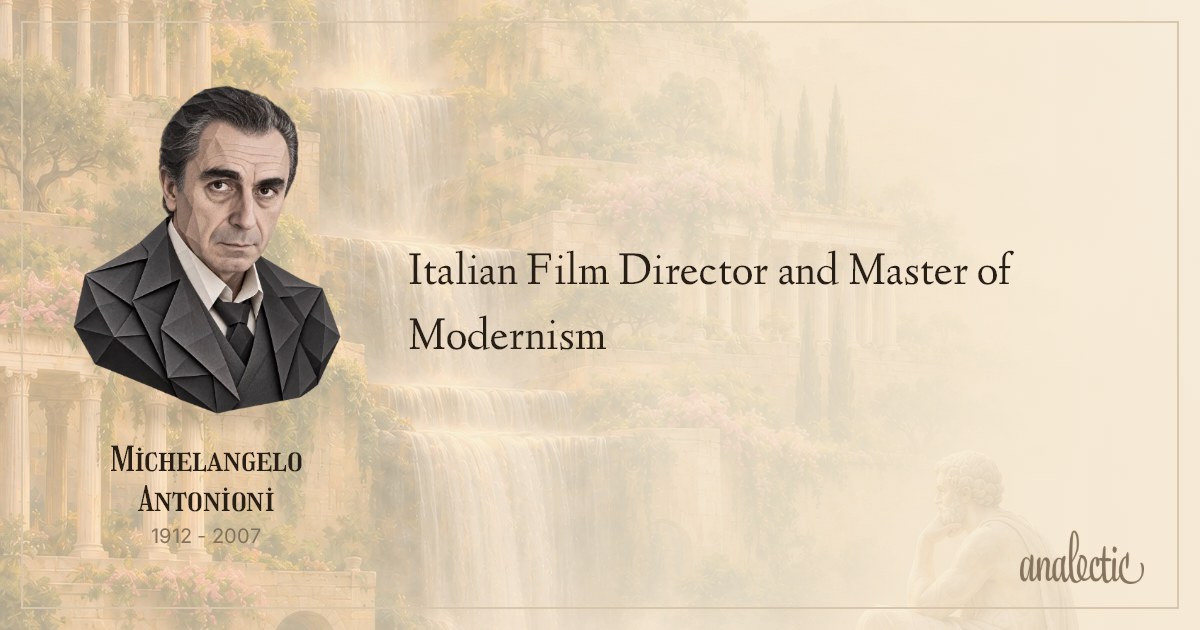
Michelangelo Antonioni
Italian Film Director and Master of Modernism (1912 - 2007)
Michelangelo Antonioni was born on 29 September 1912 in Ferrara and raised within a bourgeois family. While studying economics and commerce at the University of Bologna, he concurrently cultivated his aesthetic sensibility by writing film criticism and engaging with painting. During the 1940s, he entered the cinematic milieu around Rome's Centro Sperimentale di Cinematografia through screenwriting and assistant work. His early short films and documentaries, particularly 'Gente del Po' (1947), revealed his nascent interest in the relationship between environment and characters' psychological states, signalling a departure from Italian Neorealism towards a more personal mode of expression. This formative period laid the groundwork for his unique cinematic language, which would increasingly eschew conventional narrative structures to probe the existential alienation of modern humanity.Antonioni's international renown was cemented by the works that constitute his celebrated 'trilogy on modernity' from the 1960s: 'L'Avventura' (1960), 'La Notte' (1961), and 'L'Eclisse' (1962). In these films, he rejected traditional plot progression, instead depicting characters' inner void, incommunicability, and cold relationship with their modernist surroundings through extended sequence shots and minimal dialogue. His transition to colour in 'Il Deserto Rosso' (1964) further deepened these themes, employing a dominant colour palette that rendered industrial landscapes a psychological extension of the characters' states. With the 1966 film 'Blow-Up', he moved into an English-language context, interrogating the slippery ground between reality and representation through the lens of a photographer, thereby raising profound philosophical questions about the unreliability of visual perception.Michelangelo Antonioni's legacy resides primarily in his expansion of cinema's narrative possibilities and the radical innovation in his use of visuality as a philosophical instrument. His aesthetic, which can be described as an 'image of emotion,' wherein space, duration, and emptiness become carriers of characters' psychic states, exerted a profound influence on directors such as Godard, Tarkovsky, and numerous independent filmmakers of subsequent generations. A career crowned with countless awards, including an Honorary Academy Award in 1995, proved that cinema is not merely a storytelling art but a form of thought that examines the complex, often ineffable conditions of modern existence. His works continue to pose fundamental questions about the individual's relationship with their environment, remaining acutely relevant in our contemporary era of heightened technology and isolation.
Michelangelo Antonioni: quotes
- “My work is like digging, it's archaeological research among the arid materials of our times. That's how I understand my first films, and that's what I'm still doing...”
- “Hollywood is like being nowhere and talking to nobody about nothing.”
- “The photographer in Blow-Up, who is not a philosopher, wants to see things closer up. But it so happens that, by enlarging too far, the object itself decomposes and disappears. Hence there's a moment in which we grasp reality, but then the moment passes. This was in part the meaning of Blow-Up.”
- “I am not a theoretician of the cinema. If you ask me what directing is, the first answer that comes into my head is: I don't know.”
- “A director is a man, therefore he has ideas; he is also an artist, therefore he has imagination. Whether they are good or bad, it seems to me that I have an abundance of stories to tell. And the things I see, the things that happen to me, continually renew the supply.”
- “When I am shooting a film I never think of how I want to shoot something; I simply shoot it. My technique, which differs from film to film, is wholly instinctive and never based on a priori considerations.”
- “I began taking liberties a long time ago; now it is standard practice for most directors to ignore the rules.”
- “I want my characters to suggest the background in themselves, even when it is not visible. I want them to be so powerfully realized that we cannot imagine them apart from their physical and social context even when we see them in empty space.”
- “I would like to make clear that I speak only of sensations. I am neither a sociologist nor a politician. All I can do is imagine for myself what the future will be like.”
- “I don't want what I am saying to sound like a prophecy or anything like an analysis of modern society .... these are only feelings I have, and I am the least speculative man on earth.”
- “Modern life is very difficult for people who are unprepared. But this new environment will eventually facilitate more realistic relationships between people.”
- “I think people talk too much; that's the truth of the matter. I do. I don't believe in words. People use too many words and usually wrongly. I am sure that in the distant future people will talk much less and in a more essential way. If people talk a lot less, they will be happier. Don't ask me why.”
- “Don't regard my characters as symbols of a determined society. See them as something that sparks a reaction within you so that they become a personal experience. The critic is a spectator and an artist insofar as he transforms the work into a personal thing of his own.”
- “My characters are ambiguous. Call them that. I don't mind. I am ambiguous myself. Who isn't?”
- “I've always said that the actor is only an element of the image, rarely the most important. The actor is important with his dialogue, with the landscape, with a gesture — but the actor in himself is nothing.”
- “When we find ourselves up against practical obstacles that can't be overcome, we must go forward. You either make the film as you can or don't make it at all.”
- “I have always imposed my wishes on the cameraman. Moreover, I have always picked them at the outset of their careers and, to a certain extent, have formed them myself.”
- “I always want to tell stories. But they must be stories that evolve, like our own lives. Perhaps what I seek is a new kind of story.”
- “One doesn't enter groups of people simply because one wants or needs to. One has an infinite number of opportunities that occur for no particular reason. Sometimes you feel a sudden unexpected pleasure at being where you find yourself.”
- “Is it important to show why a character is what he is? No. He is. That's all.”
- “You mustn't ask me to explain everything I do. I can't. That's that. How can I say why at a certain moment I needed this. How can I explain why I needed a confusion of colors?”
- “The greatest danger for those working in the cinema is the extraordinary possibility it offers for lying.”
View on Analectic →