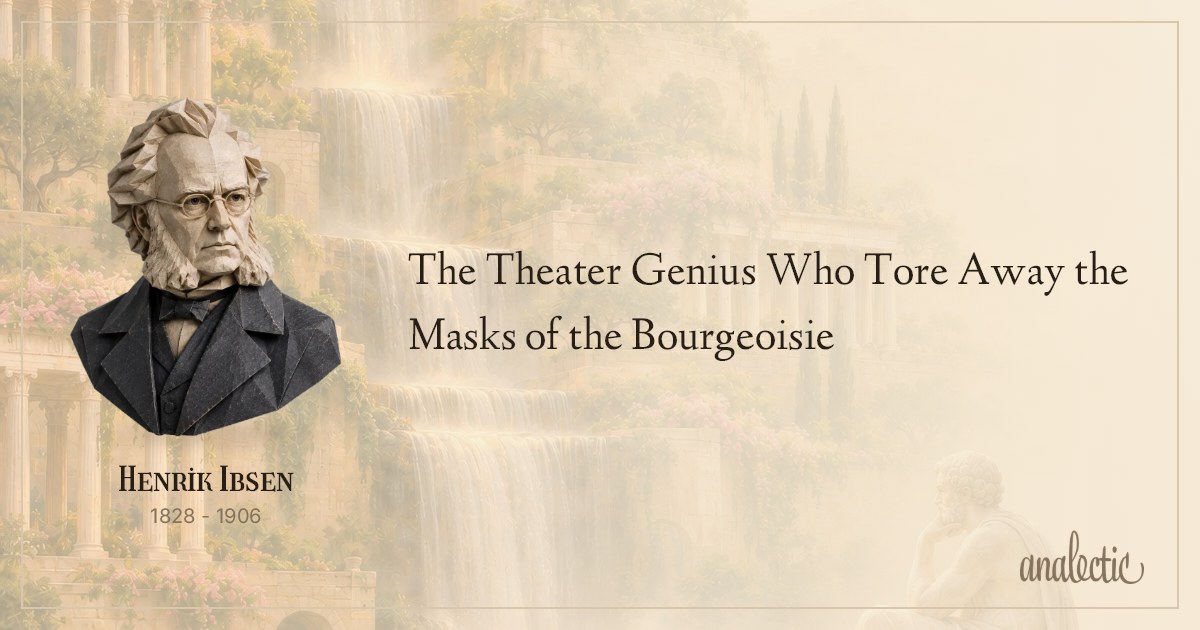
Henrik Ibsen
The Theater Genius Who Tore Away the Masks of the Bourgeoisie (1828 - 1906)
Henrik Ibsen, born in 1828 in the Norwegian town of Skien, grew up in the shadow of poverty as the son of a bankrupt merchant. During his youth, while apprenticing as a pharmacist in Grimstad, he secretly wrote poetry; his escape from the narrow confines of provincial life began with a failed play in Oslo. In 1864, fleeing the cultural repression of Norway, he embarked on a 27-year exile in Italy and Germany—a period in which he matured his inner rebellion through poetic masterpieces such as 'Brand' and 'Peer Gynt', laying the foundations of modern drama within Europe’s intellectual climate.Known as the 'Father of Modern Drama,' Ibsen was a revolutionary who shattered the hypocritical bourgeois morality of the Victorian era on stage. Nora’s rebellion against her husband in 'A Doll’s House' shook societal gender roles; the taboo of incest in 'Ghosts' and Hedda Gabler’s suicide shocked audiences and pushed the boundaries of realism. In 'The Wild Duck,' he explored the tragic equilibrium between living a lie, and in 'An Enemy of the People,' he dramatized the individual’s struggle against society. His poetic masterpiece, 'Peer Gynt,' transformed the human quest for selfhood into a universal myth.Ibsen liberated theater from moralistic sermons by transmuting his characters’ inner conflicts into acts of moral accounting. His philosophy—summed up in the maxim, 'The strongest man is he who stands most alone'—elevated the individual’s free will against social coercion. Through themes spanning women’s rights to spiritual alienation, Ibsen inspired 20th-century theater and became, as a mirror that strips away humanity’s masks, the immortal revolutionary of art.
Henrik Ibsen: quotes
- “The strongest man in the world is he who stands most alone.”
- “The majority is never right. Never, I tell you! It is one of those societal lies that a free, thinking soul must rise up against.”
- “I am first and foremost a human being, I, just as much as you.”
- “All or nothing; half-measures are the soul’s suicide.”
- “Thousands of women have sacrificed their honor for family and loved ones; but no man has ever abandoned his honor for the sake of the woman he loves.”
- “Do you know what it is to be oneself? It is to transcend oneself, to realize one's own truth.”
- “Take away the illusion of life from an ordinary person, and you strip them of happiness at the same stroke.”
- “Truths built on convention rarely outlive their time; by the time they grow old, they’ve already begun to rot into lies.”
- “The further one strays from the beaten path, the more original the outcome becomes.”
- “If you cannot, it may be forgiven; but never if you will not.”
- “Courage is man's refusal to sacrifice his own destiny to the expectations of others.”
- “The peace of conscience is a nobility no victory can buy.”
- “Our home has been nothing but a dollhouse—I was your doll-wife, and the children, my dolls.”
- “The most dangerous enemy of truth and freedom among us is the compact majority.”
- “I peel myself like an onion—layers upon layers fall away, yet at the center, nothing remains.”
- “We are all ghosts—not merely the inheritance from father and mother that haunts us, but the dead beliefs we cling to, the newspapers we read as gospel, the prejudices we refuse to bury.”
- “Youth knocks at the door — and I know they will come to take my place.”
- “The soul's greatness is measured by the height of what it refuses to compromise.”
- “A wounded wild duck lies buried deep within every soul, drowned in the mud of forgotten depths, never to rise again.”
- “When the dead awaken, we realize we never truly lived.”
- “Freedom is to stand on your own feet and think with your own mind.”
- “When a new idea first emerges, it is in the hands of the few; when it passes into the hands of the majority, it is already obsolete.”
- “A man who cannot achieve wholeness within himself is no different from a leaf tossed about by the wind of life.”
- “To choose what is easy is to accept defeat beforehand; virtue is to climb the steep slopes.”
- “The silent reckoning with oneself is the hardest prison of all.”
- “If you cannot live life with beauty, at least bid it farewell with dignity.”
- “The joy of living and the joy of work — these are the two sacred feelings whose loss robs a man of all he is.”
- “To desire the impossible is the only way for man to transcend his own limits.”
- “When fighting for a cause, even those friends you trust most may abandon you; the true warrior is the one who dares to face this solitude.”
- “The Third Kingdom shall come — where spirit and flesh, freedom and fate, entwine as one.”
View on Analectic →