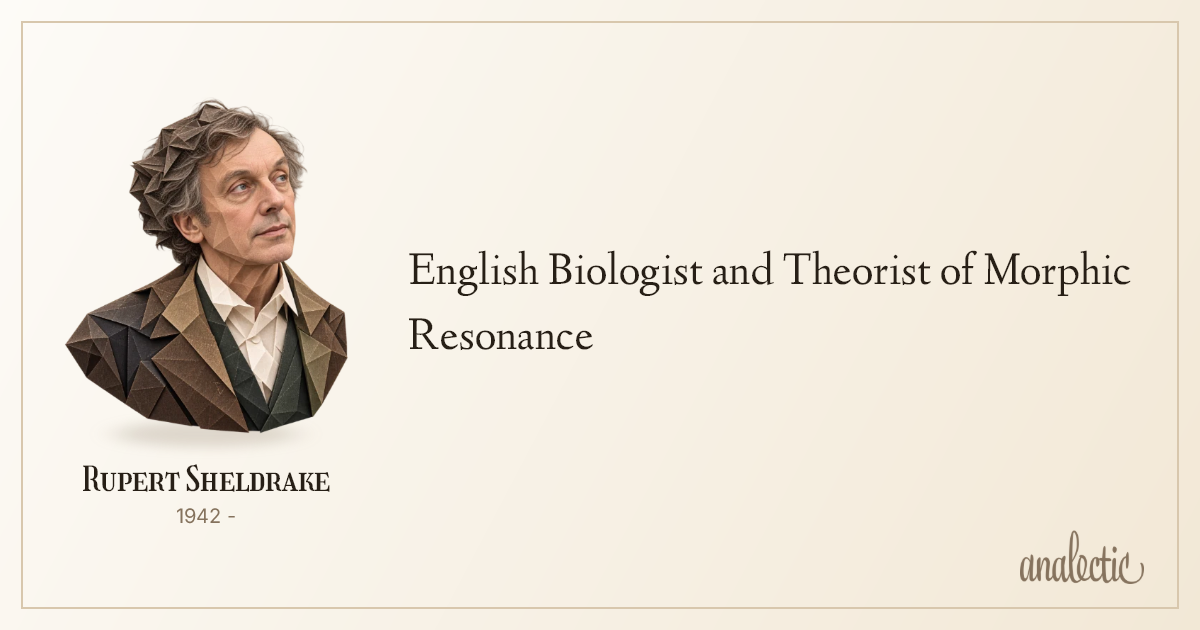
Rupert Sheldrake
English Biologist and Theorist of Morphic Resonance (1942 -)
Rupert Sheldrake was born on June 28, 1942, in Newark-on-Trent, England. After studying biochemistry at Cambridge University and philosophy at Clare College, he completed his PhD in plant physiology at Harvard University. While teaching biochemistry and cell biology at Clare College, Cambridge, his doubts about the traditional mechanistic understanding of biology deepened. These doubts led him to seek more holistic and teleological explanations for the organization of living systems, a quest that became the central focus of his career.Sheldrake provoked major controversy in the scientific world with the publication of his book 'A New Science of Life: The Hypothesis' in 1981, in which he proposed his theory of 'morphic resonance'. This theory posits that habits in nature are shaped not only by chemical laws but also by a memory transmitted through 'morphic fields' that transcend time and space between similar structures. This radical hypothesis offered a fresh perspective on biological development, behavior, and even cultural learning processes, presenting a strong alternative to Darwinism and mechanistic genetic determinism. His magnum opus, 'A New Science of Life', positioned him as a 'heretic' within conventional scientific circles while simultaneously making him a focal point of interdisciplinary interest.Sheldrake's work has had a lasting impact by challenging scientific dogmas and expanding the boundaries of scientific inquiry and the concept of 'scientific taboo'. His theories have become a significant reference point in the field of parapsychology, which explores potential links between biology and psychic phenomena. Today, although largely rejected by mainstream science, Sheldrake's ideas continue to exert influence within the philosophy of science, alternative medicine, and New Age thought, constituting an ongoing challenge for science to re-examine itself.
Rupert Sheldrake — alıntılar
- “Tourism is often a form of frustrated pilgrimage.”
- “Atheism is a purifying fire. It burns up religious hypocrisy, corruption, laziness and pretention. But its scorched-earth policy can leave many people spiritually hungry, thirsty and isolated.”
- “In rituals, patterns of activity are deliberately and consciously performed the way they were done before. In habits, previous patterns are repeated unconsciously; in rituals, they are repeated consciously. In habits, the presence of the past is unconscious; in rituals, it is conscious.”
- “Meditation is like breathing in, directing the mind inwards; and prayer like breathing out, directing the mind outwards.”
- “When people talk of being disenchanted, I take this literally and tell them the remedy for disenchantment is to chant. To enchant is to make, and to be made, magical through sound.”
- “Pilgrimage seems to be a deeply ingrained part of human nature, with its roots in the seasonal migrations of hunter-gatherers, and, more remotely, in many millions of years of animal migrations.”
- “In the pre-Reformation world, spiritual power resided in physical objects, such as the relics of saints or the consecrated Host, as well as in people. Humans were porous.”
- “Holiness is about connection and relationship. The word comes from a root that means whole or healthy. We are not holy when we are separated and disconnected from each other, from the more-than-human world and from the source of all being.”
- “Just as we can come into a kind of resonance with each other through love and through taking part in shared activities, so we may come into resonance with more-than-human minds when we are not preoccupied with our own desires, fantasies and fears.”
- “I cannot prove that the sun is conscious; but a sceptic cannot prove that it is unconscious. From a non-dogmatic point of view, the consciousness of the sun is an open question.”
- “If you form a relationship with a life form that is bigger and older than yourself, and which may go on living long after you die, it will help to put your life and your problems in a much broader perspective.”
- “If listening to music alone were enough to counteract depression, then depression would have decreased in recent decades, because music has become all-pervasive through radio, recordings, background music, film soundtracks, commercials, portable music players, and the Internet. But rates of depression have increased rather than diminished.”
- “Our entire culture is split between the experience of direct connections with the natural world, often established in childhood, and the mechanistic theory of nature that dominates the sciences and secular society.”
- “The materialist worldview is a belief system, not a statement of scientific facts.”
- “Spirituality remains the great hole in secularism, humanism, rationalism, atheism, and all the other defensive postures that reasonable men and women strike in the presence of unreasonable faith.”
- “As soon as we stop taking almost everything for granted, we begin to realise that we can be grateful for almost everything.”
- “Meditation is a spiritual practice because it is about living in the present, which can also be experienced as living in the presence of a mind or consciousness or awareness greater than one’s own.”
- “Rituals cross time, bringing the past into the present.”
- “Holy places can grow in holiness through people’s experiences within them.”
- “All the qualities we experience – colours, like green, and smells, like lavender – are present in the mind of God. We participate in the divine experience of qualities.”
- “Collectively we are potentially more vengeful and terrifying than any of the vengeful gods or goddesses in myths and legends. Our potential for acts of destruction is vaster.”
- “Materialism is not solely a philosophical theory. Below the surface, it is an unconscious cult of the Great Mother.”
- “We experience that which is holy when we are connected to the source of life that goes far beyond our own limited natures.”
- “The gift of sound is silence.”
- “Until we can talk about spirituality in rational terms – acknowledging the validity of self-transcendence – our world will remain shattered by dogmatism.”
Analectic üzerinde tüm alıntılarını incele →