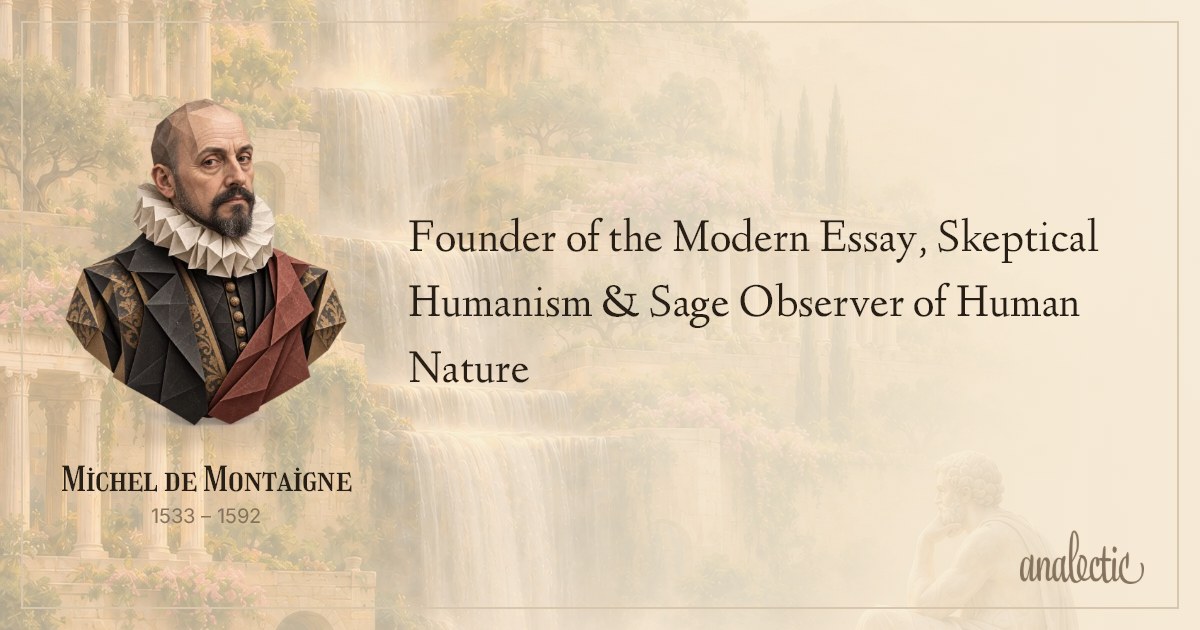
Michel de Montaigne
Founder of the Modern Essay, Skeptical Humanism & Sage Observer of Human Nature (1533 – 1592)
Michel Eyquem de Montaigne (February 28, 1533, Saint-Michel-de-Montaigne – September 13, 1592, Dordogne) was the preeminent humanist philosopher of the French Renaissance and the seminal originator of the modern essay (*l'essai*). Born into a wealthy noble household, Montaigne was raised under his father’s visionary pedagogical principles, speaking Latin as his primary language until the age of six. After rigorous training in law at the Collège de Guyenne and Toulouse, he served as a magistrate in the Parlement of Bordeaux. His intense philosophical communion with Étienne de La Boétie left an indelible mark on his soul; following La Boétie’s untimely death and appalled by the fratricidal carnage of the French Wars of Religion, Montaigne retired at age 38 to his secluded library tower at Château de Montaigne.
Surrounded by Greek and Roman maxims carved into the wooden rafters of his tower, he commenced writing his monumental masterpiece, the Essays (*Les Essais*). Placing the iconic question 'What do I know?' (*Que sais-je?*) at the core of his intellectual inquiry, he resurrected ancient Pyrrhonian skepticism to dismantle scholastic arrogance, fanaticism, and dogmatic certainty. Rejecting abstract metaphysical systems, he inaugurated a radically honest examination of the self: 'Every man bears the whole form of the human condition.' By candidly documenting his personal anxieties, physical ailments, kidney stones, and everyday habits, Montaigne demonstrated that intimate self-knowledge is the supreme gateway to universal human truth.
Far from being a detached recluse, Montaigne served as a trusted mediator between warring Catholic and Protestant factions and served two distinguished terms as Mayor of Bordeaux. His philosophical wisdom was fundamentally ethical and practical, formulating the supreme art of living harmoniously with nature. He maintained that true nobility consists in recognizing our shared frailty and living peacefully within our human limitations. Influencing generations of profound thinkers—including William Shakespeare, Francis Bacon, René Descartes, Blaise Pascal, Voltaire, and Friedrich Nietzsche—Montaigne bequeathed to posterity the liberating power of doubt, intellectual tolerance, and authentic self-possession.
Michel de Montaigne: quotes
- “Stubborn and ardent clinging to one's opinion is the best proof of stupidity.”
- “My life has been full of terrible misfortunes most of which never happened.”
- “Nothing fixes a thing so intensely in the memory as the wish to forget it.”
- “If there is such a thing as a good marriage, it is because it resembles friendship rather than love.”
- “If you press me to say why I loved him, I can say no more than because he was he, and I was I.”
- “I do not speak the minds of others except to speak my own mind better.”
- “When I play with my cat, who knows whether she is not amusing herself with me more than I with her.”
- “A good marriage would be between a blind wife and a deaf husband.”
- “I have never seen a greater monster or miracle in the world than myself.”
- “If a man urge me to tell wherefore I loved him, I feel it cannot be expressed but by answering: Because it was he, because it was myself.”
- “If a man should importune me to give a reason why I loved him, I find it could no otherwise be expressed, than by making answer: because it was he, because it was I.”
- “Confidence in the goodness of another is good proof of one's own goodness.”
- “I speak the truth not so much as I would, but as much as I dare, and I dare a little more as I grow older.”
- “In true education, anything that comes to our hand is as good as a book: the prank of a page- boy, the blunder of a servant, a bit of table talk - they are all part of the curriculum.”
- “No pleasure has any savor for me without communication.”
- “No wind serves him who addresses his voyage to no certain port.”
- “Age imprints more wrinkles in the mind than it does on the face.”
- “I quote others only in order the better to express myself.”
- “If you don't know how to die, don't worry; Nature will tell you what to do on the spot, fully and adequately. She will do this job perfectly for you; don't bother your head about it.”
- “I put forward formless and unresolved notions, as do those who publish doubtful questions to debate in the schools, not to establish the truth but to seek it.”
- “A man who fears suffering is already suffering from what he fears.”
- “The value of life lies not in the length of days, but in the use we make of them... Whether you find satisfaction in life depends not on your tale of years, but on your will.”
- “I study myself more than any other subject. That is my metaphysics, that is my physics.”
- “The most certain sign of wisdom is cheerfulness.”
- “Marriage is like a cage; one sees the birds outside desperate to get in, and those inside equally desperate to get out.”
- “He who fears he shall suffer, already suffers what he fears.”
- “Confidence in others' honesty is no light testimony of one's own integrity.”
- “A wise man sees as much as he ought, not as much as he can.”
- “Even from their infancy we frame them to the sports of love: their instruction, behavior, attire, grace, learning and all their words azimuth only at love, respects only affection. Their nurses and their keepers imprint no other thing in them.”
- “We only labor to stuff the memory, and leave the conscience and the understanding unfurnished and void.”
View on Analectic →