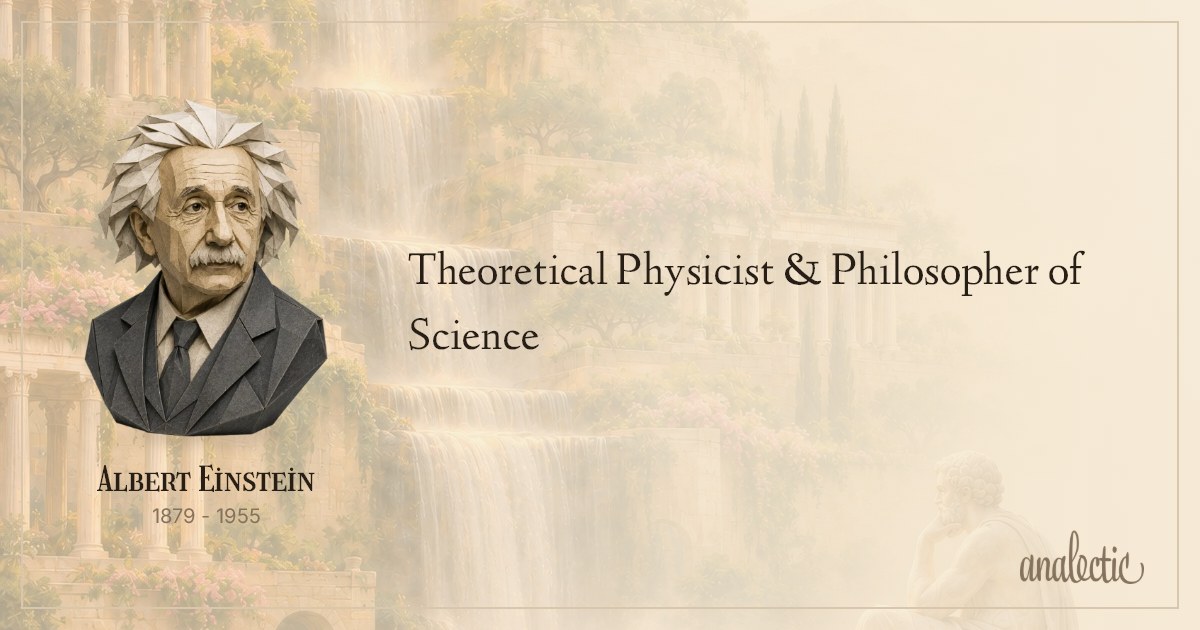
Albert Einstein
Theoretical Physicist & Philosopher of Science (1879 - 1955)
Albert Einstein (1879–1955) was born in Ulm, Germany, carrying from youth an insatiable curiosity that defied rigid scholastic dogmatism. Working as an unassuming examiner at the Bern Patent Office after his studies in Zurich, he conducted daring thought experiments that culminated in his 1905 'Annus Mirabilis.' In that singular year, Einstein published four revolutionary papers—explaining the photoelectric effect (which earned him the 1921 Nobel Prize in Physics), Brownian motion, and Special Relativity. With the immortal formulation E=mc², he dismantled the immutable Newtonian architecture of absolute space and time, demonstrating that reality is an interconnected fabric of relative motion.In 1915, he unveiled the General Theory of Relativity, recasting gravitation not as an invisible pull, but as the dynamic curvature of spacetime itself. Guided by a Spinozan reverence for the cosmic symphony, Einstein elevated physics into a profound philosophical contemplation of universal order. Exiled to Princeton by the rise of totalitarianism, he spent his remaining decades as a tireless advocate for nuclear disarmament, civil liberties, and unwavering pacifism. Einstein's enduring legacy transcends mathematical equations, standing as an eternal testament to intellectual audacity, moral conscience, and humanity's sacred capacity for cosmic wonder.
Albert Einstein: quotes
- “Life is like riding a bicycle. To keep your balance, you must keep moving.”
- “Imagination is more important than knowledge. For knowledge is limited, whereas imagination embraces the entire world.”
- “Human beings cannot be held responsible for falling in love.”
- “Everything should be made as simple as possible, but not simpler.”
- “Watch the stars and learn from them. Each must trace its path in silence, forever following the Master's ground, in honor of the Creator.”
- “When the solution is simple, God is answering.”
- “Few are those who see with their own eyes and feel with their own hearts.”
- “Problems cannot be solved at the same level of awareness that created them.”
- “Only two things are infinite: the universe and human stupidity, and I'm not sure about the first.”
- “Common sense is the collection of prejudices acquired by age eighteen.”
- “God does not play dice with the universe.”
- “Great spirits have always encountered violent opposition from mediocre minds.”
- “The real difficulty lies in this: How can we make our teaching so powerful in the emotional life of a human being that its influence can withstand the pressure of the fundamental psychic forces within the individual?”
- “If humanity is to survive, we need a fundamentally new way of thinking.”
- “I do not know with what weapons World War III will be fought, but World War IV will be fought with sticks and stones.”
- “If one of the aims of religions is to liberate humanity as much as possible from the bondage of selfish desires, wishes, and fears, then scientific reasoning can assist religion in another sense.”
- “Science without religion is lame; religion without science is blind.”
- “Put your hand on a hot stove for a minute, and it seems like an hour. Sit with a beautiful girl for an hour, and it seems like a minute. That's relativity.”
- “We cannot solve our problems with the same thinking we used when we created them.”
- “Peace cannot be kept by force; it can only be achieved by understanding.”
- “Look deep into nature, and then you will understand everything better.”
- “Logic will get you from A to B. Imagination will take you everywhere.”
- “It's not that I'm so smart, it's just that I stay with problems longer.”
- “Reality is merely an illusion, albeit a very persistent one.”
- “Anyone who has never made a mistake has never tried anything new.”
- “Love is a better teacher than duty.”
- “Nationalism is an infantile disease. It is the measles of mankind.”
- “Imagination is everything. It is the preview of life's coming attractions.”
- “If people are good only because they fear punishment, and hope for reward, then we are a sorry lot indeed.”
- “Any man who can drive safely while kissing a pretty girl is simply not giving the kiss the attention it deserves.”
View on Analectic →