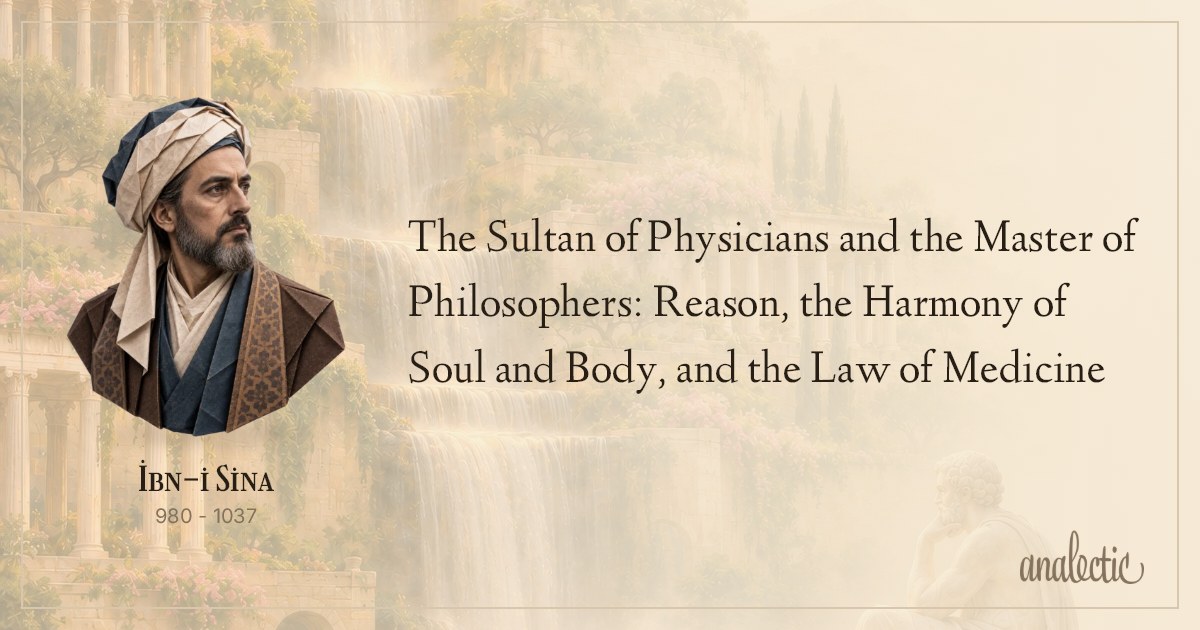
İbn-i Sina
The Sultan of Physicians and the Master of Philosophers: Reason, the Harmony of Soul and Body, and the Law of Medicine (980 - 1037)
Born in 980 near Afshana, close to Bukhara, Ibn Sina, even as a child of ten, demonstrated his extraordinary intellect by memorizing the Qur’an and excelling in language, literature, and geometry. At sixteen, he entered the field of medicine, assuming the treatment of Nuh ibn Mansur, the Samanid ruler, and thereby gaining access to the royal library. There, he turned night into day, meticulously studying ancient texts. Though he had read Aristotle’s Metaphysics forty times without comprehension, upon encountering Al-Farabi’s commentary, he cried out, ‘A torch has kindled within me!’—and embarked on an intellectual journey beyond the limits of reason. This discipline transformed him not merely into a physician, but into a thinker timeless in his insight.Known as ‘al-Shaykh al-Ra’is,’ he became the undisputed authority on medicine and philosophy in both East and West. His Al-Qanun fi al-Tibb formed the bedrock of European medical education until the seventeenth century; through his Kitab al-Shifa, he articulated, in a philosophical system, the harmony between intellect, soul, and body. With his famed ‘Flying Man’ thought experiment, he proved the soul’s independence from matter. His declaration, ‘There is no disease without a cure, only a lack of will,’ bestowed upon medicine the ontological significance of human volition. To him, nature operated as a perfect equilibrium governed by divine logic.His refusal of invitations from Mahmud of Ghazni led to a life marked by exile and political turmoil. Though he rose to the rank of vizier along the roads from Khwarezm to Isfahan, he was repeatedly cast into prison. Yet even in chains, he continued to write. From the back of a horse, even amid battlefields, he dictated his books to his students. When he breathed his last in Hamadan in 1037, he left behind a legacy of wisdom that would nourish the Renaissance: an eternal torch illuminating the mind of humanity.
İbn-i Sina: quotes
- “There are no incurable diseases; there is only a lack of will and perseverance.”
- “The physical world is transient; true reality is the eternal journey of the intellect and spirit toward perfection.”
- “Medicine is the science and art of preserving health when present, and restoring it when lost.”
- “Anger and anxiety are the most destructive poisons to the body; tranquil composure of the soul is the sovereign remedy.”
- “The intellect is a divine light capable of deciphering the cosmic order; do not extinguish it with dogma.”
- “To labor through the silent watch of the night while others sleep is the solitary price of true mastery.”
- “Whenever I encountered an impasse in logic, I sought tranquility to quiet my mind until clarity was restored.”
- “No adversity can divert a mind devoted to truth; neither exile nor prison can chain the sovereign intellect.”
- “A concentrated mind, even when stripped of bodily sensations, remains undeniably aware of its own existence.”
- “He who possesses no reason possesses no true faith, for wisdom reveals itself only to contemplative minds.”
- “Most ailments stem from delusion and fear; patience and courage are the supreme shield of health.”
- “To doubt and demand rigorous proof in science is the indispensable first step toward truth.”
- “Knowledge in the hands of one whose soul is undisciplined brings only harm to himself and society.”
- “Cleanse your intellect from trivial desires, so that like a pristine mirror, it may reflect eternal truth.”
- “Inner tranquility is the sacred state wherein the body, desires, and intellect abide in perfect equilibrium.”
- “Do not accept the assertions of authorities blindly; examine every claim through the rigorous filter of logic.”
- “The most impregnable fortress against the storms of time is an independent soul armed with wisdom.”
- “The purpose of medicine is to heal the body; the purpose of philosophy is to bring the soul to perfection.”
- “Intense focus upon a single inquiry unlocks the most intricate mysteries of existence.”
- “True courage is to carry the quiet torch of reason unflinchingly against the clamor of ignorance.”
- “An hour of profound contemplation is far more fruitful than years of mechanical memorization.”
- “Every created being possesses an innate yearning to reach its highest beauty and perfection.”
- “A life lived in serene contemplation is the noble harvest of a consciousness aligned with cosmic order.”
- “Fortitude in the face of political turmoil proves that the true scholar belongs to the realm of eternity.”
- “Direct your full attention to the underlying causes of things, for appearances are merely shadows.”
View on Analectic →