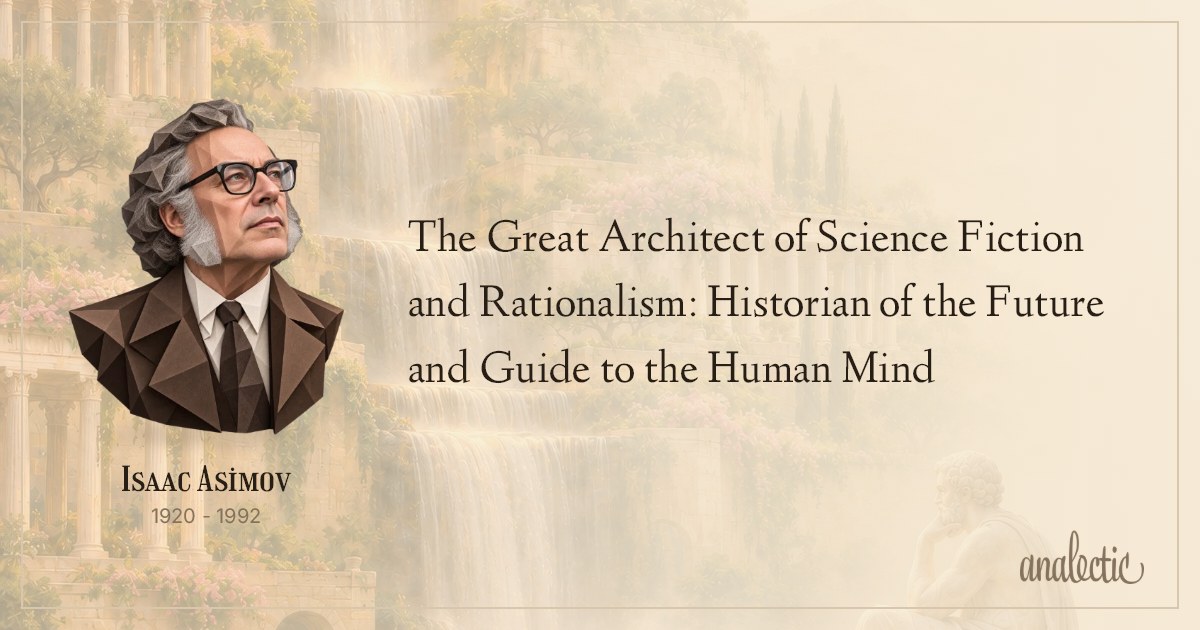
Isaac Asimov
The Great Architect of Science Fiction and Rationalism: Historian of the Future and Guide to the Human Mind (1920 - 1992)
Isaac Asimov was born in 1920 in the village of Petrovichi, Russia. At the age of three, he emigrated with his family to Brooklyn, New York, where his childhood spent in candy shops introduced him to science magazines. These publications ignited in him an insatiable curiosity about the mysteries of the universe. While pursuing a doctorate in biochemistry at Columbia University, he began writing stories that would define the Golden Age of science fiction in the 1940s. His prodigious intellect manifested not only in literature but also in disciplines such as chemistry, astronomy, and history—transforming his insatiable thirst for knowledge into a philosophy of life.Asimov, the most prolific author in the history of literature and scientific historiography with over five hundred books, introduced the concept of 'psychohistory' in his Foundation series, offering a mathematical perspective on the rise and fall of civilizations. The Three Laws of Robotics in 'I, Robot' became the first universal code delineating the ethical boundaries of artificial intelligence. Aphorisms such as 'Violence is the last refuge of the incompetent' and 'Self-education is the only form of education that exists' evolved into a manifesto of a worldview synthesizing rationalism with humanism.By highlighting the chasm between scientific progress and societal wisdom, Asimov emerged as a pioneer in the struggle against ignorance. Through his popular science writings, lectures, and a vision that inspired thinkers like Carl Sagan, he transformed rationalism into a cultural movement. Upon his passing in 1992, he left behind an intellectual legacy that shaped the future: a call to the human mind to embark on an unbounded quest for discovery—from robots to galactic empires. He was not merely a writer, but a guide who walked in the light of reason.
Isaac Asimov: quotes
- “The saddest aspect of life right now is that science gathers knowledge faster than society gathers wisdom.”
- “Violence is the last refuge of the incompetent.”
- “Self-education is, I firmly believe, the only kind of education there is.”
- “The most exciting phrase to hear in science, the one that heralds new discoveries, is not 'Eureka!' but 'That's funny...'”
- “If my doctor told me I had only six minutes to live, I wouldn't brood. I'd type a little faster.”
- “Never let your sense of morals prevent you from doing what is right.”
- “There is a cult of ignorance nurtured by the false notion that democracy means that 'my ignorance is just as good as your knowledge'.”
- “The true great joy lies not in possessing knowledge beforehand, but in pursuing truth and discovering it step by step.”
- “In life, unlike chess, the game continues after checkmate.”
- “It is change, continuing change, inevitable change, that is the dominant factor in society today. No sensible decision can be made without anticipating the future.”
- “To surrender to ignorance and call it God has always been premature, and it remains premature today.”
- “I write for the same reason I breathe; because if I didn't, I would die. Creation is my vital necessity.”
- “Life is pleasant. Death is peaceful. It's the transition that's troublesome.”
- “If knowledge can create problems, it is not through ignorance that we can solve them.”
- “A subtle thought that is in error may yet give rise to fruitful inquiry that can establish great truths.”
- “You must have the courage to question your deepest certainties; that is the very birthplace of reason.”
- “Humanity has survived catastrophe after catastrophe because the spark of curiosity in our spirit refused to be extinguished.”
- “Peace of mind belongs to those who have made peace with the vast and indifferent grandeur of the cosmos.”
- “Genius is not a lightning bolt; it is the patient accumulation of clear thoughts practiced day after day.”
- “Read relentlessly. To stop reading is to close the windows of the mind against the sunlight of new ideas.”
- “Any planet is 'Earth' to those that live on it. We are all passengers on the same fragile ship.”
- “Do not fear the unknown; fear the dogmas that pretend the unknown does not exist.”
- “When facing adversity, reason is our only reliable compass; emotion alone will steer the ship upon the rocks.”
- “Simplicity in expression reflects clarity of thought. A calm mind needs no complicated masks.”
- “Humanity has the stars in its future, and that future is too magnificent to be lost to narrow-minded folly.”
View on Analectic →