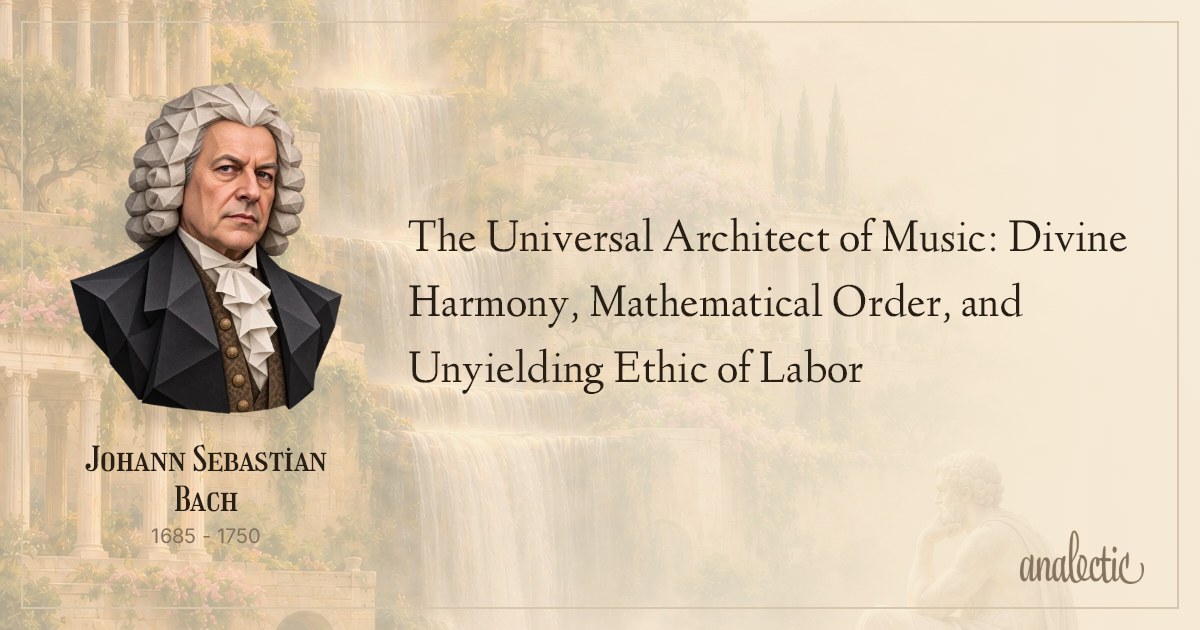
Johann Sebastian Bach
The Universal Architect of Music: Divine Harmony, Mathematical Order, and Unyielding Ethic of Labor (1685 - 1750)
Johann Sebastian Bach, born in Eisenach in 1685, was the brightest fruit of a family steeped for generations in music. The Bach lineage, home to more than fifty musicians, immersed him in the art from childhood, guiding him inevitably to the organ bench. Though orphaned at an early age, the sleepless nights spent in the dim corridors of churches were transmuted into an unrivaled virtuosity on the clavichord and violin. His years in Weimar, when he withdrew from the world and vanished into the layered textures of counterpoint, gave way in Köthen to the period in which he wove the foundational stones of polyphonic architecture. With the precision of a mathematician, he processed his notations, extending the boundaries of the Baroque into infinity.Upon his appointment as Kantor of the Thomaskirche in Leipzig, he composed a brand-new cantata each week, guided by the conviction that ‘the ultimate purpose of music is the glorification of God and the sanctification of the soul.’ From the tender choral passages of the Matthäus-Passion to the lyrical profundity of the Johannes-Passion, he rendered the sorrows of humanity in the language of notes. With the Well-Tempered Clavier, he expanded the horizons of tonality; in The Art of Fugue, he endowed counterpoint with a philosophical dimension. His declaration—‘I had to work hard; anyone who works as diligently as I did will reach the same height’—was not merely an aphorism, but an unshakable manifesto that undergirded his entire artistic being.Bach’s compositions were a architectural marvel, translating the cosmic order of the universe into harmony. The mathematical exactitude of his scores captured the deepest resonances of the human spirit, while his dialogue with the Divine transcended the limits of mortal genius. Though long believed forgotten after his death, Mendelssohn’s 1829 revival of the Matthäus-Passion restored him as the ‘eternal pole star’ of Western music. Today, the voice that echoes in every fugue and every chorale transforms the chaos of the mortal world into a divine harmony: a mosaic of truths beyond time.
Johann Sebastian Bach: quotes
- “I was obliged to be industrious. Whoever is equally industrious will succeed equally well.”
- “The aim and final end of all music should be none other than the glory of God and the refreshment of the soul.”
- “There's nothing remarkable about it. All one has to do is hit the right keys at the right time and the instrument plays itself.”
- “Ceaseless work, analysis, and persistence are the only true masters of art.”
- “Where there is devotional music, God is always at hand with His gracious presence.”
- “Order in art is not a constraint upon freedom; it is the very foundation upon which beauty can soar.”
- “I have had to work hard; anyone who works just as hard will get just as far.”
- “Harmony is the divine architecture that transforms fleeting sounds into timeless truth.”
- “Music washes away the dust of everyday life and restores the tranquility of the inner spirit.”
- “Mastery does not arrive by inspiration alone; it is forged through countless hours of quiet, patient labor.”
- “Each individual voice in a polyphony has its own dignity, yet all must weave together to form a greater unity.”
- “Do not seek the shallow applause of the world; seek the perfection of your craft.”
- “Difficulties are not obstacles in our path; they are the very tools that refine our understanding.”
- “To build a great work, one must possess the boldness to explore the uncharted depths of sound and soul.”
- “True tranquility is found not in the absence of sound, but in the perfect balance of every element.”
- “Music is the language of the cosmos; it calculates the infinite without ever uttering a single word.”
- “Repetition is not monotony; it is the sacred ritual by which the raw becomes sublime.”
- “Keep your heart undivided and your mind clear; a scattered soul cannot produce harmony.”
- “Grief and loss are woven into the fabric of life, yet music possesses the power to transfigure sorrow into grace.”
- “Never fear the complexity of a theme; trust the law of counterpoint to guide every voice to its rightful home.”
- “When the mind is still and receptive, even the simplest melody can open the gates of eternity.”
- “In every chord lies a dialogue between tension and resolution, reflecting the profound rhythm of existence.”
- “A craftsman must never rest upon yesterday's accomplishments, but greet each dawn as a fresh apprentice.”
- “To touch the essence of truth, one must strip away all superfluous ornaments and honor pure structure.”
- “Music is an invisible bridge between the mortal heart and the eternal order of the universe.”
View on Analectic →