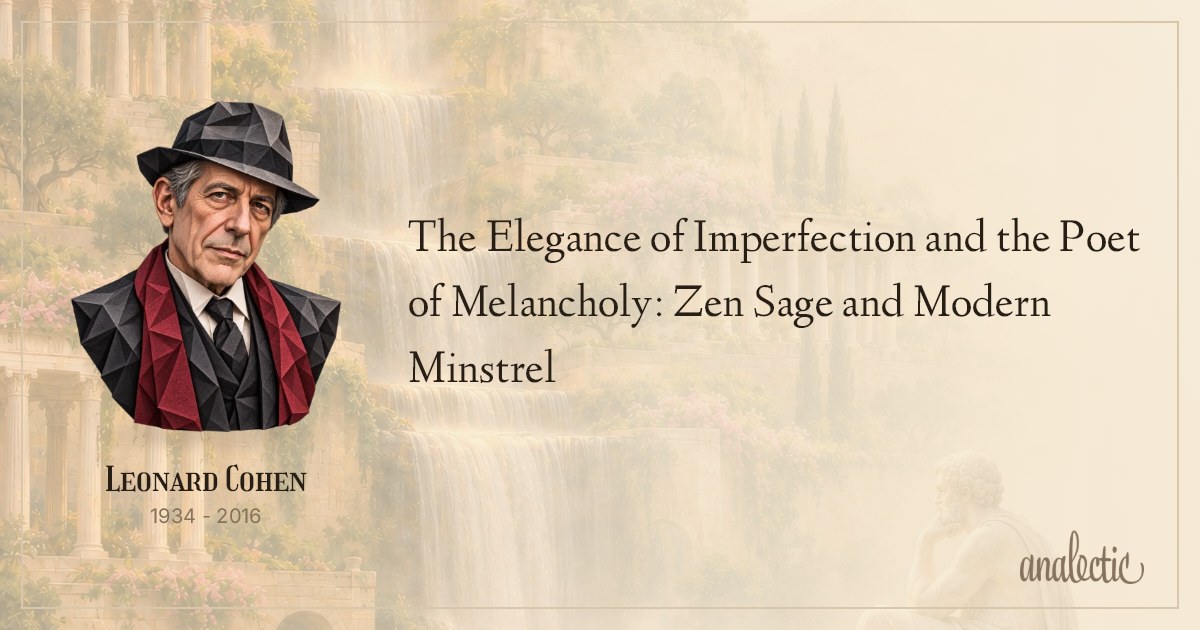
Leonard Cohen
The Elegance of Imperfection and the Poet of Melancholy: Zen Sage and Modern Minstrel (1934 - 2016)
Leonard Cohen, born in 1934 in Montreal’s Jewish quarter, was raised under the shadow of a profound Talmudic tradition and an insatiable passion for literature. His youth, crowned with poetry at McGill University, transformed in the 1960s into the reclusive life of a poet on the Greek island of Hydra. There, while composing his first novel, he took up the guitar at thirty—an instrument that would fuse the unadulterated lyricism of poetry with the intimate timbre of folk music, forging him into a singular artist. The tranquil waters of Hydra became his first sanctuary, nurturing the storms he wove with words.Cohen, with his deep baritone and voice like a broken hymn, revolutionized the history of music by transmuting the mystical love of Suzanne, the sacred anguish of Hallelujah, and the epistolary elegance of Famous Blue Raincoat into melody. In his verses, he portrayed love as a crucifix and melancholy as a rite of devotion. This Zen dervish, who sanctified imperfection with the words, 'There is a crack in everything, that’s how the light gets in,' embarked on a five-year spiritual purification at Mount Baldy Monastery in Los Angeles during the 1990s. The silence he discovered there deepened the quiet storms within his music.Though crowned with the Prince of Asturias Award and the Grammy Lifetime Achievement Award as the Socrates of the modern age and the dervish of words, Cohen’s true legacy lies in his alchemy of human fragility into a hymn of triumph. Even as he bid farewell in 2016 with You Want It Darker, this universal minstrel presented darkness not as a lament, but as a manifesto of enlightenment. In all his imperfection, he wrote the poetry of wholeness. That endless quest—where light seeps through the cracks—made him a timeless sage.
Leonard Cohen: quotes
- “What is the appropriate behavior for a man or a woman in the midst of this world, where each person is clinging to his piece of debris? What's the proper salutation between people as they pass each other in this flood?”
- “There is a crack, a crack in everything / That's how the light gets in.”
- “Poetry is just the evidence of life. If your life is burning well, poetry is just the ash.”
- “Act the way you'd like to be and soon you'll be the way you act.”
- “Ring the bells that still can ring / Forget your perfect offering / There is a crack in everything.”
- “You cannot run away from sorrow; you must invite it in, make it a cup of tea, and ask what it has come to teach you.”
- “Love is not a victory march / It's a cold and it's a broken Hallelujah.”
- “I don't consider myself a pessimist. I think of a pessimist as someone who is waiting for it to rain. And I feel soaked to the skin.”
- “The older I get, the surer I am that I'm not running the show.”
- “Like a bird on the wire / Like a drunk in a midnight choir / I have tried in my way to be free.”
- “Children show scars like medals. Lovers use them as a secret to reveal. A scar is what happens when the word is made flesh.”
- “We are so lightly connected to the world; yet we suffer as if we are bound to it with iron chains.”
- “To be a musician, to be an artist, is not a profession. It is a condition of existence.”
- “In solitude, you face the raw truth of who you are when nobody is applauding.”
- “Do not be afraid to look deeply into your own darkness; wisdom is born in the shadows.”
- “If you do not express your own original ideas, if you do not listen to your own being, you will have betrayed yourself.”
- “Silence is not empty; it is the sacred space where the soul speaks.”
- “I am ready, Lord; to face and surrender to the ultimate secret of life.”
- “We are all walking each other home across the fragile bridge of time.”
- “A song is a way of keeping the heart open when the world tries to shut it.”
- “Discipline is the only bridge between the chaos of the mind and the peace of the spirit.”
- “To write is to dig beneath the surface of everyday illusions until you touch living water.”
- “Do not seek a life without suffering; seek a spirit strong enough to transform suffering into beauty.”
- “Kindness is the highest form of rebellion against a cynical world.”
View on Analectic →