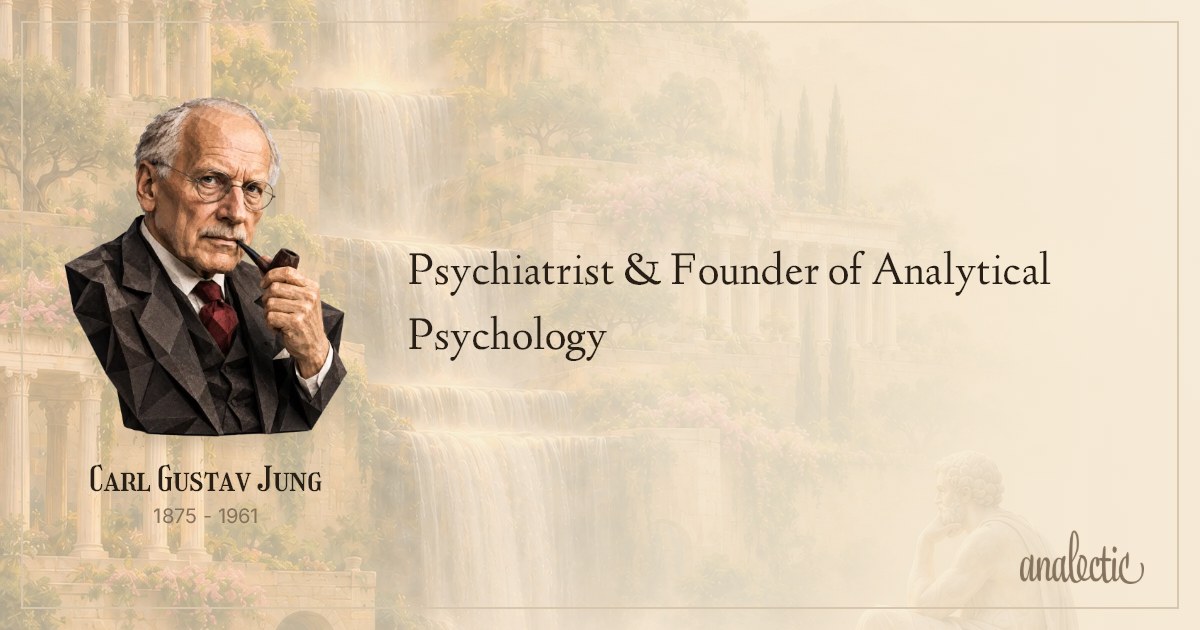
Carl Gustav Jung
Psychiatrist & Founder of Analytical Psychology (1875 - 1961)
Carl Gustav Jung was born in 1875 in Kesswil, Switzerland, amidst a landscape suspended between rural pastoral traditions and the ascendant rationalism of modern science. Haunted from an early age by vivid dreams, occult intuitions, and the spiritual anxieties of his clerical lineage, he pursued medicine at the University of Basel before joining Eugen Bleuler at the renowned Burghölzli Psychiatric Hospital in Zurich. His groundbreaking word-association tests drew the admiration of Sigmund Freud, inaugurating an incandescent yet volatile intellectual alliance. When ideological fractures over the nature of the libido and the metaphysical depth of the unconscious severed their kinship in 1913, Jung plunged into a legendary period of creative confrontation with his inner turmoil, chronicled in the mythopoetic pages of The Red Book.As the architect of Analytical Psychology, Jung synthesized empirical clinical rigor with ancient alchemy, Eastern metaphysics, comparative religion, and mythology. He bequeathed to modern consciousness transformative concepts: the collective unconscious, archetypes such as the Shadow and the Anima, and individuation—the lifelong, arduous pilgrimage toward psychological wholeness. Refusing to reduce the human spirit to mechanistic instinct, Jung envisioned the psyche as inherently teleological, propelled by a sacred hunger for meaning and integration. His enduring legacy transcends clinical psychiatry, casting an indelible illumination over twentieth-century philosophy, literature, and art, while forever challenging humanity to illuminate the immense, untamed cosmos within.
Carl Gustav Jung: quotes
- “Consciousness is the prerequisite for existence.”
- “A human being cannot endure a meaningless life.”
- “He who looks outside dreams; he who looks inside awakens.”
- “The greatest error is not to be aware of one's own errors.”
- “What you resist persists.”
- “Knowledge does not rest merely on the truth, but also on error.”
- “Fanaticism is found in those who live with inner contradiction.”
- “When some cannot understand the other, they call them foolish.”
- “We spend a large part of our lives in the unconscious.”
- “We are bound to this world with all our ego and thoughts.”
- “A million zeros lined up side by side, alas, still amount to nothing.”
- “Show me a man who is sane, and I will heal him for you.”
- “The aspects of others that irritate us reveal the parts of ourselves we have yet to understand.”
- “Thinking is a difficult art; that is why the majority follows the herd.”
- “Reaching Mars is easier than reaching oneself.”
- “If we do not face the darkness within us, we will never attain wholeness.”
- “I am not the sum of what happens to me; I am what I choose to become.”
- “A human becomes enlightened not by contemplating light, but by bringing darkness into consciousness.”
- “At the root of all mental illness lies the refusal to experience legitimate suffering.”
- “A person is not enlightened by imagining light, but by becoming conscious of darkness.”
- “We cannot change what we refuse to accept. Denial does not liberate us—it imprisons us.”
- “To be freed from the effect of a poison, you must drink it to the last drop.”
- “The more animals gather in herds, the wiser they become; the more humans gather in crowds, the more foolish they grow.”
- “No one becomes enlightened by imagining light; it is the confrontation with darkness that illuminates the human soul.”
- “To know one’s own darkness is the best way to deal with the darkness of others.”
- “The most pitiable thing in life is for a person to be unable to see that their problem stems from within themselves.”
- “Do not try to hold back someone who wishes to leave; otherwise, you will fail to see what is truly meant for you.”
- “The more we repress ourselves, the more we expose ourselves to the dangers of the unconscious.”
- “To think means to simplify, to highlight what matters, and to discard the insignificant.”
- “If we wish to change something in the child, we must first seek and transform it within ourselves.”
View on Analectic →