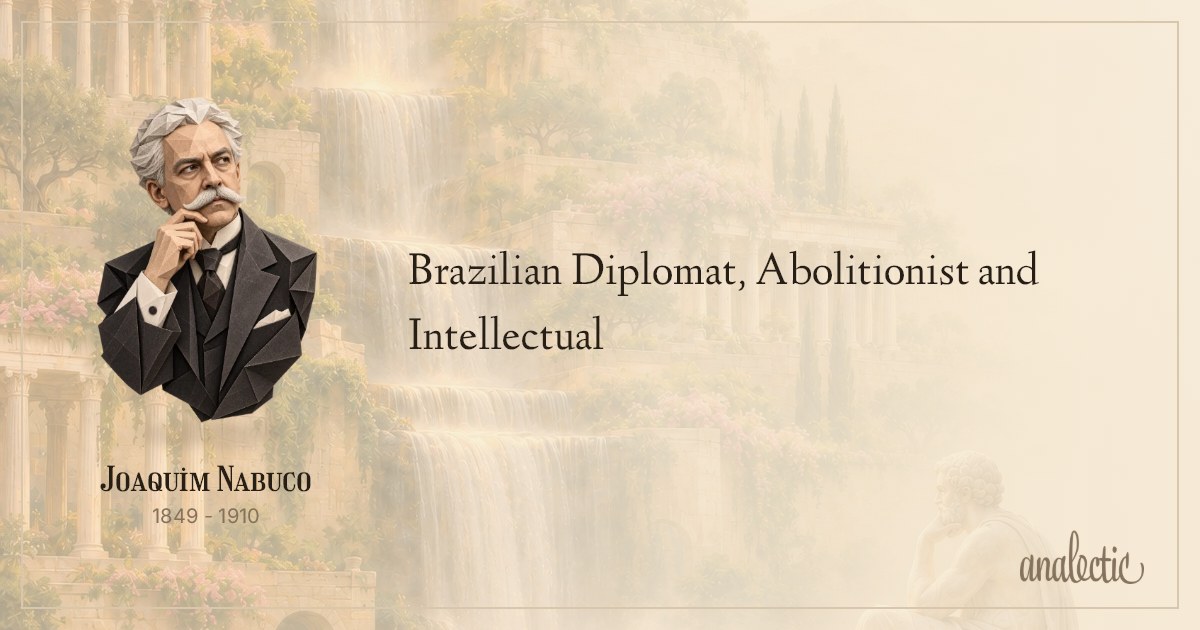
Joaquim Nabuco
Brazilian Diplomat, Abolitionist and Intellectual (1849 - 1910)
Joaquim Aurélio Barreto Nabuco de Araújo was born into an eminent family of 19th-century Brazil, in Recife, Pernambuco. His father, Senator José Tomás Nabuco de Araújo, played a decisive role in drawing him into the traditions of law and public service. After pursuing legal studies in Recife and São Paulo in his youth, he commenced his career as a lawyer and journalist. Yet, despite being raised in a society where slavery was institutionalized, he developed a profound moral opposition to the system from an early age. This stance laid the foundation for his engagement in the abolitionist movement, which would become the central struggle of his life, and shaped him not merely as a politician but as a moral philosopher and social reformer.Nabuco's political and intellectual legacy is defined primarily by his resolute parliamentary and public campaign for the abolition of slavery, culminating in the Lei Áurea of 1888. As a congressman from 1878 onward, he distinguished himself through fiery oratory, arguing that slavery was not merely an economic issue but a stain that weakened the nation's moral foundations. His seminal work, 'O Abolicionismo' (1883), is a foundational text that systematically analyzes how slavery permeated the entire fabric of Brazilian society; therein, he contends that slavery morally enslaved and stunted not only Black people but the entire nation. His diplomatic career, particularly his tenure as Ambassador to the United States, was dedicated to strengthening Pan-American ideals and his country's prestige on the international stage. Furthermore, his loyalty to Emperor Pedro II and his defense of the monarchy's role in modernization reflect his particular brand of conservative liberalism.The legacy of Joaquim Nabuco endures as that of a central figure in the construction of Brazil's national identity. As one of the most influential voices of the abolitionist movement, he advocated not merely for a legal change but for a profound social and moral transformation. His ideas left a deep imprint on 20th-century Brazilian thought, especially on sociologists such as Gilberto Freyre. His activities in the Brazilian Historical and Geographical Institute (IHGB), of which he was a founder and first president, and in the Brazilian Academy of Letters (ABL) demonstrate his commitment to the preservation of cultural and intellectual heritage. Nabuco is regarded as one of the paramount moral voices in Brazil's transition from monarchy to republic, a statesman, orator, and thinker whose reflections on human dignity, the rule of law, and national reconciliation retain their relevance to this day.
Joaquim Nabuco: quotes
- “In the examination of our past, I have observed one thing: how futile our attempts to belittle it are.”
- “In our history there will never be either a Hell or a Purgatory.”
- “Lamennais's 'Words of a Believer', Lamartine's 'History of the Girondins', Pelletan's 'The World Progresses', Esquiros's 'Martyrs of Liberty' were the four Gospels of our generation, and Quinet's 'Ahasvérus' was its Revelation.”
- “Thus, pomp, majesty, all the splendour of royalty, whatever the cultural level of society, entered for me among the necessary instruments to govern and satisfy the imagination of the masses.”
- “When the two governments are compared, the American government appears to me like a clock that shows the hours of public opinion, while the British government was like a clock that shows even the seconds.”
- “For me, the Republic was a clock that needed its spring rewound after a short time; the Monarchy was like an almost eternal clock.”
- “From a very young age, there was in my soul an anxiety that drew me to politics and yet was, in a way, a kind of talisman against it: slavery.”
- “The personal imprint that every writer possesses is now fixed, it will change no more.”
- “I am a spectator of my century, not of my country; the play for me is civilization, if it is represented on all the stages of humanity linked today by telegraph.”
- “I never knew that particular pleasure of the politician in the struggle of parties; in politics I sought the moral side, I imagined it as a kind of modern chivalry, a knight-errantry of principles and reforms.”
- “We Brazilians – and the same may be said of other American peoples – belong to America through the new, suspended sediment of our soul, and to Europe through its stratified layers.”
- “Poetry is the noblest form of thought.”
- “What gives London that tone of majesty and dominion is the dignity, the silence that envelops it; the tranquility, the calm, the repose, the security it breathes.”
- “France is a great country and a free country, but it lacks a rooted spirit of liberty; it is always subject to the crises of revolutions and glory.”
- “For the Englishman, if liberty is man's great quality, which he feels as the development of personality, order is the true social architecture.”
- “Legends will always live like beams of light in the accumulated darkness of the past, but their beauty lies not in their truths, which are always small; it lies in the effort of humanity to thus retain some fragments of so long a life that no memory could possibly encompass...”
- “The question of initiative is already of a wholly secondary importance, especially when the idea is in the air and the spirit of the time is animating it everywhere.”
- “The moment when selfishness first gave way to sacrifice and man trembled for the fate of his kin, the feeling of dependency entered his heart and thus religion was born. Primos in orbe deos fecit timor. The first gods were created by fear, fear for love.”
- “Science is truly the mirror of infinity, but a mirror broken into fragments that only religion can reassemble.”
- “If God did not exist, man would be a mere automaton. Before such a concept, moral pride becomes impossible. Esteem could only enter his soul with the opposite concept that he is a free being. In universal automatism, freedom could have no moral meaning, nor could it have a purpose.”
- “The most glorious years of great careers will often pass unrecorded, and lives that seem ordinary from a human perspective will deserve full pages.”
- “Thoroughbred atheists are rare. He who investigates their origins will soon reach the trunk of faith.”
View on Analectic →