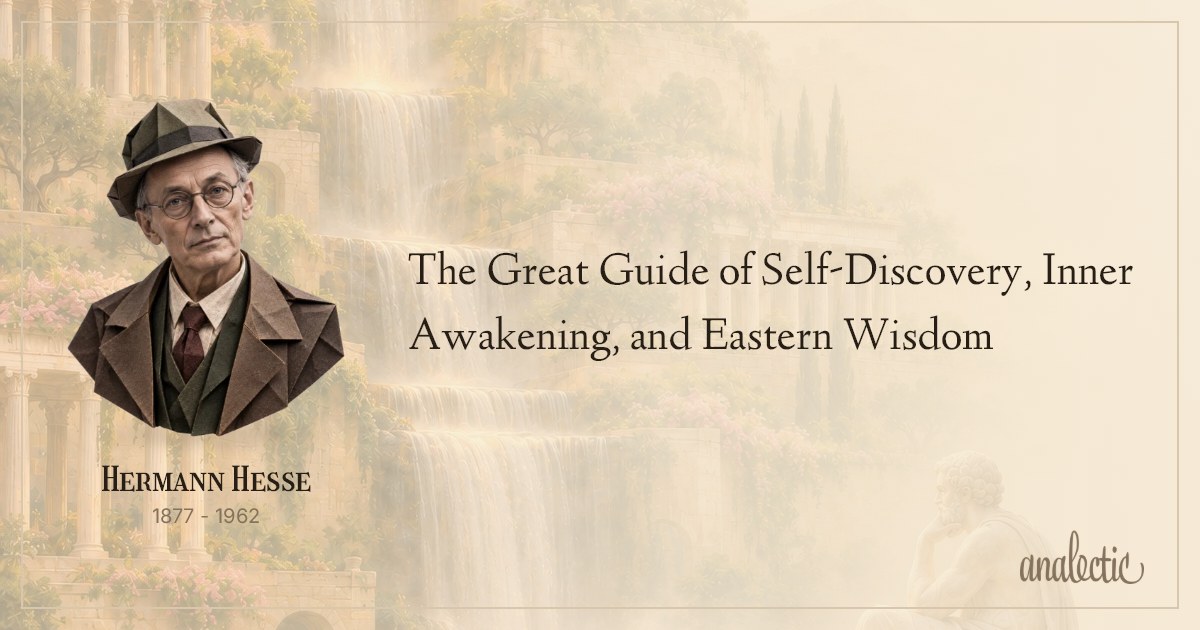
Hermann Hesse
The Great Guide of Self-Discovery, Inner Awakening, and Eastern Wisdom (1877 - 1962)
Hermann Hesse was born in 1877 in Calw, Germany, into a devout and rigid family of missionary heritage. In his youth, fleeing the oppressive Christian orthodoxy of his family, he worked as a clockmaker and bookseller—a period during which he encountered Goethe and Nietzsche. His journey to India in 1911 forged a profound bond with Buddhism and Eastern mysticism. Opposing the militaristic madness of World War I, he settled in the Swiss village of Montagnola, where, amid the dark labyrinths of the human soul, he crafted works that placed the individual’s inner quest at the very heart of literature.Deeply influenced by Carl Gustav Jung’s psychoanalysis, Hesse symbolized the individual’s shadow self in ‘Demian’ and Buddhist enlightenment through the tranquil flow of a river in ‘Siddhartha.’ In ‘Steppenwolf,’ he portrayed the fractured spirit of modern humanity through Harry Haller, a man who rebels against society’s hypocritical norms. Hesse wrote the manifesto of personal enlightenment when he declared, ‘The sole true purpose of human life is to find the path to one’s authentic self,’ offering Eastern wisdom as an antidote to the West’s spiritual crisis. For him, truth did not flow from books, but from the inner journey of the soul: ‘Knowledge may be transmitted, but wisdom must be lived.’Recipient of the Nobel Prize in Literature in 1946, Hesse united music, mathematics, and philosophy into a universal language in ‘The Glass Bead Game,’ bequeathing to humanity an intellectual utopia. This wise author, who affirmed, ‘Softness is stronger than hardness, water more enduring than stone,’ championed the liberation of the human spirit through harmony with nature and transcendence of inner conflict. Though he departed from us in 1962, his legacy—carrying the universal light of humanism to all who wander the labyrinths of the soul—endures as a timeless guide.
Hermann Hesse: quotes
- “The true vocation of a man is to find the path to himself.”
- “Wisdom cannot be imparted. Wisdom that a wise man attempts to impart always sounds like foolishness to someone else. Knowledge can be communicated, but not wisdom.”
- “Some of us think holding on makes us strong, but sometimes it is letting go.”
- “Soft is stronger than hard, water is stronger than rock, love is stronger than violence.”
- “I wanted only to live in accord with the promptings which came from my true self. Why was that so very difficult?”
- “You must be ready to burn yourself in your own flame; how could you rise anew if you have not first become ashes?”
- “Words do not express thoughts very well. They always become a little different immediately after they are expressed, a little distorted, a little foolish.”
- “Within you there is a stillness and a sanctuary to which you can retreat at any time and be yourself.”
- “If you hate a person, you hate something in him that is part of yourself. What isn't part of ourselves doesn't disturb us.”
- “To achieve the possible, one must constantly attempt the impossible.”
- “There is no reality except the one contained within us. That is why so many people live an unreal life.”
- “Every great realization is born out of pain, and every deep awakening requires the shattering of an old illusion.”
- “When someone seeks, then it easily happens that his eyes see only what he seeks, and he cannot find anything, because he is obsessed with his goal.”
- “Learn to listen to the river of life; in its gentle current, every sorrow eventually dissolves into peace.”
- “The bird fights its way out of the egg. The egg is the world. Who would be born must first destroy a world.”
- “Solitude is independence. It had been my wish and with the years I had attained it. It was cold, still, and wondrously vast.”
- “A master is not someone who knows everything, but someone who never ceases to learn with humility.”
- “Grief and joy are the twin wings of the soul; without both, we cannot take flight into wisdom.”
- “Do not let the judgments of the crowd cloud the quiet whisper of your own inner truth.”
- “Eternity is not a vast amount of time; it is the timeless presence of this very moment.”
- “Opposites are not enemies; they are complementary halves of the single, indivisible truth of life.”
- “To be afraid of life is the greatest danger. Step boldly onto your uncharted path.”
- “Inner harmony is not a gift bestowed by chance; it is a daily discipline cultivated in the silence of the soul.”
- “Nothing is pure that has not passed through the fire of deep reflection and conscious choice.”
- “In the end, all rivers reach the sea; and in that boundless ocean, all our separate journeys become one.”
View on Analectic →