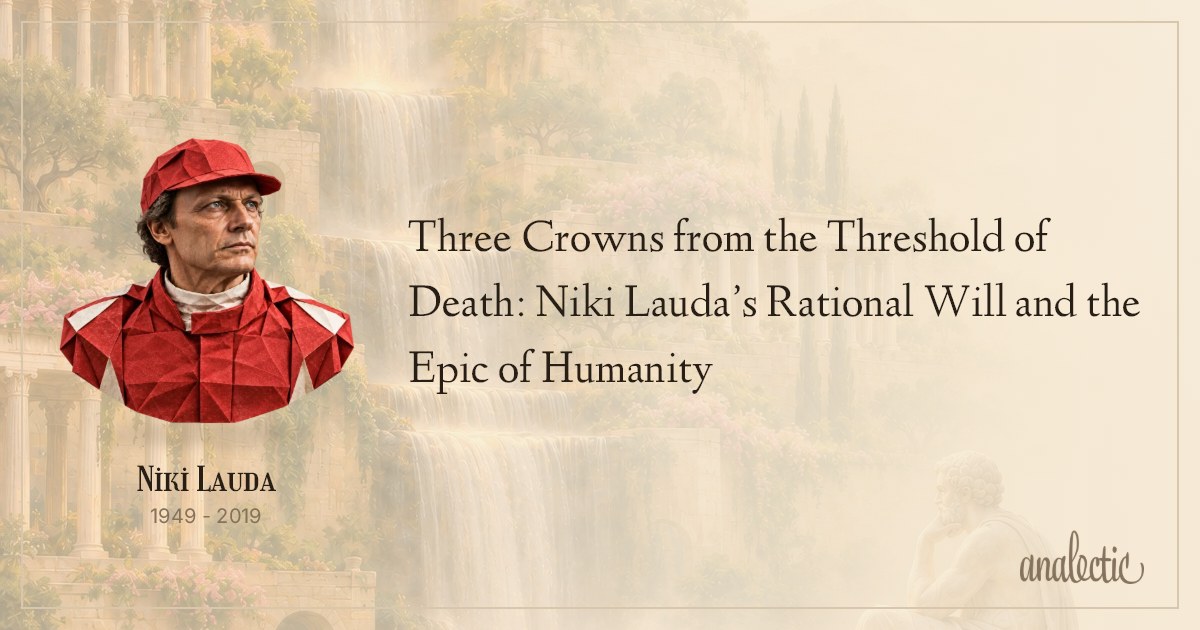
Niki Lauda
Three Crowns from the Threshold of Death: Niki Lauda’s Rational Will and the Epic of Humanity (1949 - 2019)
Born in Vienna in 1949, Niki Lauda wrote history not as an heir to a textile empire, but by pledging a bank loan against his family’s fury to buy his racing seat. When he transferred to Ferrari, he engraved his engineering genius onto every millimeter of the track: calculating engine revolutions with mathematical precision, analyzing tire wear with the rigor of a chemist. In winning his first championship in 1975, he redefined the symbiotic dance between machine and human. To him, the automobile was not 'soulless metal,' but an organic being that breathed with the driver’s intellect.After surviving 55 seconds engulfed in flames during the 1976 Nürburgring crash—his lungs charred, his face melted—he crafted a mathematical equation to cling to life: he transformed pain into a data point and planned his recovery like a racing strategy. When he returned to the steering wheel at Monza with bleeding eyelids, humanity rediscovered the meaning of 'courage.' By the time he won his third championship in 1977, his burn bandages had become medals of victory. In 1984, when he clinched the title by just half a point with McLaren, he proved to the world the mathematical projection of sheer determination.Lauda, who said, 'Risk, if accepted, is courage,' penned the philosophical manifesto of motorsport when he rejected death at Fuji for the sake of the championship: the sanctity not of victory, but of life. Though his body departed in 2019, his legacy still echoes through every corner: he taught that courage is not blind recklessness, but the sum of rational choices. Every scar is forever displayed in the temple of the track as an eternal testament to the human will defying death.
Niki Lauda: quotes
- “You learn nothing while winning. The real life lessons are hidden in the days you crash and lose.”
- “Forty-two days after the Nürburgring fire, sitting in the cockpit at Monza with my face wrapped in bandages was not an act of heroism; it was simply my refusal to let fear take me captive.”
- “Leave your emotions outside the steering wheel. When driving at three hundred kilometers per hour, the only thing you need is pure, cold, rational logic.”
- “Discipline is knowing when to press the gas, just as much as knowing when to hit the brake to save your life.”
- “When I look in the mirror, I see my scars and I tell myself: 'Despite everything you've been through, you're still here, still standing.'”
- “The burns on my face may frighten others; but for me, they are honorable badges of survival and struggle.”
- “I withdrew from the race at Fuji, at the cost of the championship; because my life was worth more than a foolish trophy. True courage is sometimes the ability to say 'stop'.”
- “Think only of your car's balance and the asphalt ahead, not your rivals. The moment your attention falters, the race is over.”
- “Inner calm is the ability to trust your own reality, even when the entire world speaks against you.”
- “Success does not come by chance. Every hour I spent with engineers was the foundation of the seconds I won on the track.”
- “What takes a person to success is not their ego, but their capacity to mercilessly analyze their mistakes and correct them.”
- “When everyone thought I would give up, I returned and became world champion again. Willpower always surpasses the limits of the body.”
- “You cannot live without taking risks; but you must draw a very clear line between foolish risks and professional risks.”
- “Be obsessive about details. Between a loose bolt and your life, there is only one corner.”
- “Both praise and criticism are illusions. You alone know yourself best; the rest is merely dry noise.”
- “Your words must be clear, your work flawless. Empty talk does not gain you time on the track.”
- “Life is based on a very simple principle: fully commit yourself to what you do and take full responsibility for the consequences.”
- “Even while having the toxic smoke cleared from my lungs in the darkest hospital room, my mind was only on the next race.”
- “Fear is the most natural instinct in a human being; what matters is not hiding behind that fear, but confronting it.”
- “I did not race to become a legend; I lived to test the limits of machines and the power of my own mind.”
View on Analectic →