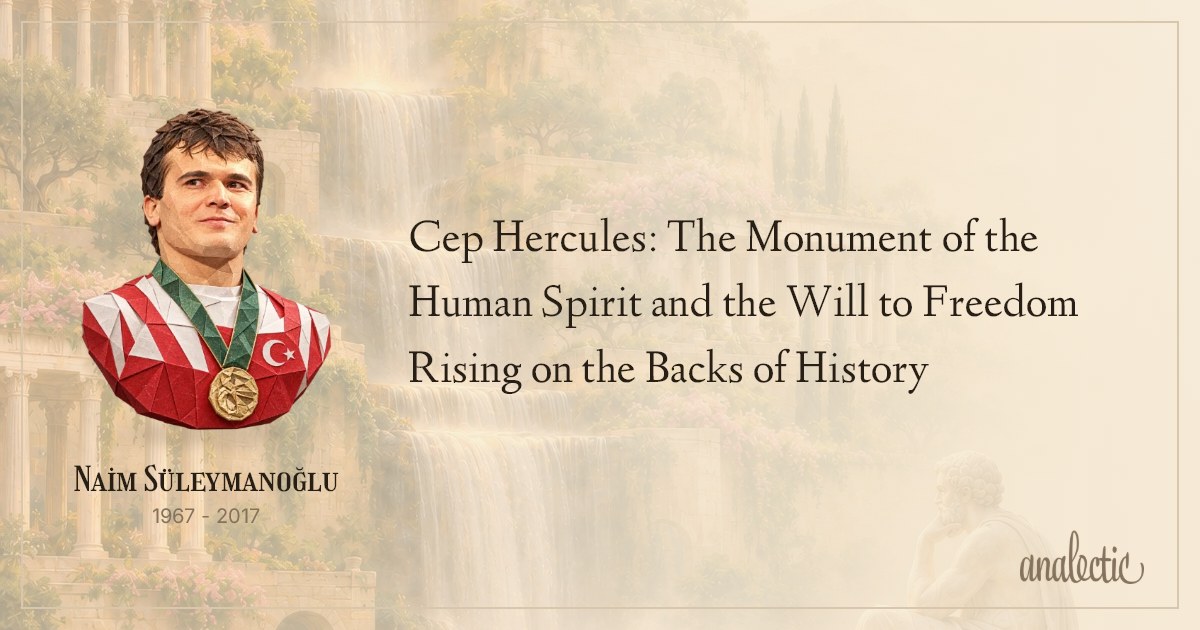
Naim Süleymanoğlu
Cep Hercules: The Monument of the Human Spirit and the Will to Freedom Rising on the Backs of History (1967 - 2017)
Naim Süleymanoğlu, born in 1967 in the Bulgarian town of Mestanlı, was hailed as the 'child prodigy of weightlifting' at just 16 when he broke a world record—yet the world still did not know the true strength behind his iron wrists. His refusal to adopt the name 'Naum Shalamanov' during the totalitarian regime's forced name-change campaigns against Turks transformed him from merely an athlete into a symbol of resistance. This young man, defying barbaric policies, turned every steel bar he lifted on the platform into a moral blow against a system that sought to erase his identity.His escape to freedom in 1986, orchestrated by Turkish intelligence in a 'film-like operation' at the World Championships in Melbourne, became the most epic escape story in sports history. Two years later, at the Seoul Olympics, the total of 342.5 kg he lifted with his 60-kilogram frame shattered not only the laws of physics but also humanity's perception of its own limits. This gem, featured on the cover of Time magazine as 'The Strongest Man in the World,' could not hold back his tears as he gazed at the Turkish flag waving on the podium; for every tear at that moment was the voice of his oppressed compatriots under Bulgarian tyranny.Süleymanoğlu, who claimed three Olympic golds, set 46 world records, and earned the nickname 'Cep Hercules,' ascended to the pantheon of sports. But his true victory came in 1996, when he spoke with a trembling voice before the UN Commission on Human Rights: 'It is not the arms that lift weights—it is the heart.' His journey, which began as a child laborer in tobacco fields, became a universal manifesto of human dignity. When he surrendered his breath in 2017, the legacy he left behind was not merely medals, but the will that shattered the chains of a people: History would write him down as the man who lifted patriotism heavier than iron.
Naim Süleymanoğlu: quotes
- “It is not your arms or legs that lift the weight; it is the unshakable belief in your heart and your love for your nation.”
- “When I lifted three times my own body weight on the podium, the iron bar carried not just ninety kilograms, but the honor and cry of freedom of a nation.”
- “I gripped that barbell for eight hours a day until my palms shattered and my calluses bled. These records deemed impossible are the legacy of those bleeding hands.”
- “That night, under pressure and threats, I ran alone toward freedom—it was a test of courage heavier than all the weights on the podium.”
- “When I step under the bar, the thousands of people, the lights, and the sounds in the hall vanish. In the universe, only I, the iron, and God remain.”
- “Inner calm is the ability to control your breath and steady your heart even in those moments when the whole world expects you to fail.”
- “Whether your neck is short or long doesn't matter; what matters is how colossal your dreams and willpower are.”
- “Despite the injuries on my shoulder and knee, I stepped onto that podium; because giving up never had a place in my vocabulary.”
- “Discipline is the determination to do one more repetition in those cold gyms when no one is watching.”
- “When I reached 190 kilograms at the Seoul Olympics, the world held its breath. In that moment, I was locked not by fear, but by victory.”
- “I broke forty-six world records; but for me, the greatest record was being able to make the voices of my oppressed compatriots heard across the entire world.”
- “The moment you touch the iron, there is no doubt. If you don't believe with 100% certainty that you can lift it, the weight will crush you.”
- “You may fall, the weight may slip from your hands; but what makes a champion a champion is the ability to rub magnesium on your palms and climb back onto that podium.”
- “The fame brought by victory is fleeting; what endures is humility and the pure love you leave in the hearts of your people.”
- “Talent is only a seed; if you do not water it daily with sweat, it will wither away.”
- “History remembers only the brave hearts who dare to walk toward goals that seem impossible.”
- “We lift the barbell not just to lift it, but to plant the flag on our chest to its highest peak.”
- “You may grimace when you suffer pain; but never extinguish the fire of victory in your eyes.”
- “The mind must have already lifted the weight; the arms merely execute the command given by the mind.”
- “I am Naim Süleymanoğlu; I showed the world the will of a great nation in a small body.”
View on Analectic →