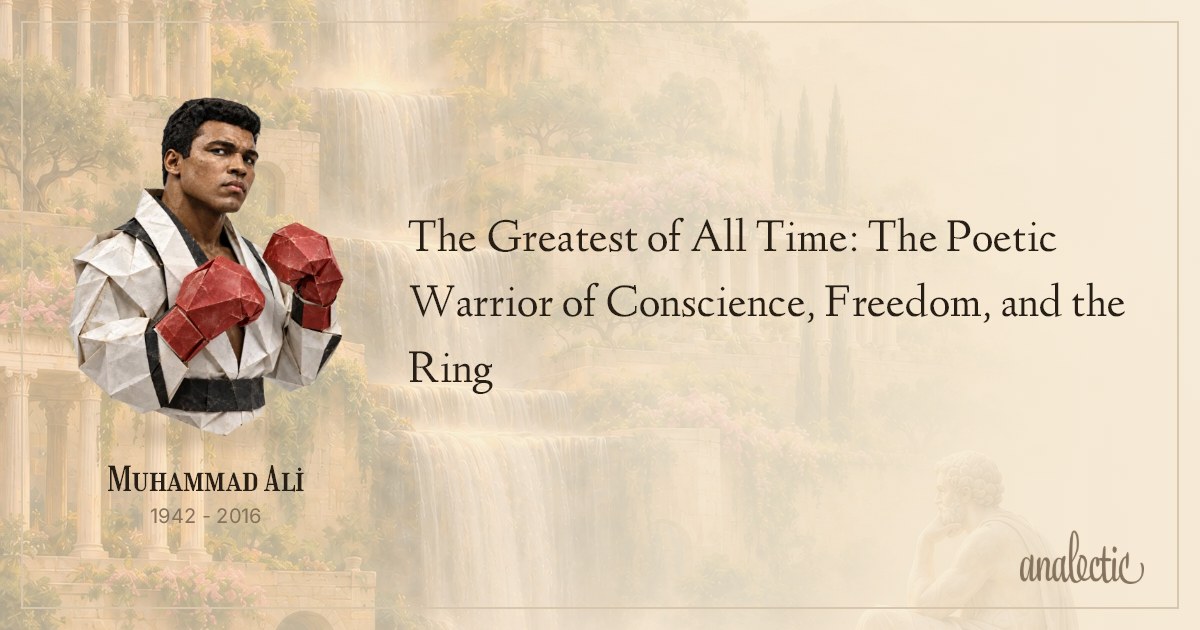
Muhammad Ali
The Greatest of All Time: The Poetic Warrior of Conscience, Freedom, and the Ring (1942 - 2016)
Born in 1942 in Louisville, Kentucky—a city walled by racial prejudice—Cassius Clay forged his destiny in a boxing gym, where he first picked up gloves to avenge a stolen red bicycle. The young man who hung the gold medal from the 1960 Rome Olympics around his neck soon found himself barred from even sipping a coffee at a diner back home because he was Black; in despair, he cast the medal into the dark waters of the Ohio River. The night he toppled the supposedly invincible Sonny Liston to become world champion in 1964, he embraced Islam and took the name Muhammad Ali—not merely a change of name, but a manifesto of liberation.He touched the ring with the grace of a butterfly and struck with the fury of a bee. Every punch was a verse, every dance a revolution. When he refused to fight in the Vietnam War, saying the Viet Cong had never subjected him to the racism he faced at home, he lost his title, his license, his career—but never his humanity. During those three and a half years spent away from the ring, he taught the world a lesson in conscience: 'I refuse to betray my people.' He did not merely defy the law—he shattered oppression.In 1974, in Zaire, he shattered George Foreman’s devastating power with the logic of poetry in the 'Rumble in the Jungle.' His epic battle against Joe Frazier in Manila, the 'Thrilla in Manila,' became a breathless hymn to the human will. Though he became world champion three times, he declared, 'My greatest victory was never bowing to anyone.' In his final years, battling Parkinson’s, the moment he lit the Olympic flame in Atlanta 1996 with trembling hands delivered his final lesson to humanity: 'Impossible is only a dream for the small-minded.' He became the voice of the oppressed and the breath of the defiant.
Muhammad Ali: quotes
- “I hated every minute of training, but I said, 'Don't quit. Suffer now and live the rest of your life as a champion.'”
- “Float like a butterfly, sting like a bee. The hands can't hit what the eyes can't see.”
- “He who is not courageous enough to take risks will accomplish nothing in life.”
- “Champions are made from something deep inside them—a desire, a dream, a vision.”
- “It's the repetition of affirmations that leads to belief. And once belief becomes deep conviction, miracles happen.”
- “Don't count the days; make the days count.”
- “I am the greatest, I said that even before I knew I was.”
- “A man who views the world the same at fifty as he did at twenty has wasted thirty years of his life.”
- “Inside the ring or out, there is no shame in going down. It is staying down that is defeat.”
- “Service to others is the rent you pay for your room here on earth.”
- “If my mind can conceive it, and my heart can believe it—then I know I can achieve it.”
- “To endure years of banishment without bending one's moral principles is true heavyweight courage.”
- “The calm stillness before the bell rings is where the warrior centers his soul and surrenders to destiny.”
- “Discipline is rising before dawn to run in freezing cold while the rest of the city sleeps.”
- “Wisdom is knowing when to speak like thunder and when to dwell in total serenity.”
- “Absorbing the opponent's fury with tranquil patience until his storm exhausts itself is the highest art.”
- “Concentrate your energy upon the absolute truth, and no deception can withstand the blow.”
- “A person who possesses no imagination has no wings to fly beyond boundaries.”
- “Physical frailty cannot diminish the inner radiance of a spirit that stood fearlessly for justice.”
- “I took a stand when it cost everything; a champion's greatest belt is his uncorrupted conscience.”
- “Silence the doubts of the crowd by the unwavering rhythm of your solitary labor.”
- “True peace comes when your actions are aligned with your eternal creator and conscience.”
- “Live each day with noble purpose, leaving an indelible legacy of courage for all humankind.”
View on Analectic →