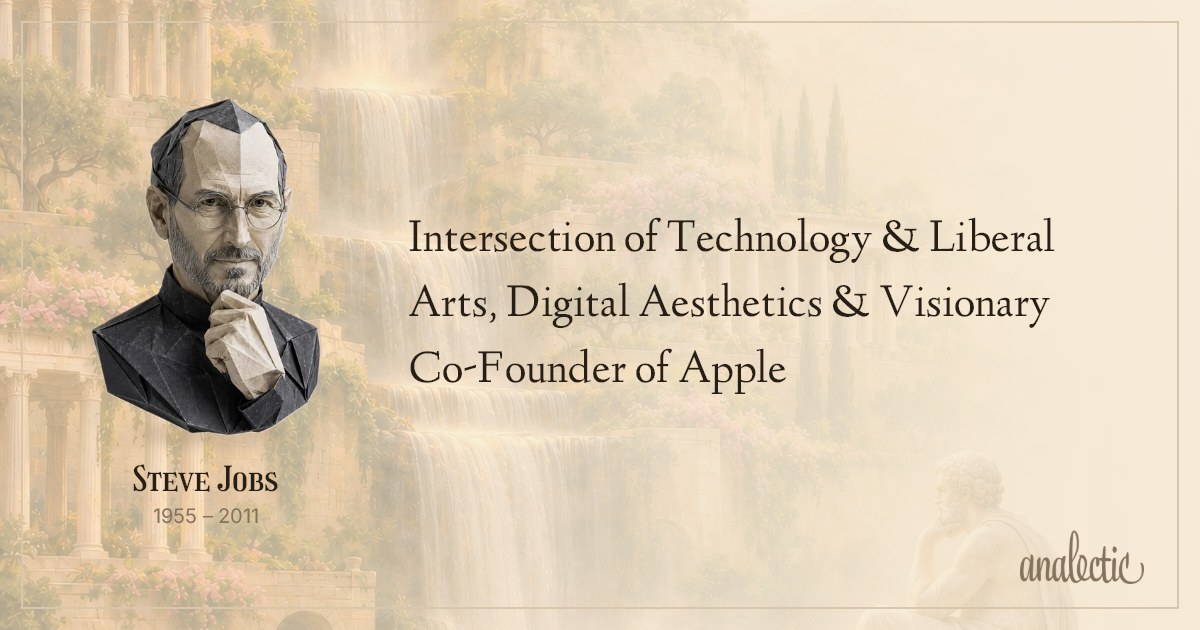
Steve Jobs
Intersection of Technology & Liberal Arts, Digital Aesthetics & Visionary Co-Founder of Apple (1955 – 2011)
Steven Paul Jobs (February 24, 1955, San Francisco, California – October 5, 2011, Palo Alto) was the defining visionary of the personal computer era and the cultural architect of the digital age. Adopted and raised by Paul and Clara Jobs in the burgeoning landscape of Silicon Valley, Jobs came of age at the intersection of 1960s counterculture, Zen Buddhism, and Eastern philosophy. Though he dropped out of Reed College after a single semester, he audited calligraphy classes that endowed him with a profound appreciation for typography, negative space, and visual elegance. In 1976, alongside Steve Wozniak in a suburban family garage, he co-founded Apple Computer with the radical premise of democratizing technology; their 1984 release of the graphical Macintosh permanently redefined how human beings interact with computing machines.
Ousted from Apple in 1985 following an intense boardroom confrontation, Jobs transformed exile into a period of extraordinary creative and structural maturity. He founded NeXT, pioneering object-oriented computing platforms that would later form the architectural foundation of macOS and iOS, while acquiring a computer graphics group from George Lucas to forge Pixar Animation Studios, revolutionizing cinema with Toy Story. Returning to an ailing Apple in 1997 on the brink of bankruptcy, Jobs ruthlessly streamlined the company’s sprawling product line by 70%, refocusing entirely on core perfection. In close creative partnership with design director Jony Ive, he orchestrated an unprecedented industrial renaissance through the iMac, iPod, iPhone, and iPad, fundamentally disrupting music, mobile communications, and publishing.
Jobs’s enduring philosophy rested on situating products at the 'intersection of technology and the liberal arts'. Viewing the computer not merely as an electronic apparatus but as 'a bicycle for the mind', he synthesized Zen simplicity with uncompromising craftsmanship, demonstrating that simplicity is the ultimate sophistication. His iconic 2005 Stanford commencement invocation—'Stay Hungry, Stay Foolish'—and his stoic resilience against illness left the world not merely the most valuable enterprise in modern history, but an indelible cultural testament: that the people who are crazy enough to think they can change the world are the ones who actually do.
Steve Jobs: quotes
- “Your time is limited; don't waste it living someone else's life.”
- “The people who are crazy enough to think they can change the world are the ones who do.”
- “Innovation distinguishes between a leader and a follower.”
- “Design is not just what it looks like and feels like; design is how it works.”
- “Quality is more important than quantity. One hit is worth more than two middling successes.”
- “Simple can be harder than complex: You have to work hard to get your thinking clean to make it simple.”
- “I believe that about half of what separates successful entrepreneurs from unsuccessful ones is pure perseverance.”
- “Making something simple requires hard work. You must grasp the fundamental difficulties and offer elegant solutions to these problems—that is only possible by truly understanding the thing.”
- “To create good design, you must understand. To truly grasp something, you must devote yourself passionately to it.”
- “A carpenter who builds a beautiful drawer doesn't use plywood for the back that faces the wall and no one will see. You'll know it's there, so you'll use a beautiful piece of wood for the back.”
- “People don't know what they want until you show it to them.”
- “Deciding what not to do is as important as deciding what to do.”
- “Details matter. It's worth waiting to get it right.”
- “Instead of worrying about what happened yesterday, let's go invent tomorrow.”
- “You can't ask customers what they want and then try to give it to them. By the time you build it, they'll want something new.”
- “Getting fired from Apple was the best thing that could have ever happened to me. The weight of success was replaced by the lightness of being a beginner again. It freed me to enter one of the most creative periods of my life.”
- “You can't connect the dots looking forward; you can only connect them looking backward. So you have to trust that the dots will somehow connect in the future. You have to believe in something—your gut, destiny, life, luck, or whatever.”
- “I am just as proud of what I didn't do as of what I did, because innovation means saying no to thousands of ideas.”
- “If you need a manual to use a product, that design has already failed.”
- “The parts you can't see should be as beautiful as the parts you can. Quality is everywhere, from start to finish.”
- “True innovation is seeing what others cannot see.”
- “Design things that people don't even know they need yet.”
- “Great experiences come from controlling the whole widget—hardware and software. The pieces must fit together seamlessly.”
- “Focus means saying no. It means saying no to even the really good ideas.”
- “Instead of doing many things moderately well, do a few things exceptionally well.”
- “Don't just make drawings; build real, working prototypes.”
- “If it doesn't feel right, don't be afraid to start over from scratch.”
- “One of the ways that I believe people express their appreciation to the rest of humanity is to make something wonderful and put it out there... You never meet the people, you never shake their hands... but somehow, in the act of making something with a great deal of care and love, something is transmitted.”
View on Analectic →